The Wheel Is 5,000 Years Old. The Rolling Suitcase Is From 1970. What Took So Long?
Here is a fact that should unsettle every product designer. The wheel is at least 5,000 years old. The suitcase, in something like its modern form, is well over a century old. And yet the two were not put together in a way that actually worked until 1970, when Bernard Sadow bolted four small wheels and a strap onto a suitcase — and the version we all now use didn't arrive until 1987. For most of human history, people who could afford to travel simply carried heavy luggage, or paid someone else to. The obvious idea sat in plain sight, unbuilt, for millennia. Understanding why is one of the most useful lessons in design there is.
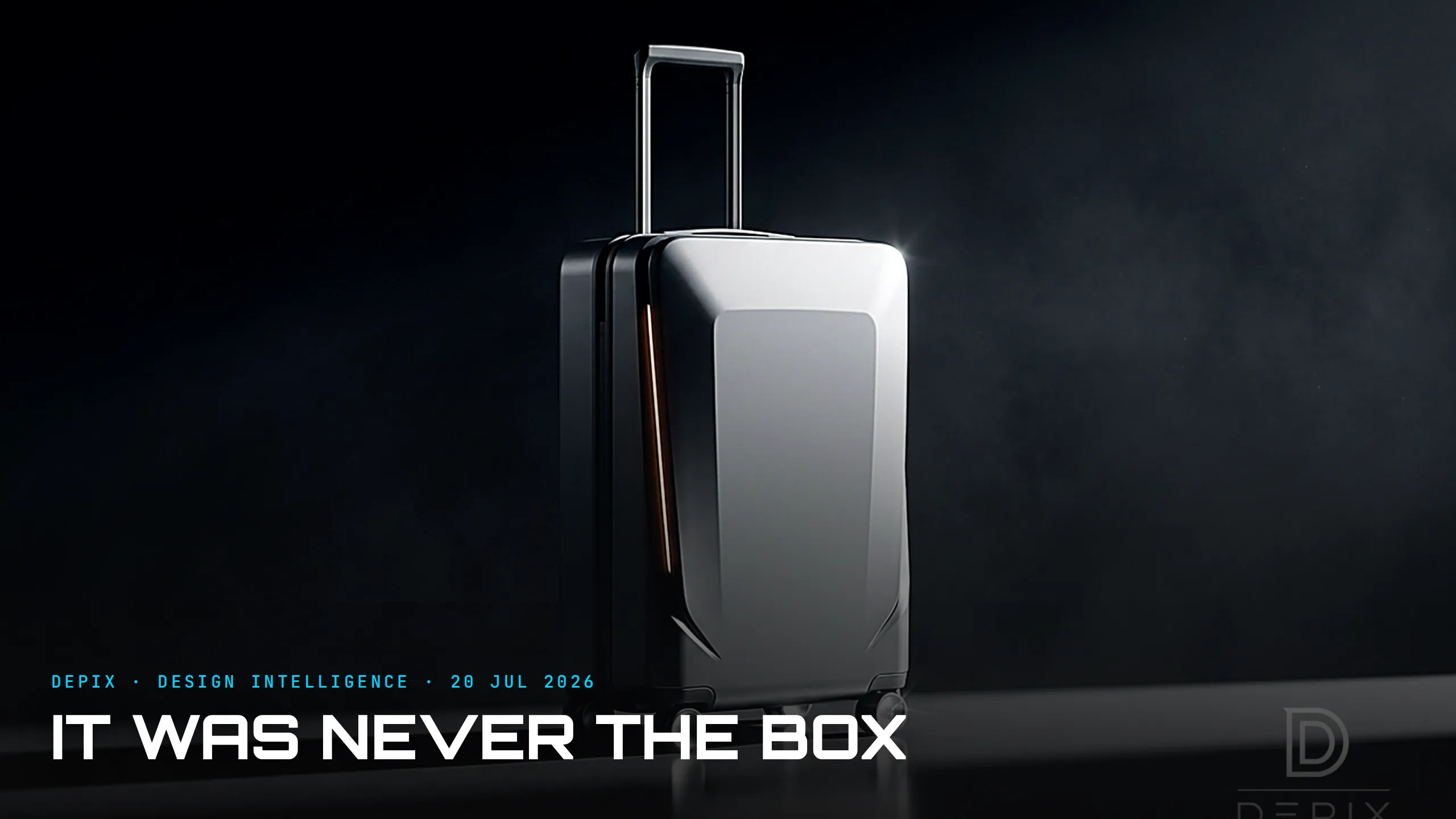
It was not a technology problem. Wheels, casters, handles and hard cases all existed. What was missing was the willingness to reframe the question. For centuries, luggage design was an exercise in perfecting the container — better leather, stronger corners, cleverer latches, standard dimensions. Everyone optimised the box. Almost nobody stopped to ask the more fundamental question hiding underneath it: not "how do we build a better container," but "how does a human actually move this thing through a space." Those are different problems, and only the second one leads to a wheel.
Even when Sadow finally asked it, the reframing was resisted for reasons that had nothing to do with engineering. His wheeled case was shunned by a travel industry that considered rolling luggage "unmanly" — "men used to carry luggage for their wives; it was the natural thing to do," Sadow later recalled being told. The idea only found its market as more women began travelling alone through the 1980s. The assumption blocking the better design wasn't in the materials; it was in the culture, and in the designers' own heads.
The truly great version came from someone standing even closer to the problem. In 1987 Robert Plath, a Northwest Airlines pilot, stood his case upright, gave it two wheels and a telescoping handle, and built the "Rollaboard" in his garage. It spread the way good design often does — flight crews wheeled them through airports, passengers saw them and wanted them. Notice that Plath's leap, too, was about the interface, not the box: the same bag, re-oriented around the human body. Everything since has followed that thread. The 2004 four-wheel "spinner" let the case pivot in any direction beside you rather than drag behind. And now, in 2026, the frontier is the auto-follow robotic suitcase — the Ovis, Airwheel and others using computer vision, ultrasonic and ultra-wideband sensors to lock onto their owner and roll along autonomously.
Look at that whole lineage and one thing is clear: every meaningful advance in luggage for fifty years has been an advance in the interface — how the bag relates to the person moving it — and almost none in the box. The container was essentially solved centuries ago. The design leverage was always in the other half of the problem, the half nobody was looking at. Even the failures prove the rule: the first "smart" suitcases packed with batteries and chargers mostly added features to the container and got themselves banned from cargo holds, while the robot that carries itself is the one that keeps advancing, because it is still working the interface.
This is the concept-phase lesson in its cleanest form. The biggest breakthroughs are usually not new technology; they are a re-framing of what problem you are actually solving, and that framing is chosen — or missed — at the very start, before anything is built. Every mature category hides one of these assumptions — the thing so obvious nobody says it out loud — and it is almost always exactly where the next breakthrough is waiting. The wheel was available for five millennia. What was scarce was someone willing to question the unspoken assumption that a suitcase is a thing you carry. Design intelligence is largely the discipline of finding that assumption — the one everyone treats as a fixed law of the object — and asking, at the concept phase, whether it was ever a law at all. Usually the obvious idea isn't waiting on a breakthrough. It's waiting on permission to be asked.
Sources:
- ●Wikipedia — Suitcase (Sadow 1970, spinner 2004)
- ●Travelpro — The History of Rolling Luggage (Plath's Rollaboard, 1987)
- ●Interesting Engineering — Who Actually Invented the Wheeled Suitcase?
- ●Hagley — America's slow acceptance of the wheeled suitcase
- ●The Curiosity Cabinet (Jeffrey Rubel) — The Rolling Suitcase
- ●Tom's Guide — The Ovis smart suitcase followed me around
- ●Airwheel — SR5 auto-follow smart robot suitcase
- ●Forbes — I Tried The $800 Robot Suitcase
- ●Forbes — This Smart Suitcase Can Follow You Around The Airport
- ●AOTOS — Smart Suitcase guide (GPS, auto-follow, battery rules)

The World's Most Revered Design Is 300 Years Old — and Blind Tests Can't Prove It's Better

The Traffic Light's Genius Isn't That It's Clever — It's That It's the Same Everywhere