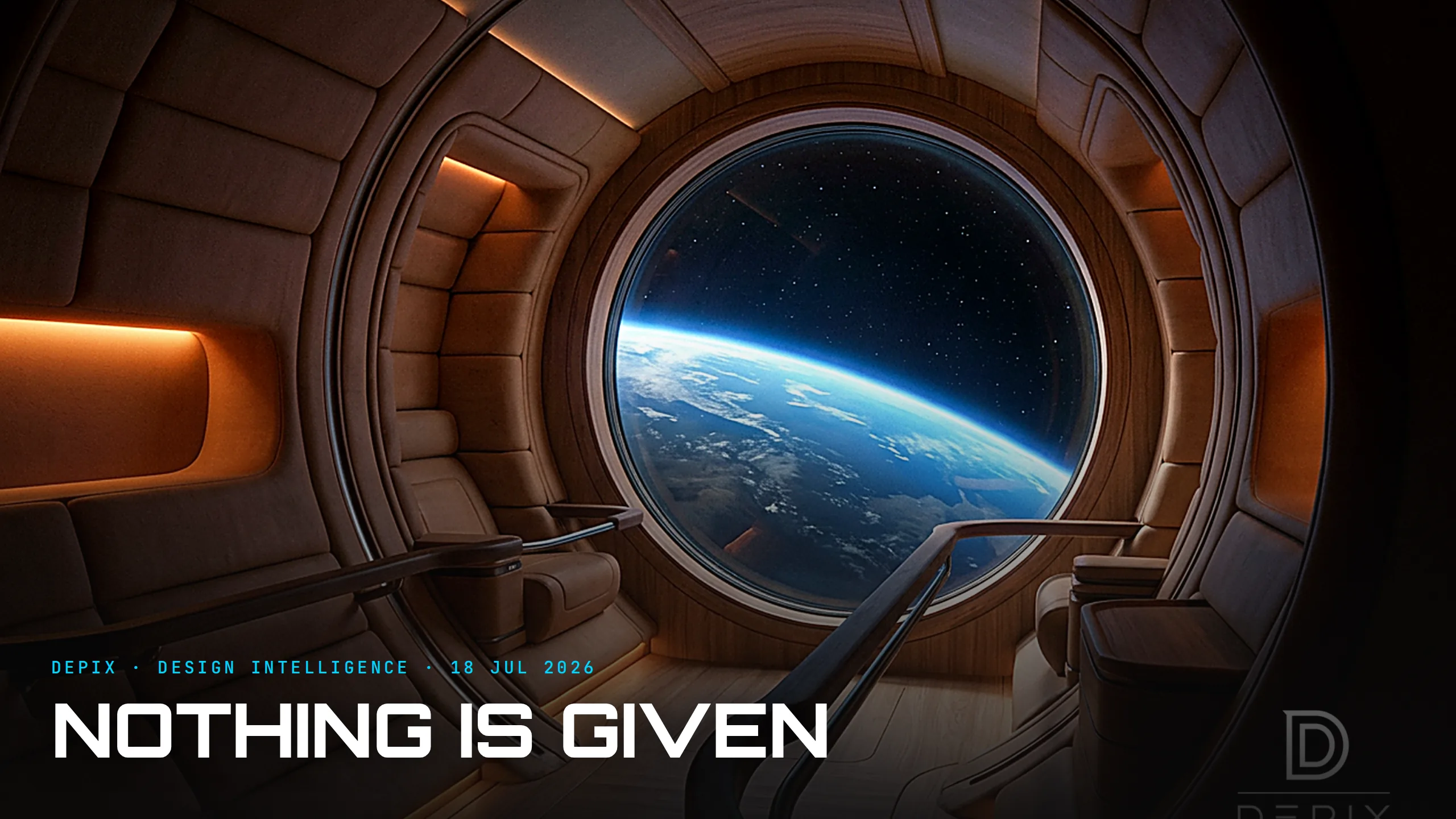
Nothing Is Given: What the First Commercial Space Stations Reveal About the Defaults You Design Around Every Day
Sometime soon, the first commercial space station will reach orbit. Vast's Haven-1 is built for four people at a time, roughly ten days per visit — and the surprising thing about it is not the rocket science. It is the wood.
Haven-1's interior is clean, considered and unusually elegant for a space habitat: warm wood-toned panelling, soft surfaces and a 1.2-metre dome window, with a duvet engineered to press gently on the sleeper so it feels a little like lying under gravity. The first look at that interior made living in orbit read, to more than one reviewer, as "wow." It was designed not by an aerospace engineer but by a product designer working with a human-factors team led by a veteran NASA astronaut. Down the road, Axiom hired Philippe Starck, who gave its module soft, womb-like padded walls studded with hundreds of colour-changing nano-LEDs.
Why hand a spacecraft interior to the designer of chairs and hotels? Because the hard problem in orbit is not keeping people alive. It is keeping them human — and that turns out to be a design problem of unusual purity.
Here is what makes a space habitat the ultimate concept-phase brief. On Earth, a "room" arrives with an enormous set of free defaults you never designed and never notice. Gravity hands you a floor, a ceiling, an up and a down. The atmosphere hands you air. The ground hands you an exit. The sun hands you one sunrise a day and a sky that tells you which way is level. Every one of those is a gift you inherited, and every one is doing quiet work in how a space feels and functions.
In orbit, all of it is revoked at once. Zero gravity is a "multi-directional freedom": no up, no down, no floor to stand on or ceiling to look toward. There is no fresh air that isn't manufactured, no door to walk out of, and fifteen or sixteen sunrises every twenty-four hours — enough to dismantle a human sleep cycle. Strip the defaults away all at once and you discover, sharply, which ones were holding a person together. Then you have to put them back, on purpose, as design decisions.
That is exactly what these interiors are doing. The big window is not a view; it is orientation — a stable reference for a floating body and a tie to home. The wood and soft surfaces are a deliberate antidote to the clinical metal box microgravity would otherwise produce. The gravity-simulating duvet re-provides a sensation the inner ear is desperate for. Starck's nano-LEDs re-provide a day, a mood, a sense of time that the ninety-minute orbit destroyed. Each is a default Earth gave away for free, now rebuilt from scratch because nobody gets it for free up there.
The contrarian lesson is not "space is hard." It is that the defaults you never notice are the ones doing the most work — and you only see them when they are taken away. An aerospace engineer, reasonably, optimises the things that are obviously hard: life support, structure, mass. A designer's job is the invisible layer underneath: the assumptions so deep everyone forgets they were ever choices. On a station those assumptions are all gone, so they all get re-decided — which makes the habitat a kind of X-ray of design itself.
And it generalises straight back to Earth. Every product, building and interface you make inherits a stack of invisible defaults — conventions, "obvious" layouts, the way it has always been done — that you did not choose and never examined. Usually they are fine. But the concept phase is precisely the moment you are allowed to ask which inherited defaults are actually right for this problem and which are just Earth's gravity: present, unquestioned, quietly shaping everything. The commercial-station teams don't get to leave that question unasked, and their work is better for it — even Haven-2, the larger follow-on, is being designed human-experience-first.
The rarest skill in design is to look at something everyone treats as given and recognise it as a decision. A space habitat forces that skill because nothing at all is given. The best designers bring the same eyes to Earth — treating the floor, the ceiling and the daylight not as facts but as choices they simply happened to inherit. Deciding, deliberately, which defaults to keep and which to rebuild — that is the part of design intelligence we care about most at Depix.
Sources:
- ●CNN — The world's first commercial space station is getting closer to launch
- ●Vast — Haven-1
- ●BBC Science Focus — Vast Haven-1: the first commercial space station
- ●Vast — Vast unveils its final Haven-1 space station design
- ●Orbital Today — Vast's new Haven-1 space station: first look
- ●Dezeen — Philippe Starck designs 'foetal' interiors for Axiom's commercial space station
- ●Designboom — Philippe Starck's womb-like habitation module for space tourists
- ●Starck — Axiom Space wins NASA approval for a commercial space station on the ISS
- ●Scientific American — How to build a space hotel
- ●MIT Technology Review — The ISS is to get a new commercial habitable module (and it might be pretty cozy)
- ●Orbital Radar — Commercial Space Stations 2026: Vast, Axiom, Orbital Reef, Starlab
- ●SpaceNews — Vast releases design of Haven-2 commercial space station

The Last Comes First: What a Shoe's Invisible Mould Reveals About the Decision Everything Else Is Built On
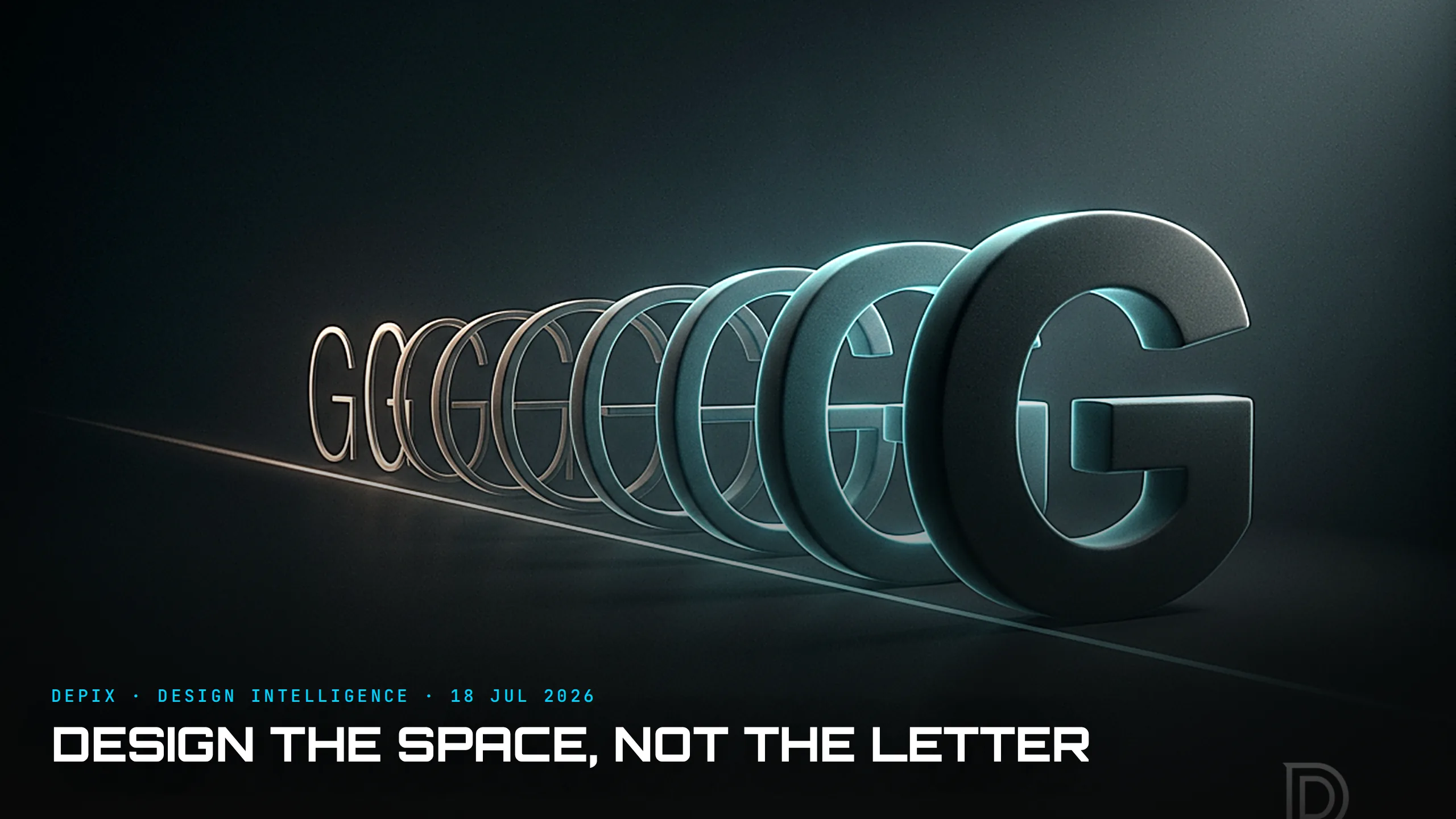
Design the Space, Not the Letter: What Variable Fonts Reveal About the Future of Every Design Decision