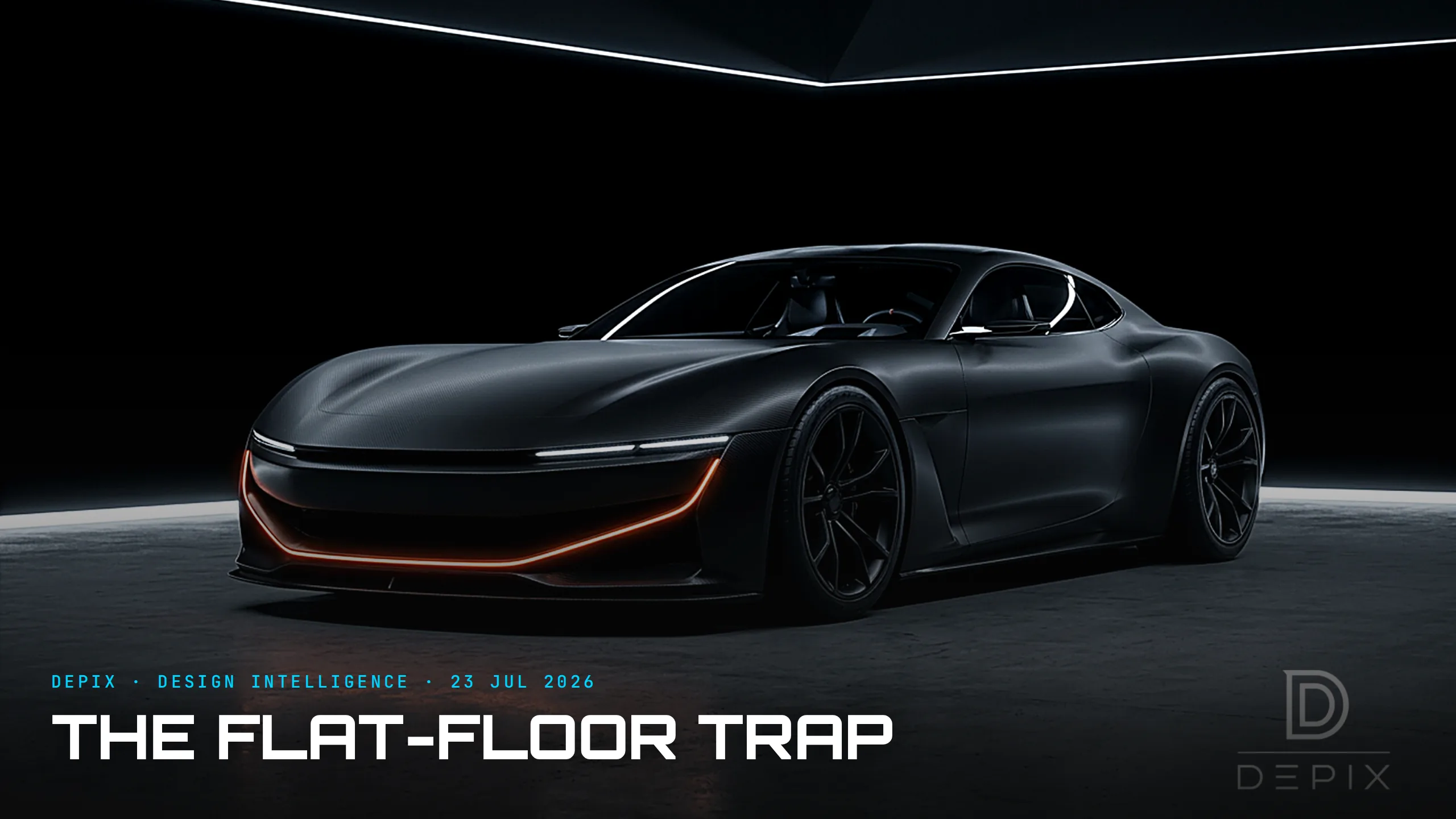
The Skateboard Promised Total Design Freedom. The Flat Floor Delivered Sameness.
In 2002, General Motors rolled out one of the most radical concepts the industry had ever seen: the AUTOnomy and its running prototype, the Hy-wire, a car reduced to an eleven-inch-thick "skateboard" holding the battery, motors and controls, with the body reduced to a shell you could unbolt and swap. The engineer behind it, Chris Borroni-Bird, described a chassis onto which almost any body could be dropped using a handful of attachment points and a single electrical umbilical. GM built the driving Hy-wire in eight months, and the idea has since been copied more than a dozen times. The promise was intoxicating and explicit: total design freedom. A blank canvas. Put any shape you like on top.
Two decades later, the skateboard has won completely — and delivered close to the opposite of what it promised.
Look at the dedicated EV platforms that now underpin the market — GM's Ultium, Hyundai's E-GMP, Rivian's quad-motor skateboard and the rest — and the sales pitch is unchanged. A skateboard gives you a completely flat floor and interiors that feel far larger than the exterior suggests; GM says it can build everything from a Hummer pickup to a compact crossover on the same underpinnings. And yet the single most common criticism of modern electric cars is that they all look the same. This is not a coincidence. It is the flat floor.
Here is the trap hiding inside the freedom. The battery is the structural belly of the car, and its thickness is a critical variable that dictates seating position, ride height and aerodynamic profile. Put a slab of cells under the floor and the floor rises; raise the floor and you must raise the occupants' hips to keep headroom; raise the hip point and you get a tall cabin sitting on a long wheelbase with short overhangs and a high beltline. Add the fact that electric range lives and dies on drag, pushing every designer toward the same stretched, tapered one-box roofline, and the platform quietly hands every brand the same proportions before a single designer has drawn a line. The skateboard did not remove the constraints; it swapped the old ones — engine, transmission tunnel, tall hood — for a new and equally rigid set. "Any body on top" turns out to mean "any body, as long as it is a tall monovolume crossover."
The deeper point is about platforms in general, and it is a concept-phase point. A platform is never neutral. It arrives with proportional defaults baked in — a floor height, a hip point, a wheelbase-to-overhang ratio — and those defaults are the single most consequential design decision in the whole car, because everything downstream is negotiated against them. The mistake is to treat platform selection as an engineering procurement step that happens before design begins. It is design. It is the concept phase. By the time a studio receives the hard points, the silhouette has largely been decided, and the designers are left decorating a stance they did not choose.
Which is exactly why the cars that escape the sameness are the ones that fought the platform at that earliest moment. The brands breaking the mould — the low-slung sports cars that engineer "foot garages" into the pack to drop the seating, the flatter and longer designs some marques insist on — are not simply more talented at surfacing. They made a different, deliberate decision about the floor and the hip point while the platform was still soft, and paid for it in cost and complexity. They treated the flat floor as a variable to be argued with, not a gift to be gratefully accepted.
That is the lesson the skateboard teaches, and it generalises far past cars. Every powerful enabling platform — a chassis, a design system, a component library, a manufacturing standard — offers freedom and smuggles in defaults at the same moment. The freedom is real, but it is only available at the concept phase, and only to the team that consciously spends it. Accept the platform's defaults and you inherit its silhouette, along with everyone else who accepted them. A freedom you never actually exercise, early, is not freedom at all. It is just a default wearing a nicer name.
Sources:
- ●General Motors Hy-wire (AUTOnomy skateboard chassis) — Wikipedia
- ●Meet the father of the skateboard chassis, Chris Borroni-Bird — Forbes
- ●Forgotten Concept: 2002 GM AUTOnomy — Autoblog
- ●A complete guide to every car brand's EV platforms — Gear Patrol
- ●What is a skateboard platform? (flat floor, feels larger inside) — Capital One
- ●The complete guide to electric vehicle platforms — InsideEVs
- ●Why all EVs look the same now — Autoblog
- ●About the skateboard platform: pack thickness dictates seating & ride height — EVreporter
- ●Design differentiation is a real EV challenge — The Truth About Cars
- ●Skateboard platforms: the new constraints — E-Mobility Engineering
- ●Modern EV cars all look the same — here's why — Yahoo Autos

Volkswagen's ID. Cross Bet That 'Normal' Is the Bravest Design Decision Left

The Hinge Carries the Whole Product: Why the Overlooked Joint Decides Its Reputation
