
The Edge of Acceptable: Raymond Loewy's MAYA Rule
In the middle of the last century, the most influential designer alive had a four-letter rule for why some designs become hits and others die on the shelf. Raymond Loewy — the man who shaped the Lucky Strike pack, the Shell and Exxon logos, the Studebaker Avanti, the sleek S-1 locomotive and even the Air Force One livery, the figure history calls the father of industrial design — called it MAYA: Most Advanced Yet Acceptable.
His theory of popularity was that people are pulled by two opposing forces — neophilia, a love of the new, and neophobia, a fear of anything too new — and that a hit lives at the exact intersection of the two. In his own words, the public's taste "is not necessarily ready to accept the logical solutions to their requirements if the solution implies too vast a departure from what they have been conditioned into accepting as the norm." Advance, yes — but only as far as the audience can still follow.
Here is the part almost everyone gets wrong. MAYA sounds like "play it safe." It means the opposite. Loewy's instruction was to push to the very edge of acceptability — to maximise advancement subject to the constraint of acceptability, to ship the most advanced version the audience will still accept and not one notch safer. The word doing the work is most, not acceptable.
Which is why there are two ways to fail, and most designers commit one of them. The timid under-shoot: they treat "acceptable" as permission to be derivative, and ship something invisible and already half-dated. The avant-garde over-shoot: they ignore the constraint entirely, ship something brilliant and alien, and are rejected — not because the work was wrong, but because it was too far ahead to be read. Both miss the line. Finding it is the whole discipline.
And the line is neither fixed nor universal. It sits in a different place for a hypercar buyer than a hatchback buyer, in a Milan gallery than a mass-market showroom, in a concept hall than on a forecourt. More importantly, it moves. What reads as "too advanced" this year becomes "acceptable" in five and "dated" in ten, because sheer repeated exposure quietly turns the strange into the familiar (the mere-exposure effect doing its slow work on a whole culture). Which means the same design can succeed or fail purely on timing: shipped early it is rejected as strange; shipped late it is ignored as ordinary. A great deal of what looks like a failure of taste was really a failure of timing — the design arrived while the acceptability line was standing somewhere else.
For anything with a long lead time — and a car takes years from concept to street — that turns MAYA into a prediction problem. You cannot aim at where the line is today, because by the time you ship it will have moved; you have to aim at where it will be. Design to the present line and you launch behind it. This is exactly why a concept car and the production car that follows it play different games: the concept is deliberately over the line, and its job is to move the line — to pull the public's sense of normal forward — so that the production car, arriving later, lands on the new position as merely advanced rather than alien.
So MAYA quietly reframes the whole idea of innovation. It is not a maximisation problem — advancement is easy, and effectively infinite; anyone can draw something no one has seen. It is a calibration problem. The concept-phase question is never "how new can we make it?" It is "how new can we make it and still be understood — by this specific audience, at the moment it actually ships?" That question has a precise answer, different for every brand and every year, and locating it is the entire job.
The most advanced acceptable design is a moving target you have to lead, the way a marksman aims ahead of a bird rather than at it. Miss ahead and you are alien; miss behind and you are invisible. Loewy's real genius was not any single object he drew. It was naming the shot — and pointing out that the edge, not the middle, is where the good designers are supposed to stand.
Sources:
- ●Raymond Loewy — father of industrial design (Wikipedia)
- ●What is the MAYA Principle? (Interaction Design Foundation)
- ●MAYA: Design for the future, balance it with users' present (Interaction Design Foundation)
- ●How Loewy's MAYA Principle Came to Define Everything Popular (InsideHook)
- ●What Makes Things Cool — neophilia vs neophobia (Derek Thompson, The Atlantic)
- ●Neophobia — fear of the new (Wikipedia)
- ●Studebaker Avanti — a Loewy design (Wikipedia)
- ●Industrial design (Wikipedia)
- ●Concept car — deliberately over the line (Wikipedia)
- ●Mere-exposure effect — familiarity breeds acceptance (Wikipedia)

The Redesign Trap: Why Your Most Loyal Customers Hate Your New Design
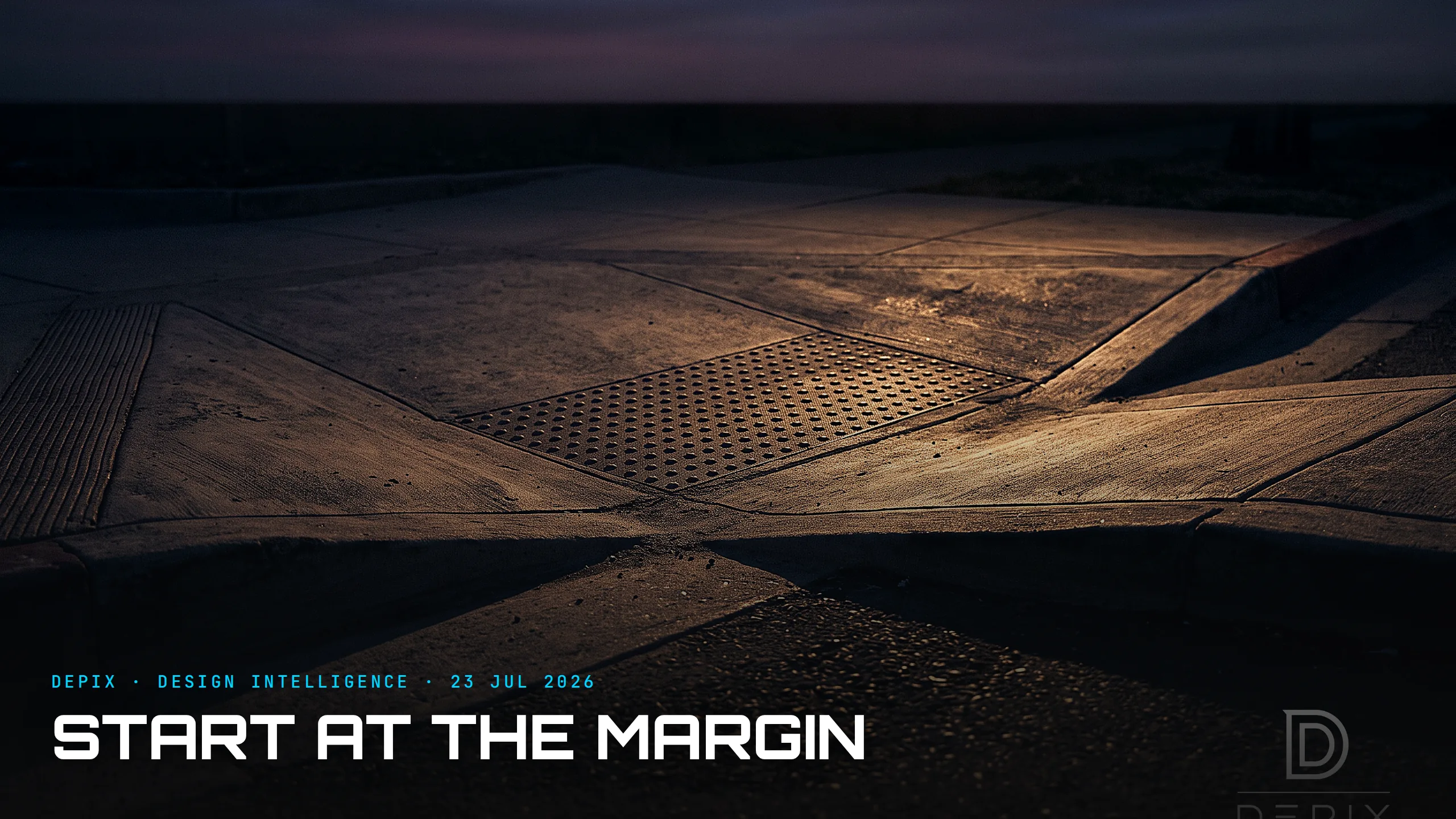
Start at the Margin: The Curb-Cut Effect
