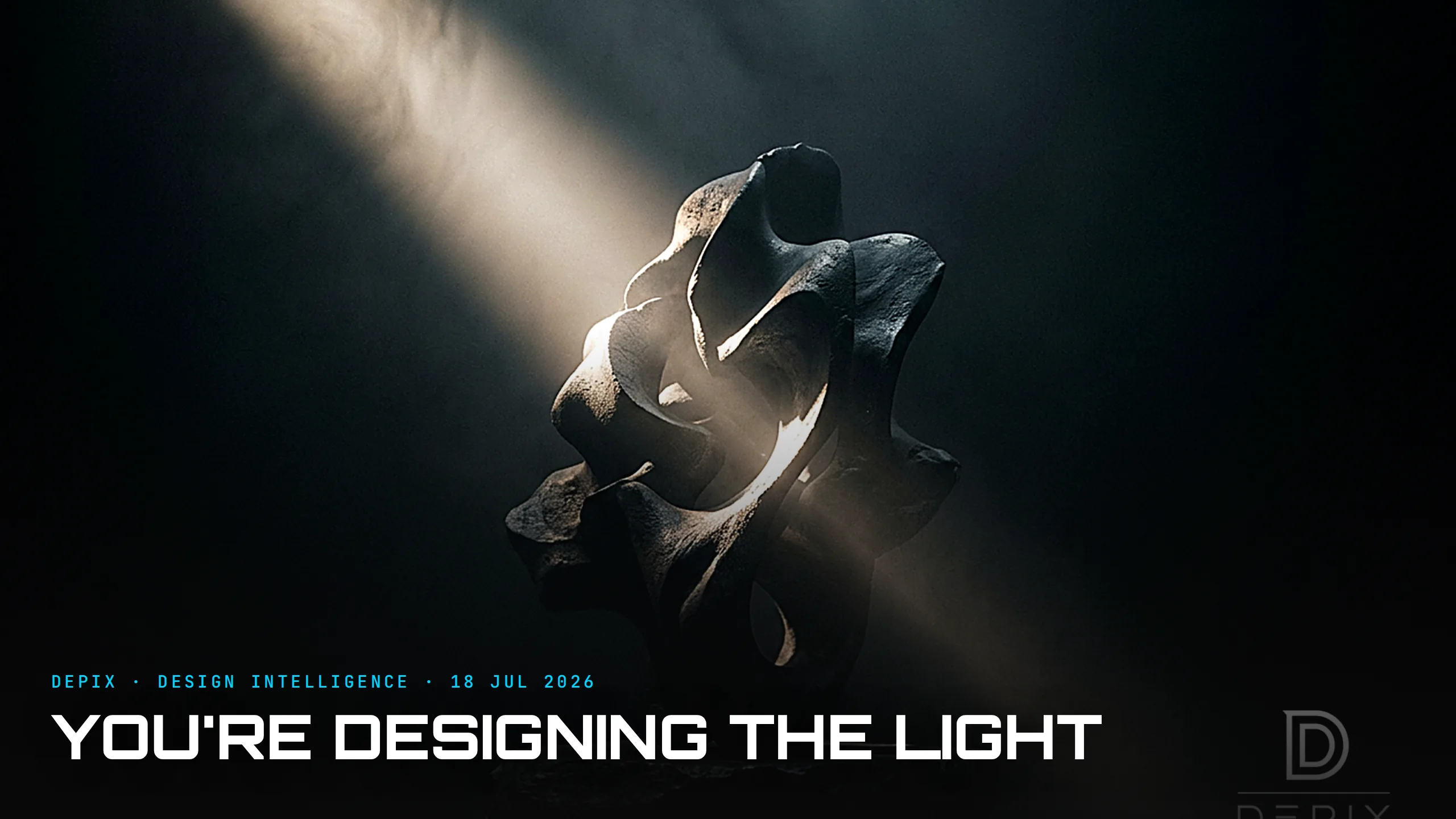
You're Designing the Light: Why the Object You Think You're Making Is Really an Instrument for Light
Here is a fact so basic it is almost never said out loud: you have never seen an object. You have only ever seen light bouncing off it. Every form, every finish, every colour and material a designer chooses is, at the deepest level, a decision about how light will behave when it arrives — where it will catch as a highlight, where it will fall into shadow, where it will scatter softly or bounce hard. The object is the instrument. The light is what you actually perceive.
The artist James Turrell has spent sixty years making this literal. His work uses light not to illuminate other things but as a physical material in its own right — and, as he puts it, "I use light as a material, but my medium is actually perception. I want you to sense yourself sensing". Stand in one of his rooms and you realise, uncomfortably, that everything you see is in some sense an illusion assembled by your brain from light — that light is not the neutral messenger revealing the "real" world but the thing itself. It is an artist's version of a truth every designer works with and few name: the same object under different light is a different object.
And light is doing enormous, measurable work. In retail, high-CRI tunable lighting that makes fresh food look right lifts sell-through by as much as 20% and keeps shoppers in the store longer — the product did not change; the light did. In a museum, lighting has to serve three masters at once: the artefact it can physically damage, the visitor whose perception it shapes, and the curator whose narrative it carries, becoming a genuine medium of storytelling able to convey ideas no wall text could. The right lighting can change the perceived size and shape of a room, invent focal points, and set an entire emotional register without a single physical element moving. Lighting is not decoration applied to a space; it is a large fraction of what the space is.
The 2026 direction only deepens this. The industry's flagship gathering frames its future around "Living Light" — human-centric, tunable systems that track the arc of daylight and quietly steer our circadian rhythm, warming and cooling through the day. And the hardware is disappearing: ultra-slim, trimless, integrated fixtures designed to vanish into the architecture so that you perceive only the effect and never the source. The more sophisticated lighting gets, the more invisible its instrument becomes — until all that is left is the perception it was designed to produce.
Which leads to the point that matters beyond lamps and galleries. Because light is literally what we perceive, lighting cannot honestly be an afterthought — and yet, almost always, it is. It gets specified last, after the form and the materials are frozen, often by a different team entirely, asked to make an already-finished object "read" well. That is backwards. If the light is what the user actually experiences, then how a thing will be lit — and therefore how it will be seen — is a concept-phase decision, and the form should be shaped to serve it, not the other way round. The lighting designers who work at the highest level do exactly this: they design the light first and treat the object as its instrument.
Turrell's inversion is the whole lesson in one move. Stop thinking of light as a tool bolted on to reveal the real design, and start treating light as the primary material — because there is no "real" design sitting underneath the light, waiting to be exposed. The design, as anyone will ever experience it, is the form-and-light together. Seeing the object and seeing the light are not two acts but one, and the designer who separates them — perfecting the form in a flat grey render and hoping the lighting team rescues it later — has split the one thing that was never meant to come apart.
This is, for us, the most literal tie there is. A render, a visualization, a concept image is nothing but a simulation of light falling on form; the entire discipline of showing a design before it exists is the discipline of controlling how light will reveal it. Deciding at the concept phase how a form will be lit — designing the light and the object as a single, inseparable perceptual event — is the part of design intelligence we care about most at Depix. You were never just designing the object. You were designing the light.
Sources:
- ●Artmag — James Turrell and the Materiality of Light
- ●Medium (SVA) — James Turrell, 'Into the Light': light as material, perception as medium
- ●ArchDaily — Light Matters: Seeing the Light with James Turrell
- ●Armor Lighting — Retail Lighting Trends 2026 (human-centric, high-CRI, integrated)
- ●Rethinking the Future — Lighting Design in Museums: Perception through Illumination
- ●Brandon Lighting — Architectural Interior Lighting: A Guide for Designers in 2026
- ●Messe Frankfurt — Living Light, Light + Building 2026
- ●Lumenture — Lighting Design Trends 2026: minimal, integrated, human-centric
- ●Nauradika — 6 Architectural Lighting Trends 2026: Shaping Spaces with Light
- ●Arkoslight — 6 developments that will define lighting in 2026
- ●Nulty Lighting — Introducing James Turrell
- ●Smithsonian Magazine — James Turrell's Light Fantastic
Felt First, Decided Last: What Colour Reveals About the Backwards Order of Design

Designed to Age: What Patina Reveals About the Decision the Render Never Shows