Kia's Bet: Don't Resolve the Tension
Most design philosophies are a search for one clean idea. Find the essence, resolve everything to it, remove whatever fights. Kia's "Opposites United" — the language introduced with the EV6 in 2021 and now overseen by Karim Habib — runs on the opposite instinct. Its five pillars ("Bold for Nature," "Joy for Reason," "Power to Progress," "Technology for Life," and, most tellingly, "Tension for Serenity") don't resolve their contradictions. They keep them in.
At Milan Design Week 2026, Kia staged the idea literally: two exhibitions under the theme "Resonance of Opposites," inner reflection and outward expression framed as a single axis, six concept vehicles between them. It is also the visible engine of the brand's push upmarket — the bet that a value marque can climb on the strength of its forms alone, the same shift the EV9 was built to lead.
Which invites the contrarian question: is "held tension" a real way to design, or a story flexible enough to staple onto any shape after the fact?
There is a serious case that it is real — and old. Sixty years ago, Robert Venturi's Complexity and Contradiction in Architecture attacked the clean modernist box with a manifesto for "both-and" over "either-or," arguing that richness comes from elements held in tension, not sanded smooth. The instinct is older still — the unity of opposites, Heraclitus's idea that a thing's character lives in the strain between its poles. "Opposites United" is that dialectic wearing a design badge.
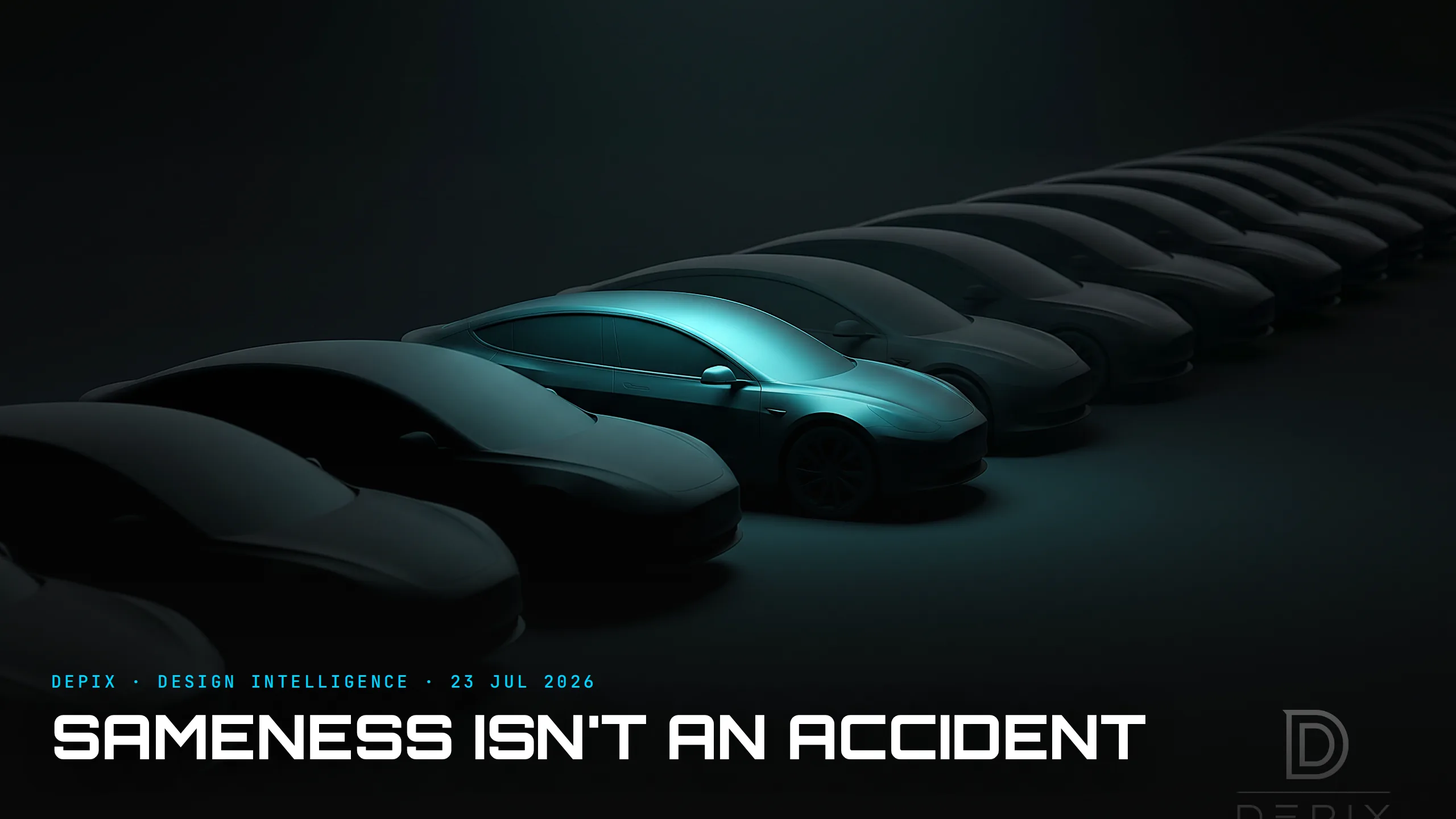
And it points at something true about why objects go dead. A form that resolves every tension to zero is not "pure." It is generic. Blandness is precisely the absence of held opposites — the shape that offends nothing because it commits to nothing. The EV6 and EV9 read as alive for the same reason: sharp technical edges sit against calm, almost architectural volumes, and neither wins. That refusal to settle is the product.
So the design decision is not "what is our one clean idea." It is which tension does this object hold — chosen at the concept phase and, crucially, protected there. Because tension is asymmetric to sand: development can always resolve a contradiction away — a line softened for tooling, a stance calmed for cost, a bold proportion trimmed for the platform — but almost nothing in the process adds one back. This is exactly how cars turn generic between the concept sketch and the showroom: not by a single bad decision, but by a hundred small resolutions, each reasonable, that quietly cancel every opposite until nothing is fighting and nothing is alive. The contradiction that survives to production is the one someone decided, early, was non-negotiable.
The honest risk cuts the other way, and Kia's philosophy is exposed to it: tension as alibi. "Opposites United" is elastic enough to describe almost anything — every object has some edge and some curve — and a philosophy that fits any shape explains none of them. The test is whether the tension is specific and chosen (this line, against this volume, on purpose) or invoked afterward to make incoherence sound intentional. A brand climbs upmarket only when the answer is the former. Premium isn't chrome; it is the perception that an object holds more resolved tension than its rivals — more things in productive disagreement, all under control. That is genuinely hard to fake, which is why it works, and why brands under cost pressure regress toward the mean the instant no one is defending the contradiction.
Kia's own heritage makes the stakes concrete. The marque's first real identity — Peter Schreyer's "tiger nose" — was a single confident idea that dragged the brand out of anonymity. "Opposites United" is a harder, riskier bet: not one idea held firmly but two opposing ones held at once, which asks far more of everyone downstream of the sketch.
For anyone deciding a product's form, the lesson survives the badge. Pick the contradiction your object will carry, and pick it at the concept phase — the only moment the choice is still cheap and still yours. Then defend it, because everything after concept is a machine for resolving tension, and a form that reaches production with nothing left in disagreement hasn't been purified. It has just been averaged.
Sources:
- ●Kia reveals new design philosophy 'Opposites United' with the EV6 (Kia Media)
- ●Karim Habib — Head of Kia Global Design (Wikipedia)
- ●Kia Explores 'Resonance of Opposites' at Milan Design Week 2026 (PR Newswire)
- ●Two Exhibitions, One Philosophy: Kia in Milan (Hyundai Motor Group)
- ●How Canadian designer Karim Habib made Kia cool (The Globe and Mail)
- ●First Sight: Kia EV9 heralds Karim Habib's new design strategy (Car Design News)
- ●Robert Venturi, Complexity and Contradiction in Architecture (Wikipedia)
- ●Unity of opposites (Wikipedia)
- ●Heraclitus (Wikipedia)
- ●Kia EV6 (Wikipedia)
- ●Kia EV9 (Wikipedia)
- ●Peter Schreyer and the Kia 'tiger nose' (Wikipedia)