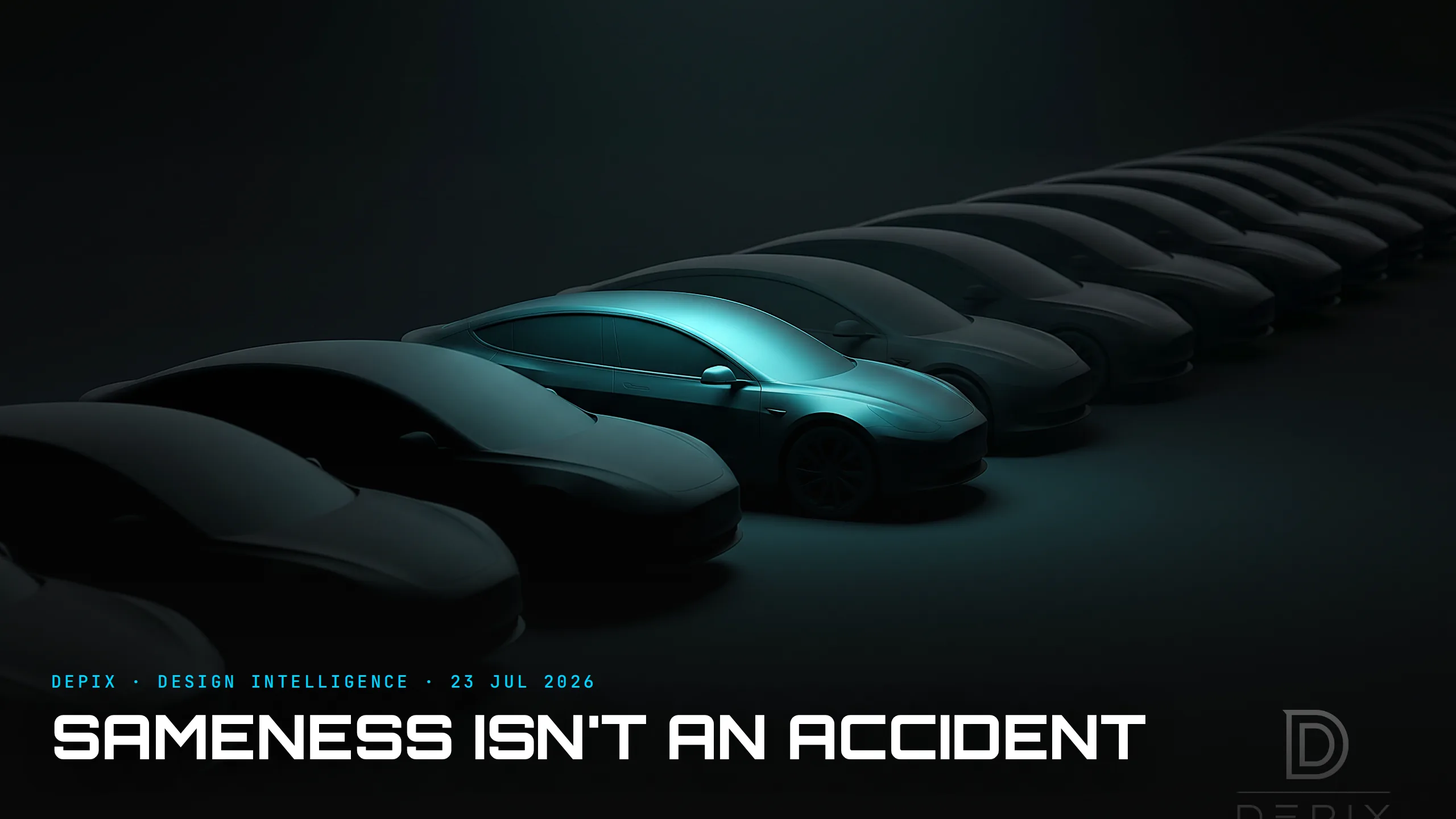
Every Car Looks Alike — and It Isn't an Accident
The complaint is constant: every new car looks the same. The usual verdict is that designers got lazy, or timid, or ran out of ideas. That verdict is wrong, and the truth is far more useful — because sameness is not a failure of talent. It is the rational endpoint of shared inputs. When everyone optimises the same objective, with the same tools, against the same references, under the same rules, they arrive in the same place.
Start with the forces nobody controls. Aerodynamics has essentially one answer: modern cars cluster around a 0.25–0.30 drag coefficient, and the low-drag optimum is a narrow shape — smooth flush surfaces, a tapered Kammback tail, a high deck. Physics converges, and everyone is finding the same solution because it is the correct one. Regulation removes options identically for all: pedestrian-impact and crash rules dictate tall blunt hoods, thick pillars and specific bumper heights, and they killed the low nose and the pop-up headlamp outright. Shared platforms pre-decide the hardpoints and proportions before a designer opens a sketchbook. And benchmarking institutionalises imitation: every studio studies the same segment leader and the same rivals, so every studio inherits the same answers.
Then there is the driver designers actually control, and quietly surrender: the reference. Everyone moodboards from the same sources — the same handful of hero cars, the same trend decks, the same corners of the internet, and now the same AI models trained on the same corpus of existing cars, which can only ever remix the mean. Once your reference board looks like everyone else's, you have already converged before you draw a single line. Talent applied after that point is talent spent decorating a decision that was already made — the reference chose the destination, and the skill only chose the scenery on the way. The reference image is the most powerful and most dangerous tool in the studio, precisely because it decides the outcome upstream of any talent applied downstream.
This has a name outside of cars. Sociologists call it institutional isomorphism: organisations facing the same pressures grow alike not by conspiracy but by the same logic acting on each of them independently — coercive pressure (regulation), mimetic pressure (copying the leader when the future is uncertain), and normative pressure (everyone trained in the same schools with the same design language). A modern car is an iron cage with wheels. The surprise is not that they look alike. It is that anyone still expects them not to.
So the design-intelligence point is not that sameness is bad. It is that unexamined sameness is bad. Most of a car should converge — the parts that are physics and law are solved problems, and diverging there just builds a worse, more dangerous, more expensive car for no gain. The skill is deciding, at the concept phase, the one axis you will diverge on — the axis that carries the brand's identity — and converging cheerfully on all the rest. Divergence is costly: you give up the aerodynamic optimum, the benchmarked safety margin, the familiar reference the whole market already trusts. You can only afford it in a few places, which is exactly why those places must be chosen deliberately rather than discovered by accident.
And there is a catch on the other side, because different-for-its-own-sake is its own trap. A brand that diverges everywhere is incoherent, slow and usually punished by its own customers; a brand that diverges nowhere is invisible. Meanwhile some convergence is a genuine gift — a working standard should be identical everywhere, and the pedal order, the door handle and the traffic light earning sameness is a feature, not a failure. The error is treating all sameness as either virtue or vice. It is neither. It is the default you get for free when no one decides otherwise.
That is the whole lesson. Convergence is what happens when nobody chooses; distinctiveness is a choice — made early, before the reference board is even assembled, about which single axis is worth the real cost of standing alone. Everything else on the car can look like everything else, and most of it honestly should. The job was never to be different everywhere. It was to know the one place being different actually means something, and to spend the whole budget there.
Sources:
- ●Aesthetics and aerodynamics: why do modern cars look so alike? (The National)
- ●Modern Cars All Look the Same — and It's Not an Accident (Unbuilt Garage, 2026)
- ●Why Do All New Cars Look the Same? (Brown Car Guy, 2026)
- ●Automobile drag coefficient (Wikipedia)
- ●Kammback — the aero-optimal tail (Wikipedia)
- ●Euro NCAP — pedestrian protection ratings (Wikipedia)
- ●Hidden (pop-up) headlamp — killed by pedestrian-impact rules (Wikipedia)
- ●Car platform — shared hardpoints and proportions (Wikipedia)
- ●Benchmarking (Wikipedia)
- ●New institutionalism / isomorphism — why organisations become alike (Wikipedia)
- ●Mood board — the reference as an upstream decision (Wikipedia)
- ●Design language (Wikipedia)

BMW Walked Back the Grille It Spent a Decade Defending

Lucid Designed Its Car From the Inside Out
