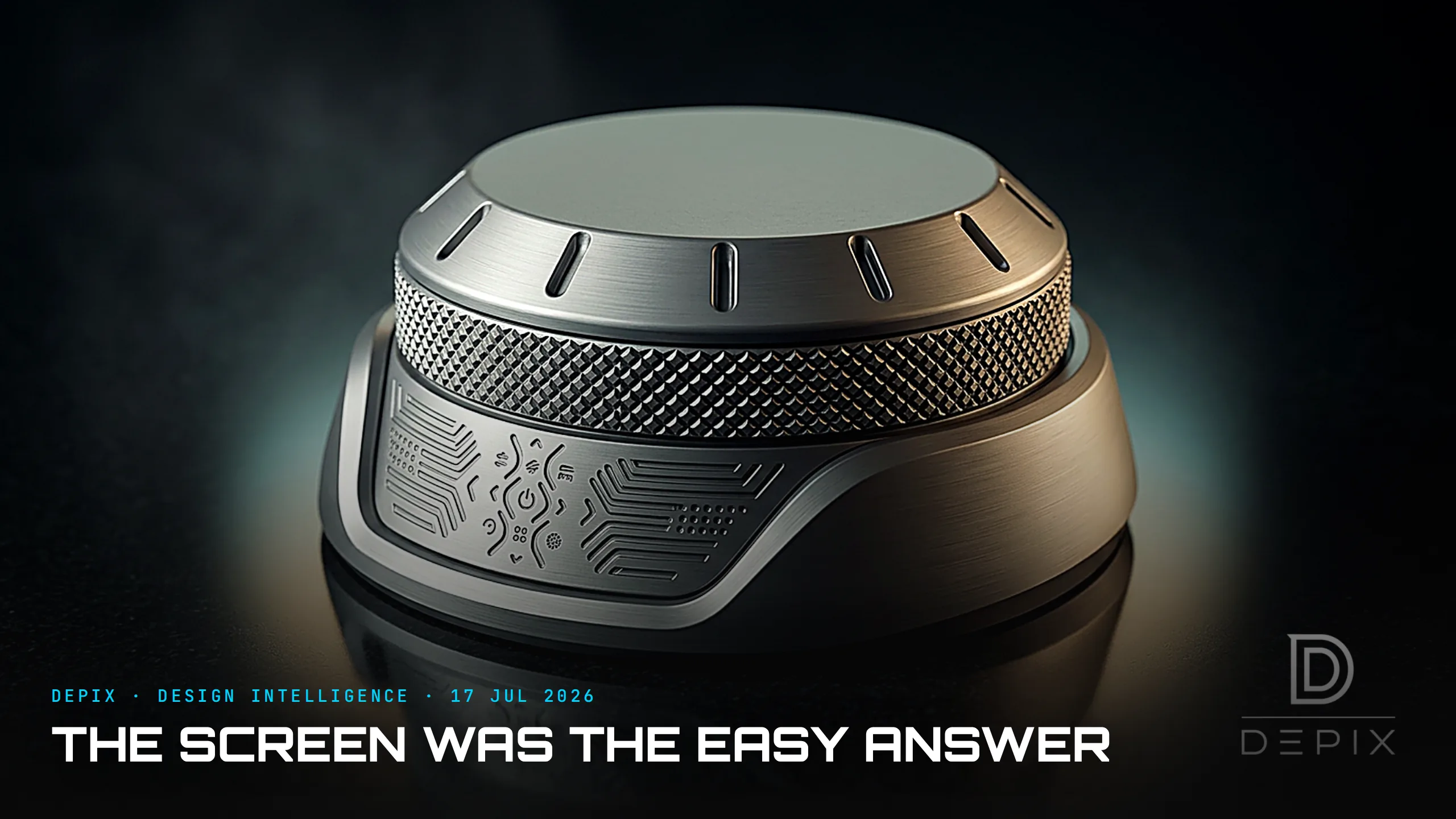
The Screen Was the Easy Answer: What IFA 2026 Reveals About Designing the Interface
When IFA — the world's oldest consumer-electronics show, now in its 102nd year — opens in Berlin on 4 September 2026, it does so at a strange moment for the industry it represents. For fifteen years, the dominant answer to almost every product-design question has been the same: put a bigger touchscreen on it. Cars, thermostats, fridges, ovens, doorbells, exercise bikes — all converged on the identical glossy black rectangle. IFA 2026 may be remembered as the show where the industry started, visibly, to walk that back.
Here is the uncomfortable truth about the touchscreen: it was rarely the best interface. It was the easiest decision. A screen is infinitely reconfigurable, which means you can defer every genuinely hard interaction-design choice to software and ship the same undifferentiated slab for every product in the catalogue. Should the volume be a knob? Should the temperature be a dial you find without looking? Should this function have a visible control at all? A touchscreen lets you answer "we'll sort it out in the app." It doesn't resolve the interface; it postpones it — and postponement, as always, has a cost.
That cost has now come due, most loudly in the car. After a decade of cramming everything into the dash, automakers are reversing hard. Knobs and buttons are returning across the market. Hyundai's own user testing found drivers were "stressed, annoyed, and steamed" by touch-only systems; Volkswagen, Subaru and others are bringing physical controls back; even Mercedes says it will de-emphasise screens in future interiors. And it is no longer only taste: the EU introduces rules in 2026 that stop certain safety-critical functions from being buried in a touchscreen. A control you have to look at is a control you cannot trust at speed — and that was knowable at the concept phase, not after ten million cars had shipped.
The same correction is visible far from the road. "Calm technology" — the idea that a device should live in your periphery and step forward only when needed — has moved from a fringe manifesto to a product category. The Mui Board hides a smart-home interface inside a plank of real oak, the screen appearing only when touched; Daylight is building a warm, blue-light-free e-paper computer designed to be ignored. And at the extreme, dumbphones are surging: sales jumped 25% in 2025, and for Gen Z the featureless flip phone has become a status symbol of self-control. The market is now paying a premium, in category after category, for less screen.
None of this is anti-technology. It is the rediscovery of a design discipline the touchscreen let everyone skip. Deciding that a function deserves a dedicated, tactile, findable-in-the-dark control — or that it should disappear into a surface, or become an ambient glow rather than a notification — is real interface design. It is expensive, product-specific, and impossible to A/B test your way to after launch. It has to be committed to up front, in the same breath as the industrial design, because the physical controls and the form are one decision, not two. A screen, by contrast, is the interface you reach for when you would rather not choose.
That is why "put a screen on it" is best understood not as a design decision but as the absence of one. The very reconfigurability that makes a touchscreen seductive is what lets a team avoid the hard, upstream questions: what is this product actually for, and how will a human reach for it in the dark, in a hurry, without looking? The devices winning the backlash — the returning knob, the oak board, the flip phone — share a single trait: someone decided, at the concept phase, exactly where a screen should not go.
IFA 2026 will be full of screens, as it always is. But the more interesting story on the show floor will be the products quietly proving that the hardest, most valuable interface decision is knowing which interactions deserve to be physical — and making that call before the first render.
Choosing where the interface lives — before the software can paper over it — is exactly the moment we work in at Depix.
Sources:
- ●IFA 2026 — Innovation For All (visitBerlin)
- ●IFA Berlin — Consumer Electronics Fair (Berlin.de)
- ●IFA Berlin 2026: Dates, Categories, and What to Watch (The Gadgeteer)
- ●Knobs Returning To Some Automakers' Vehicles (Forbes)
- ●Buttons Are Coming Back to Cars but They Will Take Time (Kelley Blue Book)
- ●Which Car Manufacturers Are Bringing Back Physical Buttons? (Autoblog)
- ●Touchscreen backlash forces automakers to rethink vehicle controls (Automotive News / Off-Road.com)
- ●Calm Technology (calmtech.com)
- ●Calm technology (Wikipedia)
- ●What is Calm Computing? (Interaction Design Foundation)
- ●Principles of Calm Technology
- ●Why Gen Z is Buying Dumb Phones — Digital Minimalism 2026 (Vertu)
- ●Dumbphones Surge in 2026: Boosting Focus Amid Digital Overload (WebProNews)
Related posts

Design for the Equator: What Singapore Design Week Reveals About Building for a Hotter World

The Cab Is a Fossil: What IAA Transportation 2026 Reveals About Designing Around the Human
The Package Drawing: Design's Hardest Puzzle Parks in Düsseldorf