The Package Drawing: Design's Hardest Puzzle Parks in Düsseldorf
Every August, the single largest vehicle exhibition on earth opens its doors — and it isn't a supercar show. From 28 August to 6 September 2026, Caravan Salon Düsseldorf fills fifteen halls of Messe Düsseldorf with 811 exhibitors and around 2,500 vehicles, drawing well over 200,000 visitors to the 63rd edition of the world's leading motorhome and caravan fair. By floor space it dwarfs Geneva, Pebble Beach and any fashion week. And the design discipline on display there is, quietly, more demanding than any of them.
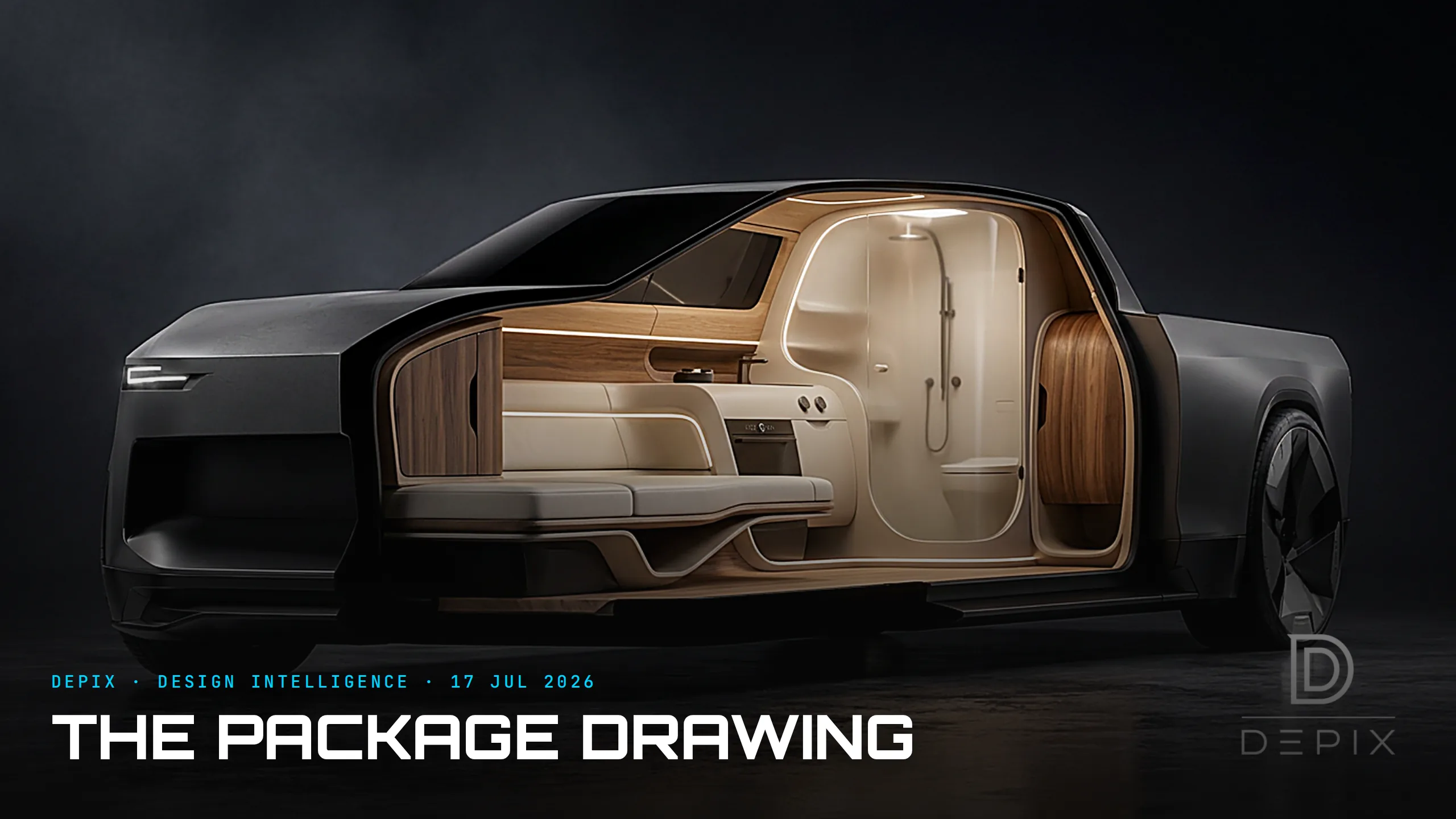
Here is why. A motorhome is the most extreme packaging problem in consumer design. It has to be a complete home — somewhere to sleep, cook, wash, store a fortnight of belongings, and sit out a rainy afternoon — while simultaneously being a road-legal vehicle bound by weight limits, axle loads, aerodynamics and a width you can still thread down a French village lane. Every function competes for the same cubic centimetres. A bigger shower steals from the bed; a fixed island bed steals from the garage; a longer galley segments the lounge. As the RV world bluntly puts it, every inch has to do double duty, and each layout is a chain of trade-offs between space, privacy and daily friction.
That makes the caravan the purest surviving example of a truth we return to constantly at Depix: the experience is decided upstream, at the concept phase, in a document engineers call the package drawing. Before anyone picks a fabric, a light or a laminate, someone decides where the bed, the wet-room, the galley, the tanks and the axle go. That single diagram — not the styling — determines whether the finished vehicle feels generous or claustrophobic, whether two adults can pass in the aisle while one is cooking, whether the bathroom is genuinely usable or merely a token. You cannot fix a bad package with a beautiful finish. You can only re-draw it, which means starting again.
So the honest way to grade a motorhome is not to admire the upholstery. It is to watch it transform. Does the dinette collapse into a bed cleanly, or does it fight you? Does the wet-room truly double as a shower and a drying room, or only claim to? Do the pop-top, the slide-out and the fold-flat furniture read as one idea or as three arguments? Good transformation is never added late; it is the consequence of a packaging concept in which every mode was drawn on top of the others from the first sketch. The clumsy conversions — the bed you reassemble like flat-pack furniture every single night — are the ones where the modes were bolted on afterwards.
This is not a niche craft. The market is large, mature and, despite the mood music, resilient. Germany alone registered around 94,000 new leisure vehicles in 2025, with motorcaravans holding above 75,000 units, and its fleet has now passed one million motorhomes on the road. Across Europe the industry booked more than 215,000 new registrations — a market the CIVD calls robust and versatile heading into 2026. These are serious products, engineered at volume, sold to people who actually live in them.
And their design lesson is about to matter to everyone, because two forces are converging on the caravan's home turf. First, cars are becoming lounges: as driving is automated, concept interiors like Volkswagen's ID. Roomzz and the ID. Buzz reorganise the cabin around rotating seats, flat floors and a living-room feel — precisely the "space that moves and does double duty" the RV industry has been solving for sixty years. Second, homes are shrinking: the micro-living and tiny-home movements have rediscovered Murphy beds, foldable furniture and modular walls that a caravan designer would recognise on sight.
In both cases the expertise flows forward from Düsseldorf. The caravan makers are the veterans of the constraint the rest of design is only now inheriting: how to make one small volume be many things — decided as a single concept, before the object has a shape. The hypercar on the concours lawn can hide its compromises behind sculpture. The motorhome has nowhere to hide, which is exactly what makes it the most honest packaging laboratory in design. Watch the package drawing. Everything after it is finish.
Sources:
- ●Caravan Salon Düsseldorf 2026 — official
- ●Caravan Salon — What to expect (scale, exhibitors, areas)
- ●The Vansmith — Class B floor plans: every inch does double duty
- ●Boondock or Bust — Making sense of Class B RV floor plans
- ●Quirky Campers — Campervan layouts explained
- ●Aboutcamp BtoB — CIVD annual report 2025/26 (registrations)
- ●CIVD — Number in use (German fleet passes 1 million)
- ●CIVD — Over 215,000 new European registrations
- ●Camping Business — CIVD snapshot: European caravanning towards 2026
- ●Volkswagen Newsroom — ID. Roomzz: a lounge on wheels
- ●Volkswagen Newsroom — ID. Buzz: interior like a lounge space
- ●Home Designing — Micro-living: small-space design that feels expansive
- ●TinyHousePlans — Multifunctional furniture & Murphy-bed trends