The Cab Is a Fossil: What IAA Transportation 2026 Reveals About Designing Around the Human
Every two years the largest gathering in commercial mobility fills the halls at Hannover. IAA Transportation 2026 runs 15–20 September, and the last edition drew more than 140,000 visitors and 1,400 exhibitors from across the logistics world. It is not a glamorous show — no concours lawn, no supercar reveals — but it may be where the most consequential vehicle redesign of the decade is quietly taking shape. And it begins by deleting a part everyone assumes is essential: the cab.
Look at a conventional semi and the driver's cab is the whole identity — the tall, upright, boxy face, the grille, the badge, the chrome. It is also an aerodynamic catastrophe. At highway speed, aerodynamic drag accounts for roughly 75–80% of a truck's resistance to motion, and that vertical frontal face is a primary culprit: the air has to make a near-right-angle turn to get up and around the cabin, building a wall of pressure. Decades of fairings, roof deflectors and streamlining have been, in effect, an elaborate apology for a shape that exists for one reason only: to seat a human where they can see the road.
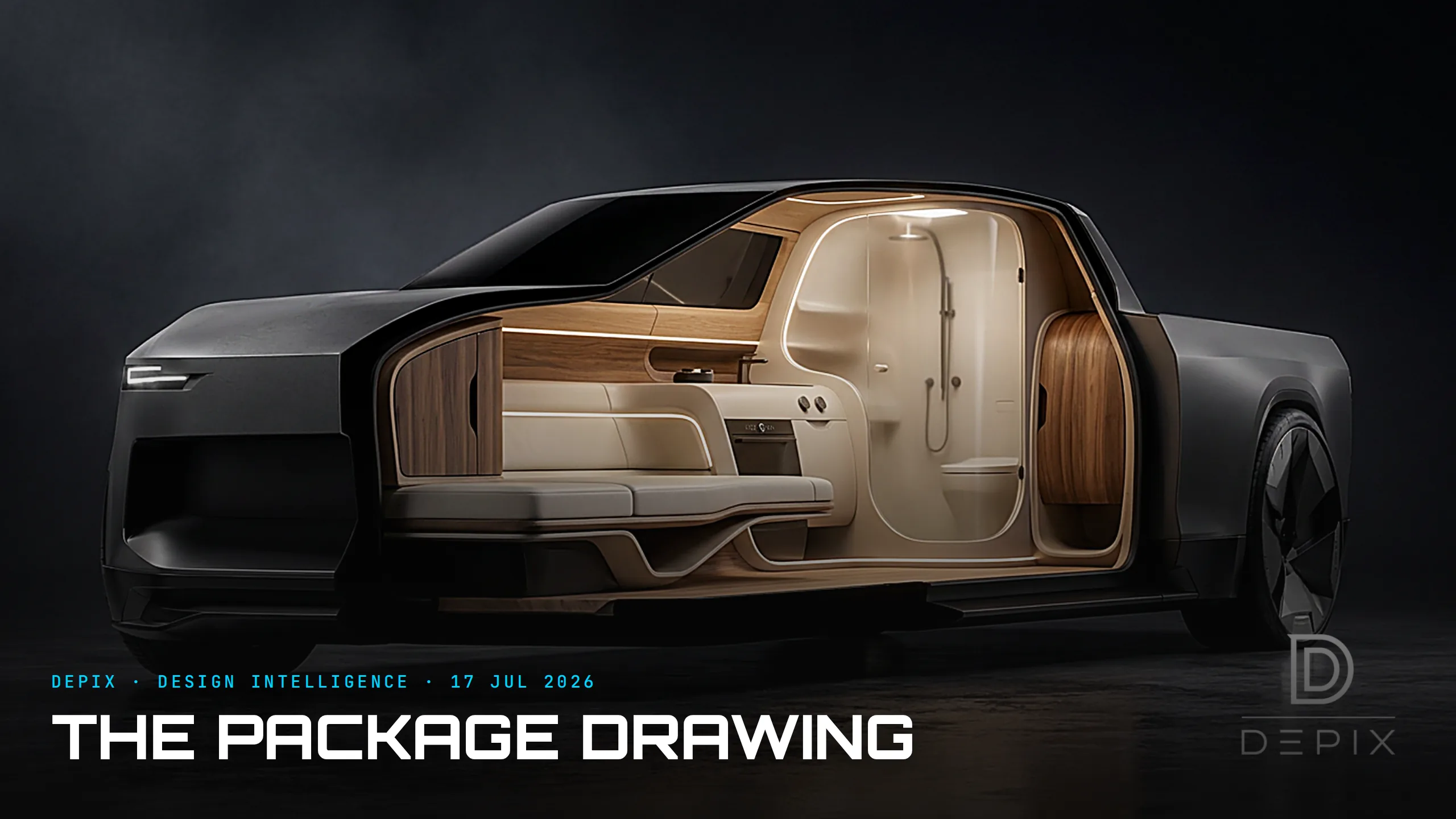
Remove the human and the apology becomes unnecessary. That is the concept-phase reset now underway. A San Francisco startup, Humble, has revealed a fully cabless, battery-electric freight hauler — no cab, no windshield, no driver seat — engineered as a motorised platform around the 40- and 53-foot containers that are the true unit of freight. By deleting the cab it claims a 20% weight reduction over a conventional semi doing the same job. When the human constraint disappears, you don't restyle the truck; you redraw it from scratch, around cargo and airflow instead of around a person.
This is not speculative. Driverless freight is already on real highways in 2026. Aurora, Gatik and Kodiak are hauling commercial loads without a driver aboard; Kodiak operates one of the largest driverless Class 8 fleets on the road. For now these trucks still wear cabs — retrofitted onto existing platforms — but that is a transitional courtesy. Once the driver is gone for good, the cab is a fossil: a vestigial structure preserved only by habit.
The design lesson generalises far beyond trucks. Almost every mature product carries fossils — features that survive because of a constraint that no longer applies. The truck cab is simply an unusually honest example, because its cost — a fifth of the weight, most of the drag — is measurable. The discipline is to ask, at the concept phase, which parts of a design are load-bearing to its purpose and which are load-bearing only to its history. Delete the second kind and the whole object reorganises.
Two honest caveats keep this from being a fantasy. First, the cab will not vanish overnight: the ATA counts a driver shortage of more than 80,000 in 2026, and the near-term model is mixed — autonomous trucks running the highway leg while humans manage the complex first and last mile. For years most trucks will still need a seat, and the debate over driver-assistance versus full autonomy is far from settled. Second, cabless design is not universal: it makes sense first for the standardised, hub-to-hub, intermodal-container lane, not for the messy, varied, human-facing work that fills most of the road.
But the direction is set, and IAA Transportation 2026 is where you will read it — not in the flashiest concept, but in how seriously the industry now treats the cabless platform as a real product category rather than a render. The brands that win the freight decade will be the ones that decide early, at the concept stage, to design the vehicle around its cargo and its physics rather than around a person who may no longer be aboard.
Every mature design eventually meets a constraint it was built around, then watches that constraint disappear. The honest response isn't to restyle — it's to go back to the first drawing and ask what the thing is actually for. At Depix, that upstream question — what's load-bearing, and what's just a fossil — is the whole job.
Sources:
- ●IAA Transportation 2026 — official (Hannover, 15–20 Sep)
- ●VDA — IAA Transportation 2026 (scale, topics)
- ●Neural Concept — truck aerodynamics: drag is 75–80% of resistance
- ●Arrow Truck — how aerodynamics impact semi-truck fuel economy
- ●Trucking Info — Humble's cabless autonomous electric hauler (20% lighter)
- ●Fifth Level — top autonomous trucking companies (Aurora, Gatik, Kodiak)
- ●Electrek — autonomous truck guide (Kodiak driverless Class 8 fleet)
- ●FleetRabbit — self-driving trucks & mixed autonomy / transfer-hub model
- ●Midwest Truck Driving School — ATA 2026 driver shortage (80,000+)
- ●UC Berkeley Labor Center — driverless & the American trucker (intermodal lane)
- ●NPR — the future of trucking: driver assistance or autonomous?