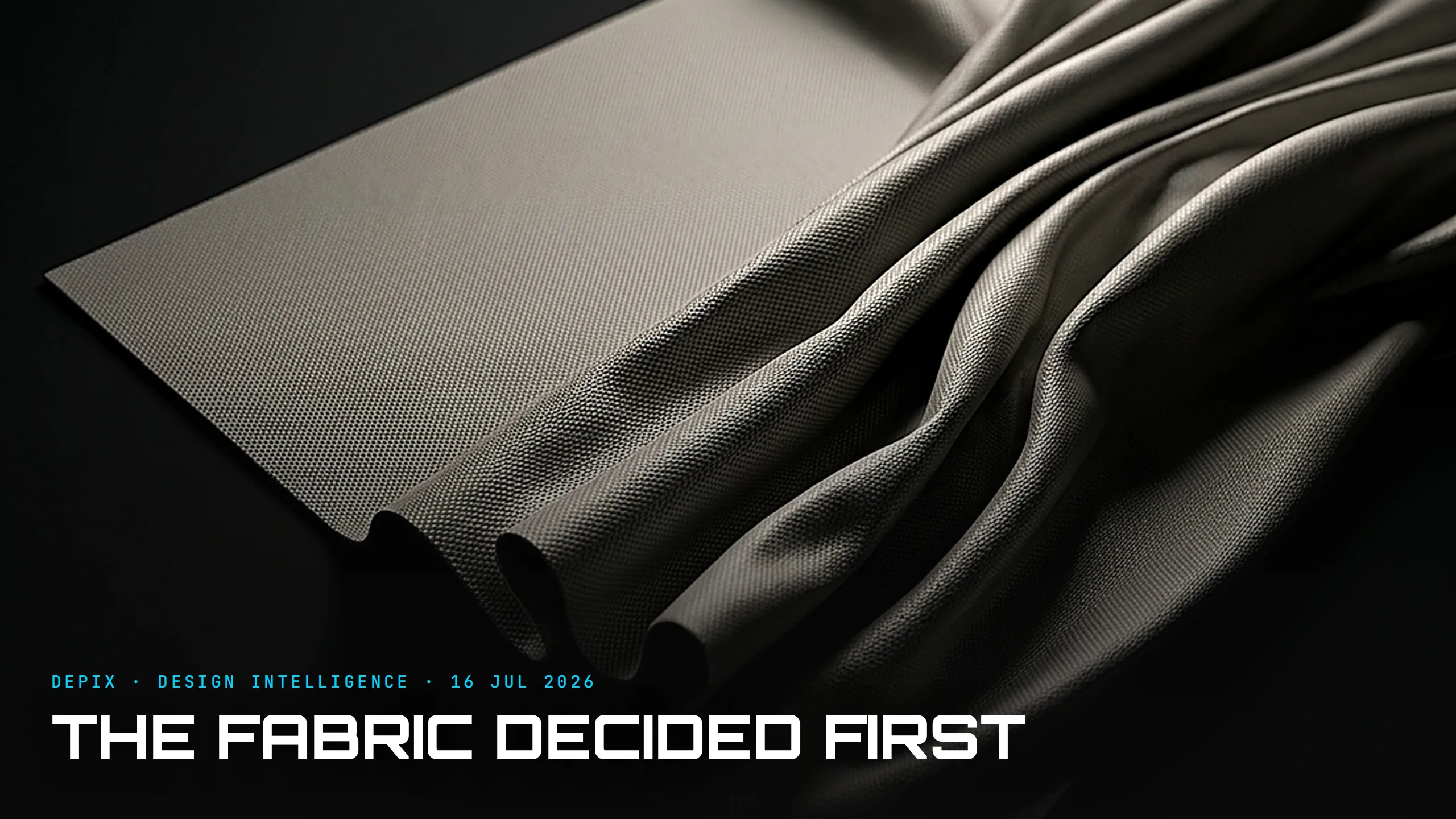
The Fabric Decided First: Why the Real Design Room Is a Shanghai Sourcing Hall, Not the Runway
By the time a garment reaches a runway, its most consequential design decision is already months old — and it was made on a trade-fair floor, not in an atelier. We lavish credit on the designer's 'vision,' the sketch, the show. But the sketch is downstream. The decisive act happened when someone chose the cloth.
That choice has an address and a date. From 25–27 August 2026, the Autumn Edition of Intertextile Shanghai Apparel Fabrics fills Shanghai's National Exhibition and Convention Center — more than 3,700 exhibitors and over 100,000 buyers working the aisles of one of the world's largest apparel-fabrics fairs. This is where next season is actually designed. Not the silhouette — the substrate.
Here is why the material is the concept, not its accessory. Drape, hand and structure decide almost everything a viewer reads as 'design.' A stiff, low-drape wool holds an architectural, boxy line; a fluid silk or rayon collapses into soft, moving folds. Weight sets whether a coat commands a room or floats around a body. A textile's fibre and weave predetermine how a garment moves, how it wrinkles, how it ages after fifty washes, what it costs, and — increasingly — whether it can legally be sold. The celebrated dress is largely the working-out of a fabric decision. The designer's genius is real, but it is exercised inside a box the material already drew.
This is why the fabric fair, not the runway, is the true concept phase. As the trade itself concedes, roughly 80% of a product's environmental impact is locked in at the design stage — and at a fabrics fair, 'design' means selecting a roll. These are no longer mere cloth bazaars; fabric fairs increasingly court material start-ups and next-gen suppliers, curating the very menu designers will later choose from.
And that menu is being rewritten in real time. Textile Exchange's Materials Market Report 2025 shows polyester still dominating at 59% of global fibre, while recycled polyester slipped to about 12% share — and 98% of it still comes from bottles, not old clothes. Genuinely new inputs remain marginal: Fashion for Good and BCG project next-gen materials — mycelium leathers, seaweed-based cellulosics like Kelsun, textile-to-textile recycled yarns — reaching just 8% of the fibre market by 2030, up from 1% today. Meanwhile the EU's Ecodesign for Sustainable Products Regulation has named textiles a top-priority category, with a Digital Product Passport that will force fibre composition, origin and recyclability to be declared at the point of sale. When traceability becomes law, the fibre you pick in Shanghai is a compliance decision, not merely an aesthetic one. And the scale sits there for a reason: China still supplies around 43% of world textile exports even as its finished-apparel share slips below 30% — the cut-and-sew moves to Vietnam and Bangladesh; the cloth does not.
This is a universal design truth, not a fashion quirk. In cars, the colour-material-finish decision — the grain of a surface, the weave of a seat, matte versus gloss — is chosen long before the clay model is signed off, and it dictates how the form reads. In architecture, whether a façade is glass, aluminium or timber governs a building's mass, cost and carbon before a single elevation is drawn. The material precedes and constrains the form, everywhere. Whoever controls the material menu controls the design space.
Now the honest counterpoint. Determinism is too clean. The best designers do not accept the menu — they push mills to invent new items on it: a seaweed or lab-grown fibre dragged onto a runway changes what the fair can even offer next season. Material and form are a dialogue, not a dictatorship. And 'the fabric decides' can curdle into an alibi — a reason to source last season's safe bestseller and call trend-following 'responsiveness.' The material-first designer who never pushes the mill is just outsourcing imagination to a supplier's swatch book. Amid the tariff turbulence and value-conscious mood of 2026, the temptation to play the fabric safe is stronger than ever.
But the lesson holds. The decisive design intelligence is exercised before the object has a shape — over a swatch, in a sourcing hall, against a regulatory and sustainability constraint set most people never see. Watch the runway if you want the show. Watch the fabric fair if you want to know what was actually decided. The garment is a conclusion. The concept was the cloth.
Sources:
- ●Intertextile Shanghai Apparel Fabrics – Autumn Edition (official, Messe Frankfurt)
- ●Fibre2Fashion — Intertextile Shanghai 2026 to spotlight textile innovation
- ●Fibre2Fashion — China's textile & garment exports gain 2.7% to $301 bn in 2024
- ●Modaes Global — China loses hegemony as the world's fashion factory (below 30% share)
- ●Textile Exchange — Materials Market Report 2025
- ●Fashion for Good — Scaling Next-Gen Materials in Fashion: An Executive Guide
- ●BCG — Next-Gen Materials to Reach 8% of Fiber Market by 2030
- ●European Commission — EU Strategy for Sustainable and Circular Textiles
- ●European Commission — Implementing the Ecodesign for Sustainable Products Regulation (ESPR)
- ●Première Vision — The Show / The Concept (80% of impact set at design)
- ●WWD — Première Vision Expands Beyond Textiles With Start-ups and Innovation
- ●Core Fabrics — Drape, Hand and Structure: Why Fabric Feel Decides Silhouette
- ●McKinsey & Business of Fashion — The State of Fashion 2026

Four Rooms, One Decision: Where Today's Design Was Actually Made

The Audience of One: Design's Last Uncompromised Brief
