The Shell Is the Strategy: What 2026's Humanoid Robots Decide Before the First Actuator
In 2026 the humanoid robot stopped being a lab demo and started being a product — and the moment it did, its designers split into two camps that tell you everything about how design decisions actually get made.
On one side: Figure 03, a hard-shelled industrial humanoid running paid pilots in BMW plants; Tesla's Optimus, inching toward Fremont production; and Apptronik's Apollo, deployed with Mercedes. All armour, structural panels, exposed actuation — machines that look like machines.
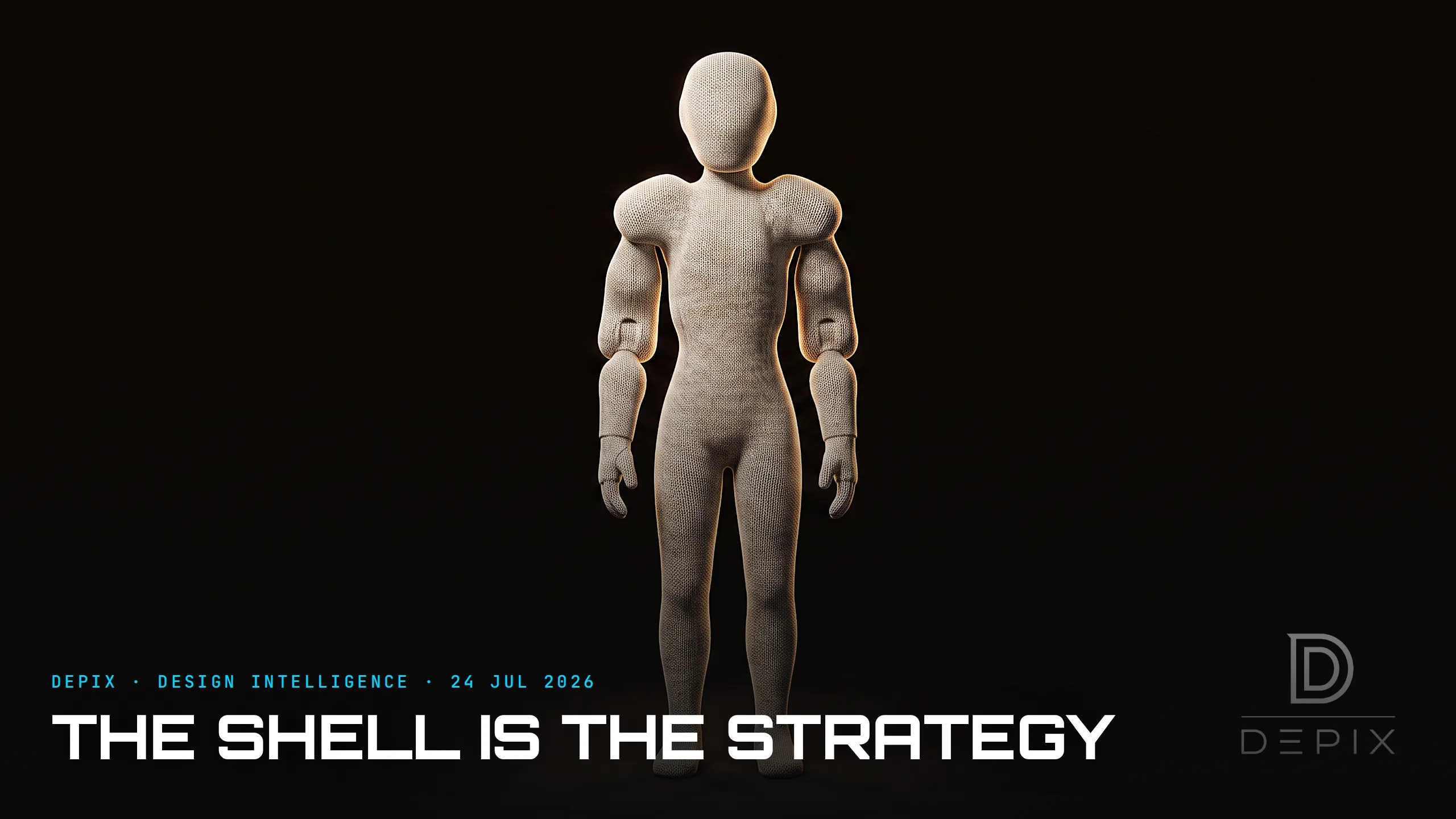
On the other: 1X's NEO, a home humanoid dressed head-to-toe in beige knitwear. Same basic premise — a bipedal, human-shaped robot built to work in spaces made for people — and a completely opposite skin. Underneath, the mechanisms are converging. On the surface, they could not be further apart. That gap is the lesson.
The shell decides where it lives
A hard shell is not a look; it is a habitat decision. Figure, Optimus and Apollo are built for the warehouse and the factory line — environments where humans are supervised, spaced away, or absent. There, an exoskeleton reads correctly: it says equipment. It prioritises impact resistance, serviceability, heat dissipation and the visual language of industrial capability. Nobody needs to love it. It needs to survive a ten-hour shift and be bolted back together on a Tuesday.
NEO answers a different question, because it lives in your kitchen. 1X's problem was never "how do we armour this?" It was "how do we make a 30-kilo articulated machine feel safe standing next to a child?" The answer was a one-piece 3D-knitted nylon suit in a soft neutral tone — a shell chosen so the robot would blend into a home rather than dominate it. The knit even does acoustic work, dropping the machine's operating noise to roughly the level of a fridge. Dezeen called it a "Scandi robot servant." That is not an insult; it is the entire strategy.
The shell decides whether you trust it
There is a second decision hiding in the fabric, and it is about the uncanny valley — Masahiro Mori's 1970 observation that our affection for a machine rises as it grows more human-like, then collapses into revulsion the instant it gets almost human. Trust in a robot is designed, not assumed, and subtle wrongness reads as threat within milliseconds.
The knit suit is a clever sidestep. It makes NEO read as an appliance wearing clothes, not an almost-person — friendly precisely because it has stopped trying to be lifelike. Soft says safe, literally (padding, lower noise) and semiotically (a sweater is not a threat). The hard-shell camp sidesteps the valley from the opposite direction: by looking so overtly like a tool that you never mistake it for a being at all. Both are valid answers to the same anxiety. Both are decided by the skin, not the software — a warehouse never has to like Apollo, and a family will never accept NEO if the first thing it triggers is unease.
Why this is a concept-phase call, not a styling one
It is tempting to file the shell under industrial design finishing — the bit that happens after the engineering is done. That is exactly backwards. The skin is chosen first, and it dictates the machine beneath it. A soft knit envelope forces different actuator packaging, thermal routing, noise targets, mass distribution and a whole safety envelope than a rigid structural shell does. You cannot knit a suit over a robot that was designed to shed heat through exposed hard panels, and you cannot armour one that was designed to be quiet and yielding. "How should this be perceived?" gets answered before "how should this be built?" — because the perception decision constrains the build. Get the order wrong and you end up armouring a robot you needed to be gentle, or knitting a cosy suit over a machine that runs too hot to wear one; the retrofit is never clean, because the shell was structural all along.
That is the through-line for anyone shaping objects, robotic or not. The mechanism is converging; the differentiation lives in the interface with human feeling. Same platform, two products, because the shell — not the actuator count — is what actually defines the thing.
The most consequential line a designer draws on a humanoid isn't a joint or a sensor placement. It's the answer to a single question asked at the very start: what should it feel like to be in a room with this? Hard machine, or soft houseguest. Everything downstream — every panel, every seam, every decibel — is just the working-out of that one early decision.
Sources:
- ●Humanoid Robots in 2026: What Is Actually Deployed — Technology.org
- ●Humanoid Robots in 2026: Figure, Apptronik, 1X and Tesla Optimus compared — ValueAdd VC
- ●Tesla Optimus vs Figure AI vs Hyundai Atlas: Full Comparison 2026
- ●1X NEO Home Robot
- ●Scandi robot servant Neo Gamma is dressed head-to-toe in beige knitwear — Dezeen
- ●1X built its humanoid NEO Gamma to better fit into the home — The Robot Report
- ●Softest Humanoid Bot? 1X NEO Gamma clothed in 3D-printed nylon fabric — Tech Times
- ●NEO Gamma dons a 3D-printed fabric skin to blend with your home — Yanko Design
- ●1X NEO Gamma: Home assistant humanoid robot — Electronics360
- ●The uncanny valley: why human-like robots make people uneasy (2026) — Robotics & Automation News
- ●The Uncanny Valley and Designing Trust in Human-Robot Interaction — iMotions
- ●Experiments reveal why human-like robots elicit uncanny feelings — ScienceDaily / Emory