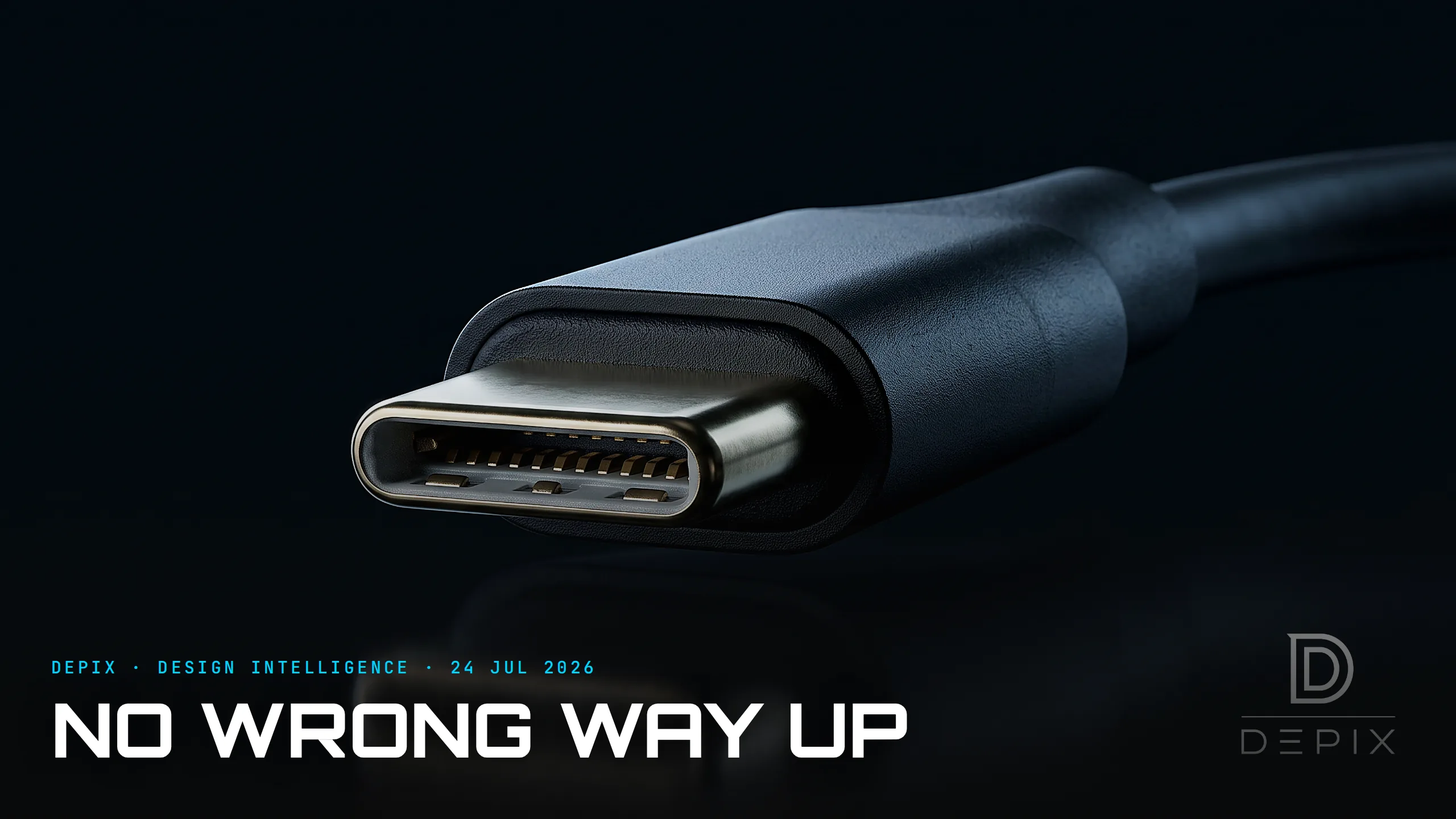
The Best Feature of USB-C Wasn't a Spec. It Was 'No Wrong Way Up.'
Ask a designer to make an object whose entire purpose is to have no identity — no brand, no distinctiveness, nothing proprietary, a thing whose highest achievement is to be perfectly interchangeable with everyone else's — and you have described the connector. It is the strangest brief in industrial design, because it runs against every commercial instinct at once. And the story of USB-C is really the story of how hard the industry fought not to make it.
USB-C was finalised by the USB Implementers Forum in 2014: a 24-pin, symmetrical, reversible connector carrying power, data and video through one port, scaling to 40 Gbps and 240 watts. Impressive numbers. But none of them are why people love it. People love it for the least impressive decision on the entire spec sheet: it is reversible — there is no wrong way up. For thirty years the industry treated "which way does it plug in" as beneath engineering attention, and gave the world USB-A, the connector with the famous coin-flip odds on first insertion. Getting the thing symmetrical was dismissed as trivial. It turned out to matter more to actual humans than any transfer speed ever printed on a box. The old rectangular plug became a genuine cultural joke — flip it, fail, flip it again, succeed — a tiny daily humiliation shipped to billions of people because the industry decided orientation was not an engineering problem worth solving. USB-C's symmetry quietly deleted that friction, and almost nobody can name the feature they are enjoying. Good design of this kind is invisible: you notice its absence, never its presence.
Here is the deeper reason it took so long, and it is not technical. A proprietary port is a moat. It is a revenue stream — tech companies make real money selling proprietary cables — and a lock-in that keeps customers dependent on one manufacturer's accessories. Apple's Lightning connector sat on its single biggest product for a decade. When the European Commission moved to standardise, Apple argued a common standard would "freeze innovation" — the reliable defence of every profitable moat. Meanwhile the actual innovation the customer wanted was simply to not own a drawer full of dead, incompatible cables, a mess the EU costed at around 11,000 tonnes of charger e-waste every year.
A fragmented market was profitable, so it would never converge on its own. Interoperability had to be imposed from outside: from 28 December 2024 the EU requires USB-C on phones, tablets, cameras, headphones and consoles, with laptops following in 2026. It is worth sitting with how unusual that is. The single most useful design decision in a generation of consumer electronics — everything charges from one cable — was one no individual company would make, and a regulator had to make it for them.
That is the concept-phase lesson, and it is uncomfortable. Sometimes the highest-value move on the board is not to be distinctive but to be interchangeable — to give up the moat, adopt the shared standard, and let your product disappear into an ecosystem that serves the user better than your walled garden did. It is the one decision commercial incentives fight hardest, which is exactly why it so often has to be forced by a standard, a platform or a law. Canada and others are already following the EU, because once one bloc breaks the logjam, fragmentation stops being defensible anywhere and the old proprietary ports quietly disappear.
And underneath the politics sits that small, almost embarrassing truth about reversibility. The connector is a reminder that the spec sheet systematically lies about what matters. Nobody stands in their kitchen at midnight grateful for 240-watt power delivery; they are grateful the plug went in the first time, in the dark, without being flipped. The details a design culture dismisses as trivial — which way up, does it click, can you do it without looking — are frequently the entire lived experience of the product. USB-C's genius was never the forty gigabits. It was deciding, at last, that there should be no wrong way up — and that the object should be humble enough to belong to everybody. The moat you give up is rarely the innovation you claimed to be protecting; more often it is just the friction you were charging people to keep.
Sources:
- ●USB-C — overview and 24-pin reversible design — Grokipedia
- ●USB Type-C and USB 3.1 explained (reversible, no wrong way up) — OnLogic
- ●USB Type-C standardization: 24-pin symmetrical connector — Same Sky
- ●What the EU's universal USB-C mandate means (40Gbps, 240W) — Acroname
- ●Decoding the EU rule: proprietary cables are real revenue — ThePrint
- ●All small electronics must share a charging port; Apple: it would 'freeze innovation' — Scientific American
- ●Common charger: 'first step to ending the e-waste tsunami' (the cable drawer) — ECOS
- ●EU standardised charging ports to cut ~11,000 tonnes of e-waste a year — Silicon Republic
- ●Official: USB-C mandatory for devices sold in the EU from Dec 28, 2024 (laptops 2026) — GSMArena
- ●Canada wants to standardize charging ports on devices — Global News
- ●USB-C becomes the new standard in the EU: the end of USB-A? — Eagle Eye

The Mortar and Pestle Went 35,000 Years Without a Design Review

The Hardest Design Brief in the World Is a Dog Toy
