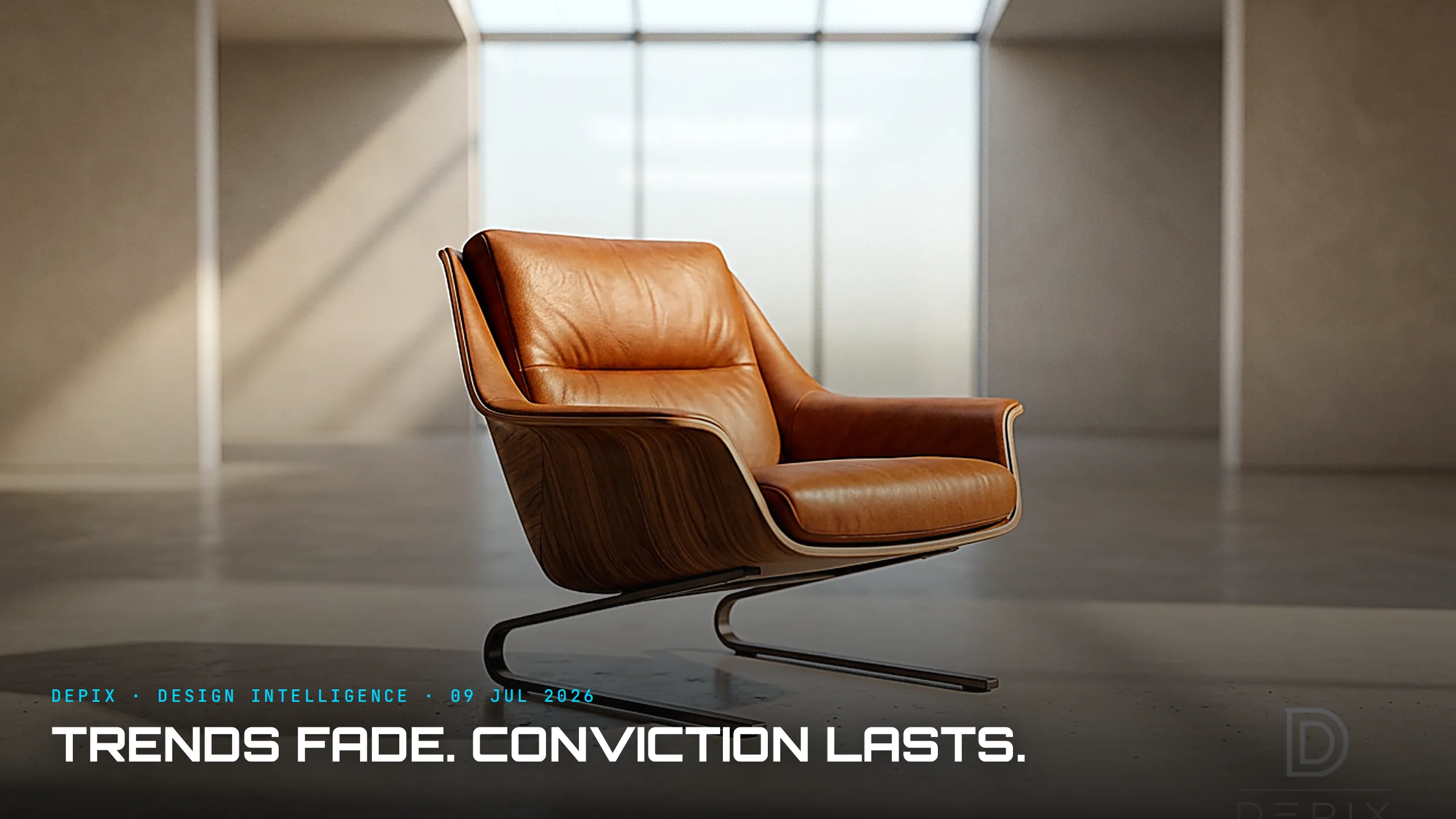
Maison&Objet Sells the Season. The Classics Ignore It.
Every September, more than 51,500 buyers, editors and designers converge on Paris Nord Villepinte for Maison&Objet, the home and lifestyle industry's biggest trade fair. The 2026 September edition runs 10-14 September, gathers over 2,100 brands across seven sectors, and - like every edition - arrives wrapped in a theme. This time it is "design in motion." The programme is, in the most literal sense, a machine for manufacturing the next season: buyers come to find out what is new and to place the orders that will fill shop floors and hotel lobbies a few months from now.
The fair is remarkably honest about this. Its Design District is described, in its own words, as an observatory of tomorrow's trends; its "What's New?" spaces and the Peclers Paris trend books exist to identify and validate directions before they reach the mainstream. If you want to know which colour, material and mood will be sold to you in 2027, this is where it is decided.
Here is the contrarian truth the fair itself keeps proving: almost none of the objects that actually last were designed to a trend.
The pieces that survive decade after decade - the ones still in production long after their launch season is forgotten - tend to be the ones whose form was resolved as a concept, not as a forecast. Dieter Rams built his entire philosophy on the principle that good design is long-lasting: it "avoids being fashionable and therefore never appears antiquated." His 606 Universal Shelving System has been in continuous production since 1960 - it has outlived more than sixty years of trend cycles - precisely because it was never trying to win a season. Rams decided what the object was - a clear, quiet, endlessly reconfigurable system - before any question of what was fashionable entered the room.
That is the tension at the heart of a trend fair, and Maison&Objet, to its credit, stages both sides of it. Alongside the seasonal palette it crowns a Designer of the Year and elevates Rising Talents, and its recent editions have argued, almost paradoxically, that the shape of the future comes from heritage. Read that carefully: the most future-facing event in interiors is quietly admitting that durability comes from conviction and roots, not from the trend book. A Designer of the Year is never crowned for nailing next season's palette; they are crowned for a body of work with a single recognisable idea running through it. The talent programmes reward designers with a point of view - a thesis about what their work is - not the ones who best predicted the season. That is the quiet lesson underneath all the newness: the fair's own highest honours go to conviction, while the trend wall is, by design, disposable.
This is not an argument against trends. Trends are useful; they move markets, they let a young studio get noticed, they give a fair its energy. The new-and-now is genuinely valuable. The mistake is treating the trend as the design decision rather than as a surface applied late. A colourway, a finish, a silhouette borrowed from the season can be swapped in a year. What cannot be swapped - what determines whether a chair is still made in 2060 - is the concept underneath: the decision about proportion, structure and purpose that was locked long before the object met a mood board.
That distinction is the whole of it. Trend-chasing is a downstream activity: you take a resolved object and dress it for the season. Concept-phase conviction is upstream: you decide what the thing fundamentally is, and only then let a season touch its surface. The 2026 trend forecasts will be right about a great deal - and almost none of it will still be in production when the next Paris calendar comes around a decade from now. The handful of pieces that will still be there are being designed, right now, by people who resolved their idea before they consulted the forecast.
At Depix, that is exactly the discipline we care about, whether the object is a chair or a car: know which decisions are load-bearing to an identity and settle them at the concept stage - because a trend can be reapplied every season, but conviction has to be built in from the first sketch, and it is the only thing that outlasts the fair.
Sources:
- ●Maison&Objet Paris - Visit the fair
- ●Maison&Objet September 2026 - Dezeen Events Guide
- ●Maison&Objet Paris - Programme
- ●Maison&Objet Paris - Talents & Awards
- ●Maison&Objet 2025: A catalyst for talent and a revealer of trends - Harmonies Magazine
- ●Maison&Objet September 2025 - Design & Interior Trends - Peclers Paris
- ●Maison&Objet September: the shape of the future comes from heritage - DesignWanted
- ●Maison&Objet Highlights Dutch Design Through Rising Talent Awards - Interior Design
- ●Maison&Objet: New & Now - SBID
- ●Maison&Objet January edition: the new trends of 2026 - DesignWanted
- ●Good design - Vitsoe (Dieter Rams)
- ●Dieter Rams' Design: Principles, Examples, Impact - Dovetail
- ●Dieter Rams' 10 Principles of Good Design - Studio FLACH
- ●Maison&Objet Paris 2026 - The Artling calendar
Seven Design Events Today. One Verdict: The Concept Phase Wins.

Pebble Beach Judges Authenticity. Its Winners Were Concept Cars.
