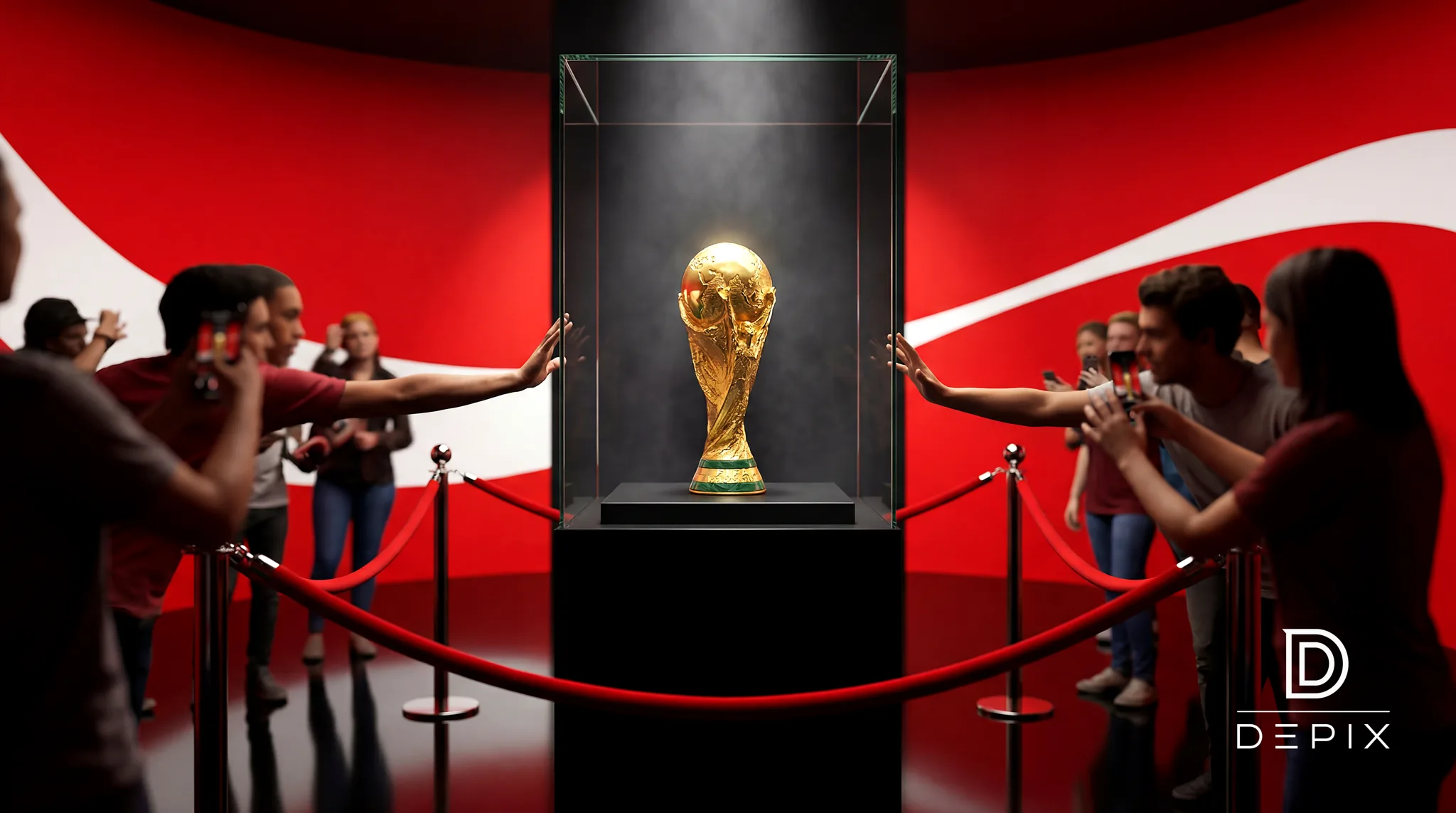
FIFA made America invent a league to host the World Cup.
Here is the uncomfortable origin story behind the tournament filling American stadiums this summer: the country did not earn the 1994 World Cup by loving football. It earned it by promising to build a football business it did not yet have.
When FIFA awarded the United States the 1994 tournament in 1988, it attached a condition that would sound absurd anywhere with a real football culture. America had to establish a top-flight professional league — a Division 1 outdoor competition — as the price of hosting. The World Cup was not a reward for a market. It was the bait used to force one into existence.
That is a design brief, not a sports story. And it is one every product team should study, because the United States had already failed this exact assignment once. The North American Soccer League ran from 1968 to 1984 and, for a few dazzling years, worked — until it didn't. Its concept was to buy attention: import ageing global superstars, expand fast, and let television and glamour do the rest. Over-expansion and the early-1980s recession finished it off. The league collapsed after the 1984 season, leaving America with a cautionary tale about a product built on borrowed shine instead of durable structure.
So the interesting decision was never "should we host?" It was "what should the league that lets us host actually be?" — and that decision had to be locked before a single match kicked off. Major League Soccer, founded in 1993 as the bid promise made good, was engineered as a direct rebuttal to NASL's mistakes. Its defining feature was structural, not stylistic: a single-entity model, where the league itself owns the player contracts and central operations, and owners run clubs as "investor-operators." That one architectural choice was designed to prevent the spending arms race that had bankrupted NASL, and to hold the whole thing together under a single legal roof. The founders decided what the thing was before they decided what it looked like.
The restraint went further. MLS was meant to launch in 1995 and deliberately waited until 1996 — ten teams, no rush — because the capital and the stadium deals were not ready. A less disciplined team would have shipped on the original date to ride the World Cup afterglow. The concept-phase discipline was to not.
The numbers make the bet look obvious in hindsight, but they were anything but at the time. The 1994 World Cup drew a total attendance of 3,587,538 across just 52 matches — an average of 68,991 per game — in a country that supposedly did not care. That total stood as the highest of any World Cup for 32 years, until this summer's 48-team edition, spread across the same three-nation region and 104 matches, finally passed it. The league those crowds were meant to seed grew from 10 clubs in 1996 to 30 in 2026. A market conjured, on paper, from a hosting condition.
This is the part that matters for anyone who designs products rather than watches football. America's second attempt succeeded where the first collapsed not because the football got better overnight, but because the concept was corrected upstream — the structure, the pace, the ownership model — while those choices were still cheap arguments on a whiteboard and not concrete, franchises and stadium leases. NASL's fatal flaws were baked into its concept and could only be discovered by going bankrupt. MLS's designers found theirs on paper first.
That is exactly the gap DEPIX exists to close. Design intelligence means seeing the consequences of a foundational decision — what the product is, how it holds together, what it will cost to be wrong — while it is still a sketch you can redraw, not a commitment you have to unwind. A country was handed a World Cup and told to invent a market to deserve it. It won the second time by deciding, early and deliberately, what that market would be.
Sources
- ●1994 FIFA World Cup — Wikipedia
- ●Major League Soccer — Wikipedia
- ●North American Soccer League — Wikipedia
- ●When FIFA gave the 1994 World Cup to the United States, it did so on one condition — SpaceDaily
- ●How the 1994 World Cup took shape and prepared America for 2026 — Stars and Stripes FC
- ●1994 World Cup Legacy — National Soccer Hall of Fame