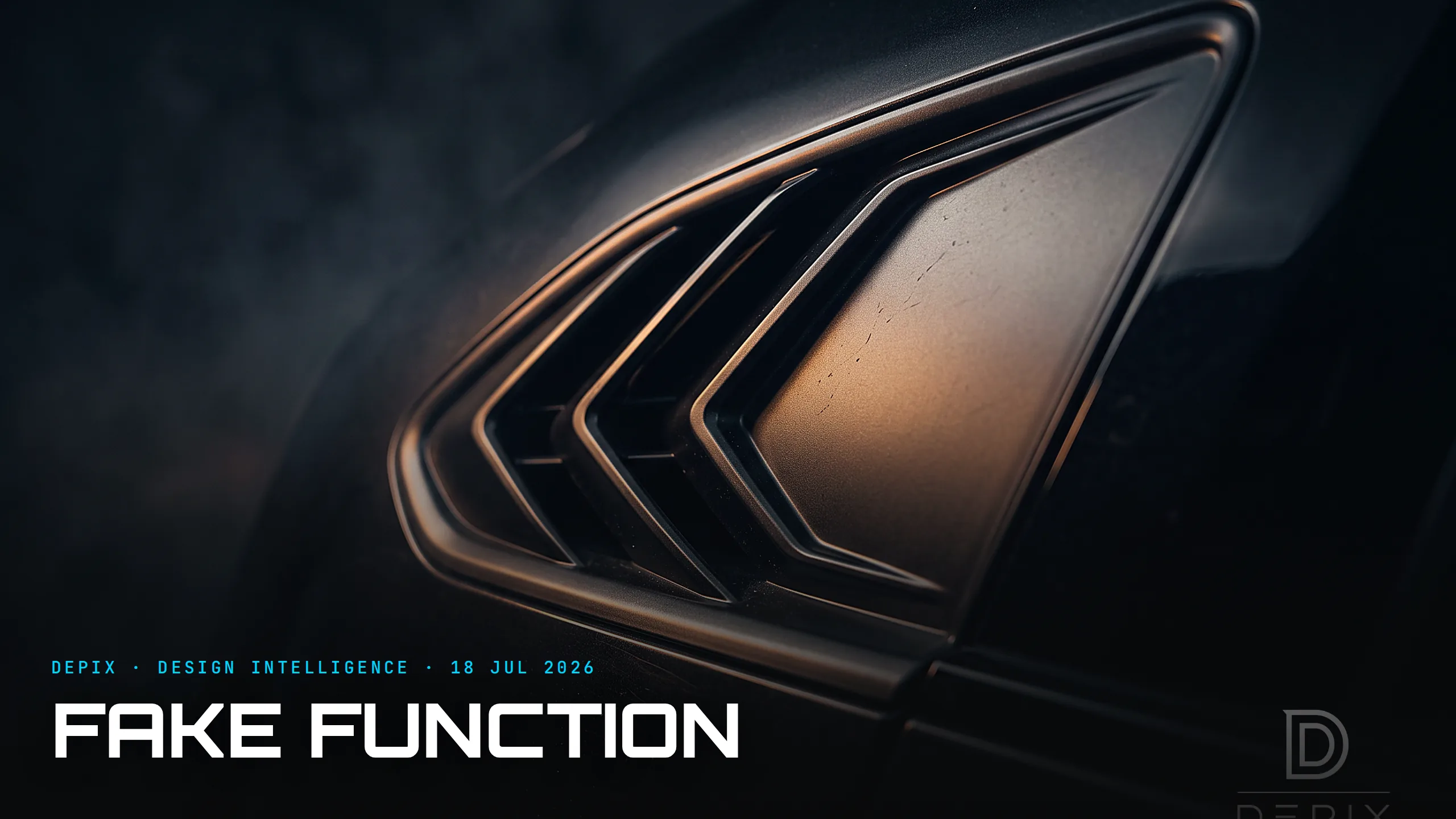
You're Not Designing the Part - You're Designing the Mold
Pick up almost any manufactured object near you - a phone, a bottle cap, a switch, a car's interior panel - and run a finger along its edge. You will find a faint seam, a line running around it where you might not expect one. That line is a confession. It is the parting line, the place where the two halves of a steel mould met, and it is proof of something designers rarely say out loud: you did not design that object. You designed the mould that made it.
Most of the manufactured world is injection-moulded - molten plastic forced into a steel tool, cooled, and ejected. And the tool imposes a strict, non-negotiable grammar on every shape that comes out of it. The most fundamental is the draft angle: every wall must taper slightly - usually at least one degree per side - so the cooled part can slide out of the mould instead of gripping it. A wall that looks perfectly vertical in a sketch almost never is; it leans by a degree you were never meant to notice. Forget that one degree and the part sticks in the tool and halts the entire production line.
The rest of the grammar is just as unforgiving. Wall thickness must be nearly uniform, because thick and thin sections cool at different rates and the part warps or sinks; a section half a millimetre too thick can double the cooling time, and the cost. Undercuts - any lip or hook facing the wrong way - can't simply pull straight out, so they demand extra sliding mechanisms in the tool, or they are forbidden. Ejector pins leave little circular marks, so they must hide on surfaces no one sees. A flat parting line is cheap; a fussy contoured one is not. None of this is aesthetic preference. It is the physics of pulling a solid object out of a hollow steel box.
So the real design act, for anything made at scale, isn't drawing the object. It is designing the object and the tool at the same time, because the two are the same decision. The shape you can have is the shape the mould can release, and the beautiful CAD model that ignores this is worthless - it either can't be tooled at all, or it can only be made with a fortune in complex, slow, failure-prone machinery. This is why every good product designer eventually stops thinking about the part and starts thinking about the mould that makes it, and why the standard advice is to bring the toolmaker into the room as early in the design as possible - not at the end, when it is too late to change anything cheaply.
That is the concept-phase point, and it is a strict one. Manufacturability is not a check you run after the design is finished; it is a constraint you design inside from the first line. The draft, the wall, the parting line, the location of every ejector mark - these are decided, implicitly, the moment you decide how the thing will be made. Choose the process first, internalise its grammar, and the constraint disappears into the form; ignore it, and it returns at the worst possible time, as a redesign, a delay, or a price the product can't bear.
And the lesson isn't only about plastic. Every medium has its version of the mould. A cast metal part has draft and parting lines too. A sheet-metal panel can only bend so tight a radius. A garment is shaped by the width of the cloth on the roll and the logic of a flat pattern. Software has its own grammar of what a framework makes cheap or impossible. In every case, how a thing is made is not a downstream detail - it is a co-author of the form, present from the first idea whether you invite it or not.
So the most useful thing a designer can learn is to see the tool inside the object: to look at a shape and read, in its tapers and seams and hidden marks, the steel box it came from. The masters make that box invisible - a form so resolved you would never guess it was shaped as much by the mould as by the eye. But it always was. You are never only designing the part. You are always, also, designing the mould.
Sources:
- ●Injection Molding Basics: Designing Plastic Parts - Protolabs
- ●How to Design Injection Molded Parts: Wall Thickness, Draft & Gates - Texas Injection Molding
- ●10 Plastic Part Design Rules for Injection Moulding - PlastFabWorks
- ●Design for Manufacturability (DFM) in Injection Molding - RJC Mold
- ●Design for Injection Molding Guidelines - DFMPro
- ●Injection molding design guide (undercuts) - Protolabs Network / Hubs
- ●Plastic Part and Mold Design Considerations (ejector pins) - PlasticsToday
- ●Injection Molding Design Guide 2026: DFM Principles - Weilin Plastic
- ●Injection Mold Design & Tooling - Matrix Tool
- ●DFM for Injection Molding: The Complete Guide - RP Proto
- ●Injection Moulding Design Guide - HLH Rapid
- ●What is Design for Manufacturability (DFM)? - EvokPoly
Designed to Be Fixed: What Reparability Reveals About a Product's Real Values

The Box That Ate the World: Why the Most Powerful Design Decision Is a Standard, Not a Shape