Ambient Light as Architecture: How the Cabin's Gimmick Became Its Structure
The easiest thing to dismiss in a modern car interior is the ambient lighting. A strip of colour-shifting LED along the door, a glow in the footwell, a party trick with two dozen preset moods — it reads as decoration, the automotive equivalent of under-cabinet kitchen lighting. That reading is about to be badly out of date. In the electric and software era, ambient light is quietly becoming the cabin's architecture: the main way an interior defines its space, communicates its state and expresses its brand — exactly as the physical detailing that used to do those jobs is being deleted.
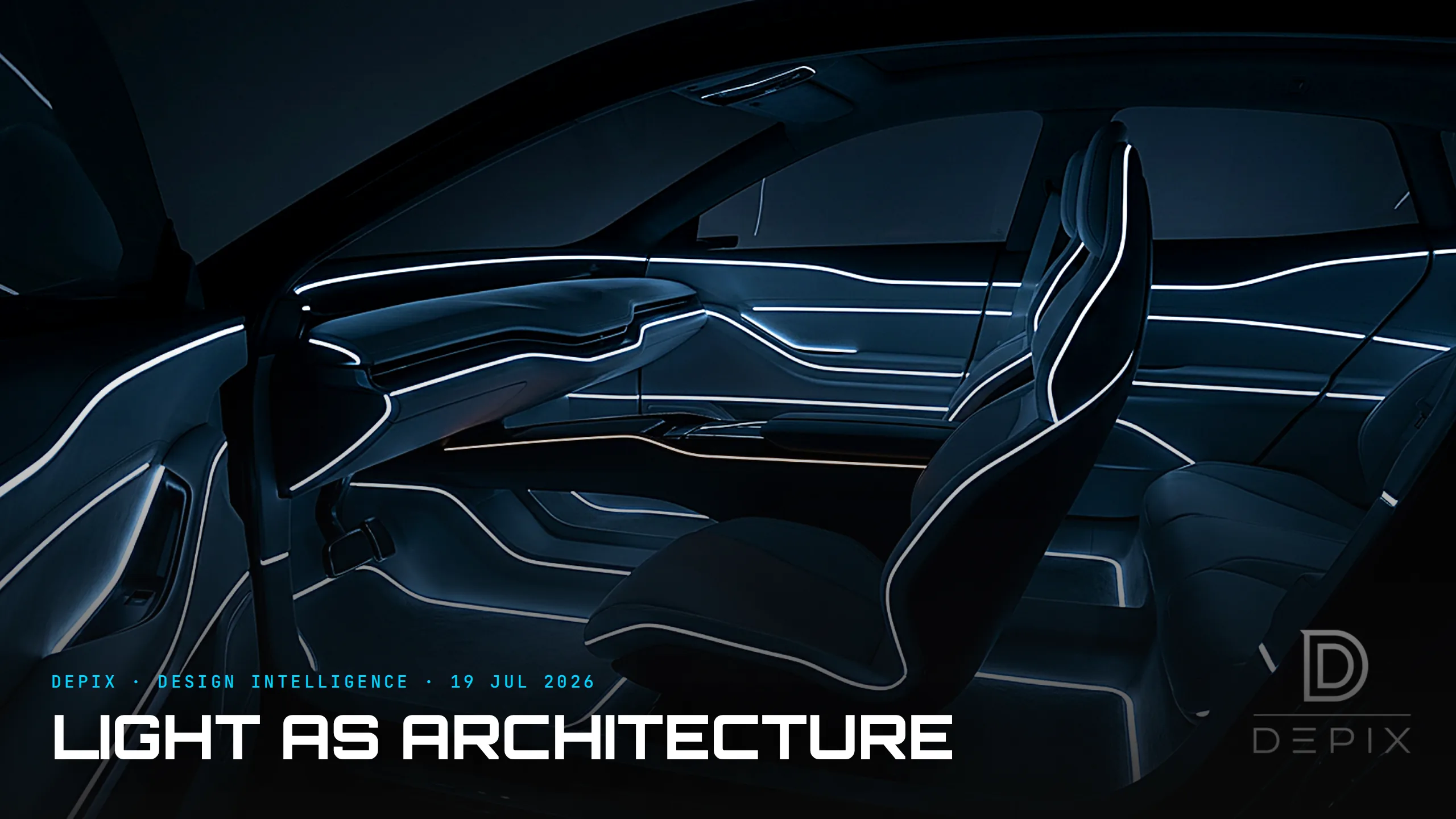
Start with what light does that we don't notice. A cabin's sense of space is not only its dimensions; it is how those dimensions are lit. A continuous line of light tracing the dashboard and doors reads the volume for you, making an interior feel wider, lower, more architectural — the same move architects use with cove lighting to shape a room without touching a wall. As cabins strip out chrome trim, physical buttons and busy surfacing in favour of clean, minimal volumes, light becomes the element that gives those blank surfaces form. The decoration is doing structural work.
Then there is communication, which is where it gets serious. Ambient light is turning into the car's new language — a programmable interface for safety and state. A red pulse along the door warns of a cyclist in your blind spot as you reach for the handle; a sweep of light guides your eye to a hazard the sensors caught; a colour shift tells you the car has taken over in autonomous mode. This matters most exactly where the industry is heading: as driving becomes partly automated, the car must constantly, wordlessly reassure its occupants about what it is doing. Light is the calmest, fastest channel for that — read pre-attentively, without a chime or a screen to look at.
And there is the body. Cabin lighting is increasingly designed around human physiology, not just taste. Circadian systems shift colour temperature with the time of day; soft blue-green wavelengths have measurable calming effects — lower heart rate and cortisol — genuinely useful in stop-start traffic. As the car becomes a place people spend passive time rather than only driving, wellness lighting stops being a spa gimmick and becomes part of what the cabin is for.
Here is why this belongs to the concept phase and not the accessories catalogue. Architectural light cannot be bolted on. To make a line of light look like part of the structure — seamless, even, with no visible LEDs or hot spots — you have to design the light guides, diffusers and addressable zones into the mouldings themselves, route the electronics through the trim, and decide where light will and won't live before the interior surfaces are locked. A cabin designed for light from the start looks effortless; one that has light added late looks exactly like what it is — strips stuck onto surfaces that were never meant to glow. The difference is entirely upstream.
There is a brand dimension too, and it is the same lesson we keep meeting. As chrome disappears and badges flatten, a signature lighting behaviour — the specific way a brand's cabin wakes up when you open the door, the choreography of its welcome sequence — is becoming a recognisable identity, the interior equivalent of a marque's exterior light signature. It is ownable, it works in the dark, and like every durable brand asset it only compounds if it is decided early and applied with discipline.
None of this makes ambient lighting immune to abuse. A cabin pulsing through a rainbow of sixty-four colours is still tacky, and more zones is not the same as better design. The discipline is restraint — using light to clarify the space and the car's intentions, not to decorate them. But the shift underneath the gimmick is real. Light is quietly taking over the jobs that trim, buttons and gauges used to do: defining the room, guiding the hand, communicating the state, calming the body. That is not decoration. That is architecture — and, like all architecture, it is decided in the first sketches, not the last.
Sources:
- ●Rina — Is Automotive Interior Ambient Lighting the Next Essential Feature?
- ●Valeo — Automotive interior lighting: from static to on-surface projection
- ●S&P Global — Intelligent automotive lighting: the car's new language
- ●Preh — Ambient lighting for car interior: design and safety
- ●EVKX — Ambient Lighting
- ●ACM — Dynamic Expressive Interior Lighting for In-Cabin Communication
- ●Automotive IQ — The changing mood in auto internal lighting
- ●FMI — Mood in Motion: How Ambient Lighting Is Transforming the In-Car Experience
- ●ams-osram — Intelligent Ambient Lighting Transforms Car Interiors
- ●Innotec — The Power of Illuminated Branding
- ●GM Insights — Automotive Interior Ambient Lighting System Market

The Retro Trap: How Heritage Design Becomes a Costume — and How the Best Brands Escape It
One Material: Why the Hardest Constraint Makes the Best Objects