Why AI Can Ace Your Email but Not Fold Your Laundry
Artificial intelligence can pass the bar exam and write working code, yet no robot can reliably fold a towel. That is not a temporary gap. It is a forty-year-old insight called Moravec's paradox.
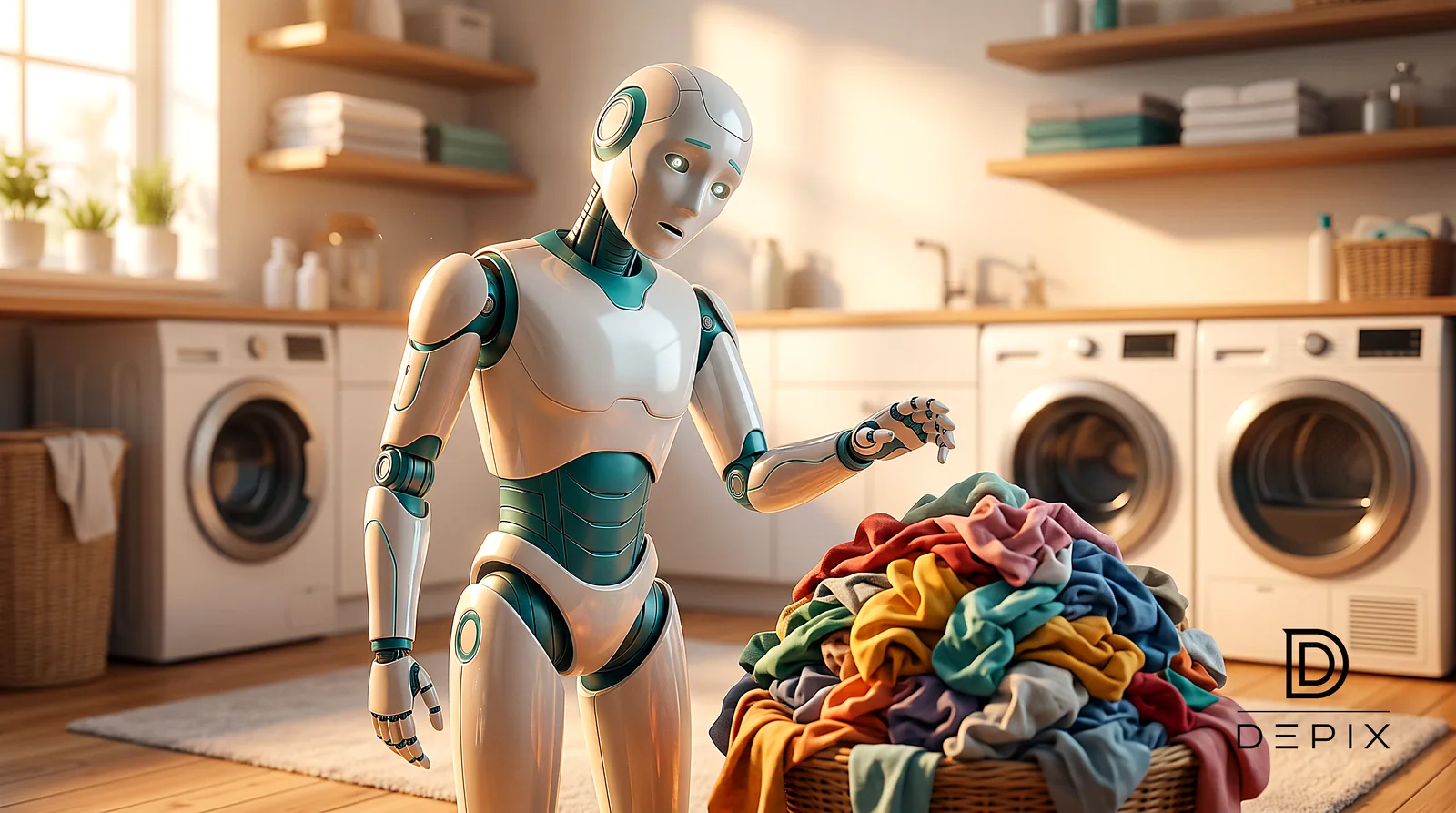
Here is a puzzle that ought to bother us more than it does. Artificial intelligence can draft a legal brief, debug software, summarise a medical paper and beat any human alive at chess. And yet, ask a robot to fold a basket of laundry, tie a shoelace or make a cup of tea in an unfamiliar kitchen, and it falls apart. The tasks we treat as signs of high intelligence turn out to be easy for machines. The tasks a four-year-old does without thinking turn out to be brutally hard. This backwards state of affairs has a name.
Moravec's paradox
In the 1980s, the roboticist Hans Moravec noticed something counterintuitive: it is comparatively easy to make computers do what we consider hard, such as high-level reasoning, and staggeringly difficult to give them the skills of a toddler, such as perception and movement. The observation became known as Moravec's paradox. His explanation was evolutionary. We have had hundreds of millions of years to perfect walking, grasping, seeing and balancing, so those skills feel effortless precisely because so much of the brain is quietly devoted to them. Abstract reasoning, by contrast, is evolutionarily recent and thin. We find it hard because we are barely practised at it, and it happens to be exactly the kind of neat, rule-bound work computers are built for.
The things a four-year-old finds easy are the things machines find hardest. That is not a bug in AI. It is the whole shape of the problem.
Why laundry, specifically, is a nightmare
Folding laundry is a perfect storm of everything robots are bad at. A pile of clothes has no fixed shape; it is a tangle of soft, floppy materials that deform the instant you touch them. Picking up a lace nightdress demands a completely different touch from unknotting a pair of stiff jeans, and no two piles are ever the same. Researchers make the point that this kind of contact-rich, deformable, endlessly variable manipulation cannot even be simulated well, which matters enormously, because so much of modern robotics learns inside simulations. A backflip can be perfected in simulation, where the physics is clean and repeatable. A crumpled towel cannot.
The demos that prove the rule
You may have seen videos of humanoid robots folding clothes, and they are genuinely impressive. But look closely at how they were made. A 2024 system learned to fold laundry only after training on tens of thousands of human-teleoperated demonstrations, and it still works slowly and under carefully controlled conditions. To gather that data, people literally strap cameras to themselves and spend their days folding towels so the footage can teach the machine. Set that beside a child who picks up the same skill in an afternoon, and the size of the gap becomes clear. We are not one clever algorithm away from a robot butler.
What this means for the "AI will do everything" story
Moravec's paradox is a useful antidote to both hype and panic. The jobs most exposed to today's AI are, ironically, many of the cognitive, screen-based ones we consider prestigious, because they live in the tidy digital world where AI is strong. The roles that look safest for now are the physical, dexterous, unpredictable ones we tend to underpay and undervalue: the electrician, the nurse, the plumber, the person who can fix a real thing with their hands in a space that was never designed for a machine. The AI that can write your emails is here. The one that can fold your laundry, reliably and cheaply, is still, quietly, science fiction.
So the next time an AI dazzles you by writing a sonnet or a slab of working code, remember the towel. The distance between drafting a contract and folding a shirt is the distance between what we built machines to do and what evolution spent an eternity teaching us. It turns out the hard problems were the easy ones all along.