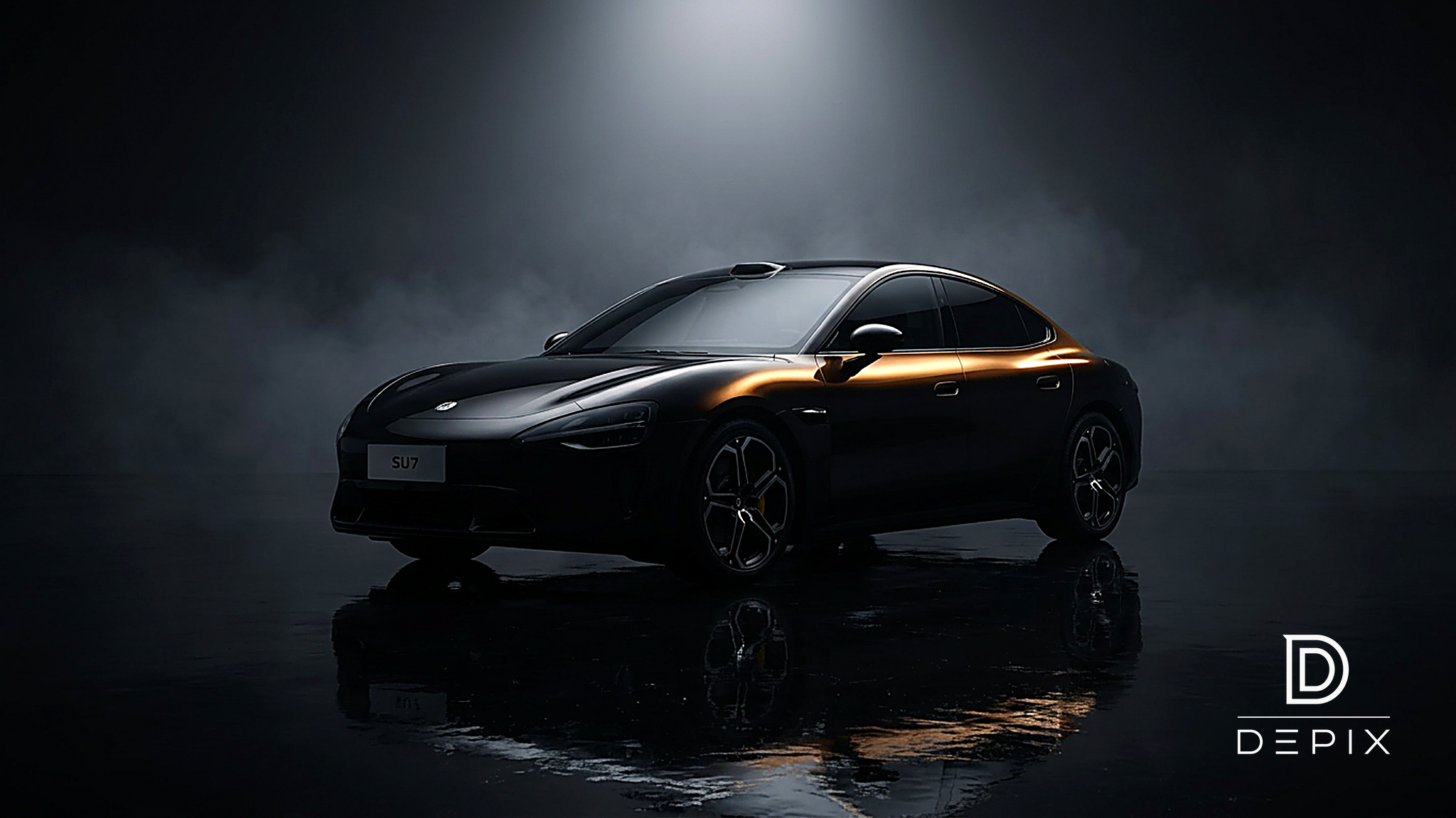
A Phone Company Made a Car the Design Press Couldn't Dismiss — Because It Imported a Discipline, Not a Heritage
For a century, the legacy automotive industry has guarded one moat it believed no outsider could cross: we have always made cars. The argument was never explicit, but it ran underneath every condescension toward a newcomer — that car design is a craft of accumulated heritage, of surfacing knowledge passed hand to hand through studios over generations, of a feel for proportion that you cannot buy and cannot import from another category. Then a company that until 2024 had made phones, rice cookers, and scooters built a sedan, and the design press — the same press that has spent decades dismissing Chinese cars as derivative — could not bring itself to dismiss it. This is a brief about why the moat turned out to be thinner than the studios assumed, and about what a phone-maker actually imported when it crossed the line onto sheet metal.
Xiaomi unveiled the SU7 on 28 December 2023 and opened orders on 28 March 2024 (Wikipedia / Xiaomi SU7, corroborated by CnEVPost, published 25 January 2025). It was the company's first car. Within 24 hours of pricing it took roughly 89,000 orders; it delivered 139,547 units in 2024, crossed 150,000 cumulative deliveries by January 2025, and the SU7 series passed 381,000 vehicles by February 2026 (CnEVPost, 25 January 2025; Wikipedia / Xiaomi SU7). Its second car, the YU7 SUV, launched 26 June 2025 and took over 200,000 orders in three minutes (CnEVPost, published 26 June 2025). By the close of 2025 Xiaomi's auto-and-AI segment had cleared ¥100 billion in revenue for the first time, delivered around 411,000 vehicles, and posted a segment gross margin of 24.3% — higher than its major Chinese EV rivals (Gasgoo, published 2026; Bloomberg, published 20 November 2025; Caixin Global, published 25 March 2026). A first car. From a phone company. At a gross margin most heritage carmakers would envy.
Sit with the thing that should be impossible here. Not the sales — sales can be bought with price. The thing that should be impossible is that the design held up. The car was not a styling embarrassment that sold anyway. It was a car the harshest design audience in the world looked at and, grudgingly, respected.
What actually happened
The hard facts, each web-verified with a real publication date:
Xiaomi did not hire car-stylists from nowhere — it imported a specific surfacing discipline. The SU7's lead designer is Tianyuan "Sawyer" Li, recruited from BMW, where he worked on the iX and the i-series concepts; exterior work was led by James Qiu, previously on the Mercedes-Benz Vision EQXX; and Chris Bangle — BMW's chief of design from 1992, the most consequential and most polarising car designer of his generation — joined as a strategic design consultant to Xiaomi EV (Hypebeast, published December 2023; Auto&Design / autodesignmagazine.com, published January 2024; Wikipedia / Xiaomi SU7). This matters precisely because it is not "a phone company guessed at car design." It is a phone company that bought, intact, a coherent body of proportion-and-surface knowledge — and then ran it through a product-design culture that already knew how to ship to a tolerance.
The press reached, immediately and repeatedly, for a Porsche. Top Gear noted "serious hints of Porsche Taycan." Reviewers called it "kind of like a budget Porsche Taycan," pointed at "the front... and those side vents – all very Porsche," and described the controls as having "a Porsche Taycan-like feel" (Top Gear; Carwow / Mat Watson). Xiaomi itself confirmed it benchmarked the car against the Porsche Taycan and Tesla Model S (Wikipedia / Xiaomi SU7). The plagiarism debate is real and it is not nothing. But read what the accusation concedes: nobody compared the SU7 to a bad car. The reflex insult the design world reached for was to liken a phone-maker's first attempt to one of the best-resolved performance sedans ever drawn. That is not how the press dismisses a car. That is how it admits a car got the proportions right and resents it.
The numbers under the skin were product-design numbers, not styling flourishes. The SU7 claims a drag coefficient of 0.195 — pitched as the world's lowest for a production car — on a 4,997 mm fastback body with a 3,000 mm wheelbase (Wikipedia / Xiaomi SU7; iGeekphone). A 0.195 Cd is not a stylist's win; it is the outcome of obsessive, sub-millimetre detail consistency across the whole surface — exactly the discipline a phone company learns shipping a billion unibody handsets where a 0.1 mm panel gap is a defect, not a rounding error.
And the design chief's defence was the whole thesis, stated out loud. Confronted in July 2025 with the Chinese-internet nicknames "Mi-shijie" (Porsche-Xiaomi) and "Fala-mi" (Ferrari-Xiaomi), Tianyuan Li did not litigate the resemblance. He reframed it — "It's often not our memory that makes something unforgettable, but the emotional imprint it leaves in that moment" — and, more pointedly, argued that Chinese automakers' lack of historical design baggage is an advantage, that the EV transition lets local designers "leap ahead" without the legacy industry's constraints (CarNewsChina, published 10 July 2025). The newcomer is not apologising for having no heritage. He is naming it as the edge.
Why a design leader should care
The instinct in a legacy studio is to file this under "China, price, scale" and move on — to treat the SU7 as a story about a cheap market and a deep-pocketed entrant, not a story about design. That instinct is the trap. The uncomfortable fact is that the part the studios were sure was protected — the craft of getting a car's form right — is the part that transferred. The phone company did not out-spend its way to good proportions. It imported a discipline and the proportions came with it.
Here is the asymmetry a design chief should sit with. The legacy moat — "we've always made cars" — is a claim about heritage: accumulated time, institutional memory, a lineage of studios. But the SU7 demonstrates that what actually produces a credible car is not heritage; it is decision-quality — the per-decision rigour about proportion, surfacing restraint, and detail consistency. And decision-quality is portable across categories in a way heritage is not. A company that has spent fifteen years making thousands of high-tolerance, restraint-led product decisions on phones has built exactly the muscle that car design rewards. The heritage was a proxy for the discipline. When a newcomer arrives already carrying the discipline — from another category entirely — the proxy stops protecting anyone.
That is why the press couldn't dismiss the car, and why the dismissal would have been the comfortable outcome for the incumbents. A car that is visibly a phone-company fumble confirms the moat. A car that draws a Porsche comparison out of a hostile reviewer's mouth dissolves it. The SU7's design credibility is not a fluke of one good hire; it is evidence that the thing the studios were charging a heritage premium for can be assembled, deliberately, by a disciplined outsider in a single product cycle.
This brief is its own axis. It is not the wheel/steering-feel brief (#180), which was about a sensation — feedback through the hands — being severed and needing redesign. This is about design credibility itself as the portable asset: not a feeling inside one car, but the transferability of an entire design discipline across an industry boundary the legacy players believed was sealed. And it is not a story about Xiaomi's price undercutting Tesla; the price is the volume engine, but the price is not why a Top Gear writer reached for "Taycan." The axis here is narrow and specific: a coherent product-design discipline — proportion, surfacing restraint, detail consistency — imported from phones onto sheet metal faster than the industry believed possible, because the underlying decision-quality was already high.
The Design-Intelligence read
Be exact about what DEPIX does and does not claim. DI does not draw the SU7, does not author surfacing, does not replace a Tianyuan Li or a Chris Bangle — the eye, the taste, the hand that resolves a fastback's shoulder line is the studio's, and on craft they will be right. What the Xiaomi case proves is the thing DI is built on: that design credibility is a function of decision-quality, and decision-quality compounds when every decision is seen, in context, before it is committed. Xiaomi's edge was not a secret styling gene. It was a culture that treats each design choice as a high-tolerance decision to be evaluated against the real thing it will ship as — the discipline a product-design house lives by and a heritage studio can lose precisely because heritage lets it coast.
The SU7 surfaces the three questions DI exists to answer, and when:
- ●Is the proportion actually right — or does it only look right in the studio? A phone-maker won here by treating proportion as a measured decision, not a felt one. DI lets a design leader see a proposed stance, surface, and detail rendered at finished fidelity, in real context, before the tooling commits — the same instrument the disciplined newcomer used, made available to the incumbent.
- ●Is the detail consistent across the whole object — or only where the eye was looking? The 0.195 Cd is a detail-consistency story. DI's value is that it makes the whole surface visible at decision time, so the discipline that wins is not left to the one panel the reviewer happened to photograph.
- ●Are we charging a heritage premium for a discipline a competitor can import? This is the CEO-level question. If "we've always made cars" is the moat, DI's read is blunt: the moat is decision-quality, not lineage — and a parallel design team that lets you make more, better, faster-evaluated decisions is how you defend it, because the outsider is already doing exactly that.
The phone company did not beat the car industry at a game it didn't understand. It beat the industry at the industry's own game — proportion, restraint, detail — by bringing a discipline the industry had let curdle into heritage. The legacy moat was real once. It is now exactly as wide as the gap in decision-quality between a studio that sees every choice before it commits and one that trusts its lineage to carry it. Xiaomi just measured that gap, in public, on sheet metal — and the design press could not look away.
Sources: Wikipedia / Xiaomi SU7; CnEVPost (25 Jan 2025; 26 Jun 2025); Hypebeast (Dec 2023); Auto&Design / autodesignmagazine.com (Jan 2024); CarNewsChina (10 Jul 2025); Top Gear; Carwow / Mat Watson; iGeekphone; Gasgoo (2026); Bloomberg (20 Nov 2025); Caixin Global (25 Mar 2026). LinkedIn (Unipile, category=posts, "Xiaomi SU7 design"): live results returned, incl. a GCC-market SU7 resale listing dated ~3w prior — confirming the car has reached Gulf secondary markets, a signal of design desirability beyond the home market.

The Windshield Is the Last Clear Surface — and Now It's a Design Decision
For a Hundred Years the Wheel Told the Driver the Truth. The Link Just Broke — and Now Someone Has to Design the Feel


