The World Cup's most engineered product is a lawn.
date: 2026-07-05
The World Cup's most engineered product is a lawn.
Eleven of North America's biggest stadiums spent this summer tearing out perfectly good artificial turf to grow a lawn. Not because the turf failed. Because FIFA said the most watched object at the 2026 World Cup would not be the ball, the boots or the kits. It would be the grass underneath all of them.
That sounds like sentimentality. It is the opposite. The 2026 pitch is the most quietly over-engineered product on any host site, and the decision that shaped it was made years before a single ball was kicked.
Start with the constraint FIFA refused to bend: World Cup matches are played on natural grass, full stop. Most of the US venues are NFL stadiums running synthetic turf, and several of those sit under fixed or translucent roofs that starve real grass of sunlight. So FIFA did not improvise in June. It ran a five-year sports-turf research programme with the University of Tennessee's Center for Athletic Field Safety and Michigan State's turf-management group, led by Professor John "Trey" Rogers, to answer one concept-phase question: what surface can survive a month of elite football indoors, and how do you build it?
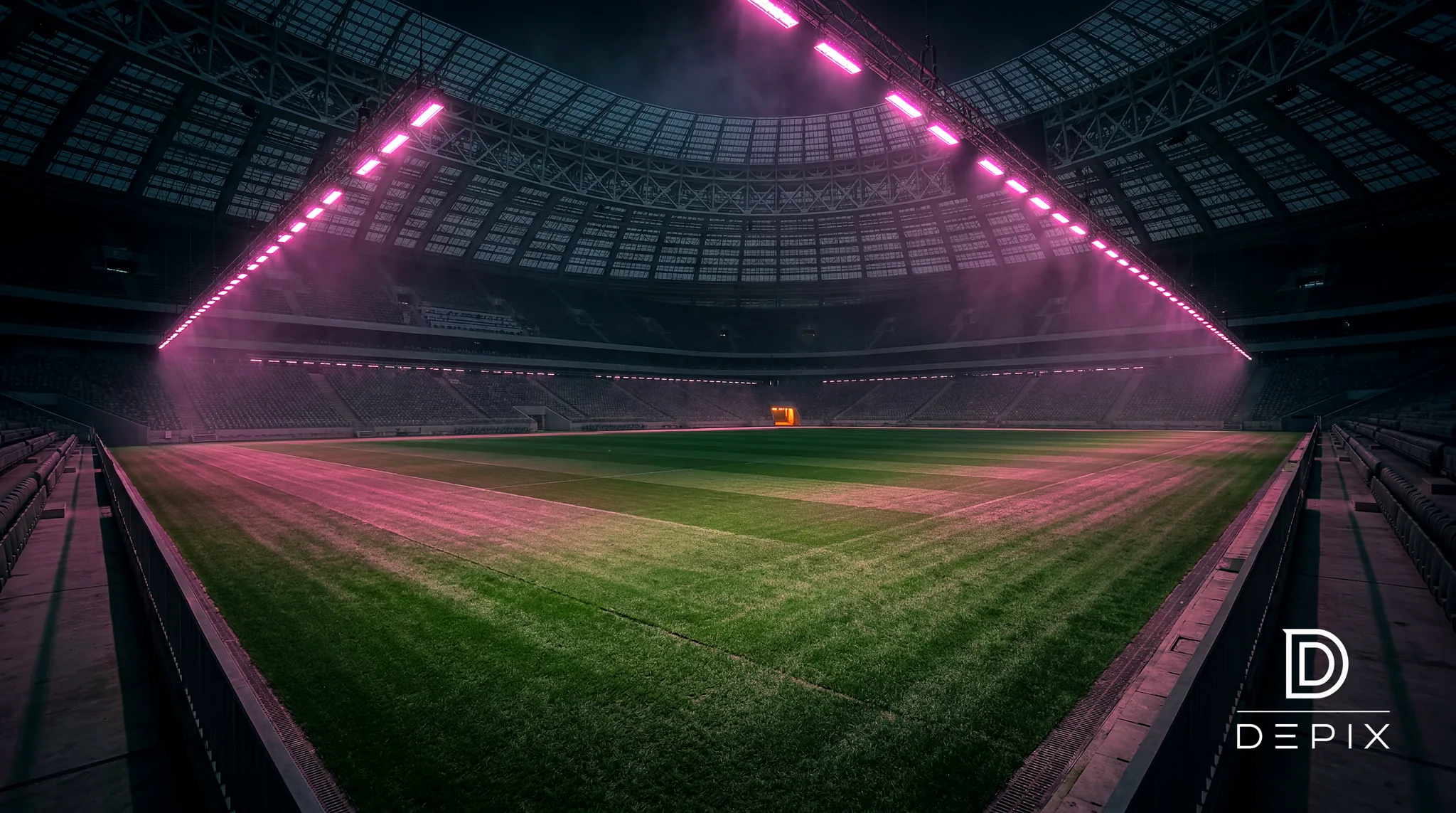
The answer is a product, not a field. Warm open-air venues got Bermudagrass. Cooler and covered venues got a Kentucky bluegrass and perennial ryegrass blend, roughly 95 percent grass reinforced with about 5 percent synthetic fibre so studs do not tear it apart. At AT&T Stadium in Arlington, the bluegrass-rye carpet was grown in Colorado, trucked in, and laid on a raised platform that sits 24 inches above the concrete floor, over an irrigation and ventilation stack. Because the roof blocks daylight, 18 pink LED grow lights hang from the ceiling and run about 12 hours at a stretch to keep the grass alive between its nine matches. At SoFi, the team stacked a Permavoid drainage system, geotextile, sand and hybrid sod on top of the existing NFL turf, floating the pitch roughly two feet above the surface it covers. Seattle built six inches of sand base right on the FieldTurf, then rolled out sod grown on a farm in Moses Lake.
There is a second forcing function most fans never see. A World Cup pitch is 68 metres wide against the roughly 48.8-metre NFL field, about 19 metres wider. That gap is why venues had to remove seats and reconfigure bowls to make the wider surface fit. The grass decision reached all the way into the architecture.
Here is the controversy. The World Cup just proved, on live television, that a domed NFL stadium can hold a healthy natural pitch for a month. Players noticed. NFLPA voices and stars like George Kittle have used it as evidence that synthetic turf was always a choice, not a necessity, on fields where they take the injuries. FIFA, chasing a broadcast look, has handed the NFL's own athletes their strongest argument in years. A tournament's grass programme became a labour talking point.
The design-intelligence lesson is the part worth stealing. The pitch could not be fixed mid-tournament. Grass species, tray depth, drainage profile, light spectrum, the two-foot raised platform, the seat removals, all of it had to be decided in the concept phase, then validated at real trial events before it mattered. Get the surface wrong and there is no patch, no over-the-air update, no June rescue. The venues that will look flawless in the final are the ones that decided the surface early and actually saw it tested under load.
That is the whole DEPIX argument in a single lawn. The expensive mistakes are the ones locked in before anyone looks. Deciding design intent early, and being able to see and pressure-test it while it is still soft, is the difference between a product that holds up under a billion eyes and one that gets taped over. It is true for a grow-light-fed pitch in a Texas dome. It is just as true for the surface, the stance and the silhouette of a car.
The ball gets the branding. The grass got the engineering.
Sources
- ●How FIFA is engineering natural grass for the 2026 World Cup — Scientific American
- ●World Cup grass in NFL stadiums stirs debate over field surface — ESPN
- ●'Dallas Stadium' unveils natural grass field under pink grow lights for World Cup — WFAA
- ●How stadiums transformed turf fields to grass for 2026 World Cup — NBC Los Angeles
- ●Bringing UT's Turfgrass Expertise to FIFA World Cup 26 — University of Tennessee
- ●NFLPA Calls Out Owners As Stadiums Swap Turf for World Cup Grass — Yahoo Sports

FIFA is cramming a Super Bowl into football's 15 minutes

The World Cup's 'free' fan zone is its most designed product
