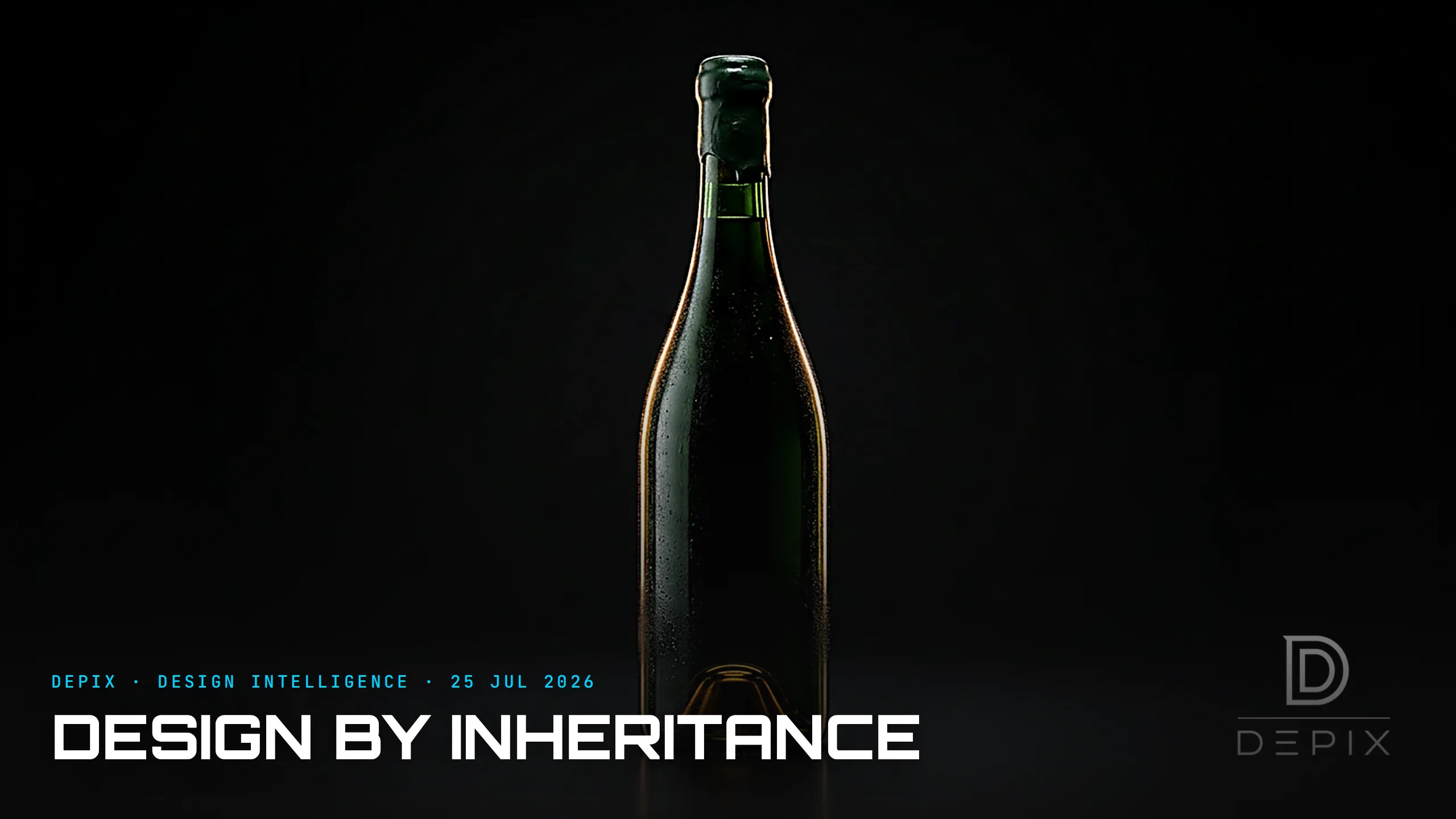
Design by Inheritance: Why the Wine Bottle Was Never Redesigned
Pick up a bottle of wine and you are holding one of the most conservative objects in modern design. Almost nothing about it was chosen by anyone alive. The wine bottle is a stack of inherited conventions — the shape, the size, the weight, the dimple in the base, the cork — and most of them stopped doing their original job a long time ago. It is, quite literally, designed by inheritance rather than by intention: the opposite of a concept-phase object.
Start with the punt, the dimple pushed up into the base. Ask ten people what it's for and you'll get ten confident, contradictory answers: it strengthens the bottle, it collects sediment, it helps you pour, it let hand-blown glass stand flat. Some of those were once true. For a modern, machine-made still-wine bottle, the punt is largely vestigial — it survives because a deep punt signals "serious wine," and a flat base reads as cheap. It's a feature that now exists to communicate, not to function.
Then the size. The 750ml standard has a tidy origin myth (the lung capacity of a glassblower) and a duller real one (old trade units, later harmonised by regulation). Either way, nobody today derives 750ml from first principles — it's the number everyone agreed on and stopped questioning. The heavy glass is the same story: dark colour once shielded wine from light and still helps a little, but the sheer WEIGHT of a premium bottle is pure signal. A heavier bottle "feels" more expensive, so producers add glass — and, with it, a large share of wine's carbon footprint, for a benefit that lives entirely in the hand.
The cork) is the sharpest example. It's a genuinely lovely material, but as a closure it has one serious flaw: cork taint, the musty TCA contamination that spoils a meaningful fraction of all bottles. The screw cap) solves it outright — no taint, a consistent seal, trivially easy to open — and yet decades after it was proven, it still reads as "cheap" to much of the market. The engineering problem was solved; the SEMIOTIC problem wasn't. That gap is the whole story.
Here's the contrarian point. We treat the wine bottle as though its form follows function, but most of its form now follows MEANING. The Bordeaux bottle's high shoulders and the Burgundy bottle's sloping ones tell you the grape and the region before you've read a word — genuinely useful, but a signal, not a physics requirement. Even the Champagne bottle's thick glass and deep punt, which really do fight internal pressure, get copied onto still wines that have no pressure to contain. The bottle is a text you learn to read, every element doing semiotic work the drinker rarely notices.
Which is exactly why redesigning it is so hard. The people who've tried — flat bottles that fit through a letterbox, boxed wine that keeps better and travels lighter, canned wine, lightweight glass — keep discovering they aren't fighting an engineering problem. Bag-in-box is, on almost every functional axis, a better package: it protects the wine from oxygen for weeks, weighs a fraction, ships far more efficiently. It has also been trapped for decades at the bottom of the market, because the box says "not serious" as loudly as the punt says "serious." The redesign that wins on function loses on meaning.
This is the concept-phase lesson hiding in a wine aisle. When a form's real job has quietly migrated from function to signal — and it happens more often than we admit — redesigning the object means redesigning what it MEANS, not just what it does. Get that wrong and your objectively-better product dies at the shelf, misread. Get it right and you're not changing the bottle; you're changing the story it tells, and letting the new form inherit the old meaning.
The wine bottle looks like tradition resisting design. It's really a reminder that the hardest design decisions aren't about the object at all — they're about the meaning we quietly loaded onto it, decades ago, and never went back to choose again.
Sources:

Who's Next Paris 2026: The Real Runway Is the Order Book

The Most-Handled Design in the World: Why a Banknote Is a Security Problem Wearing Art