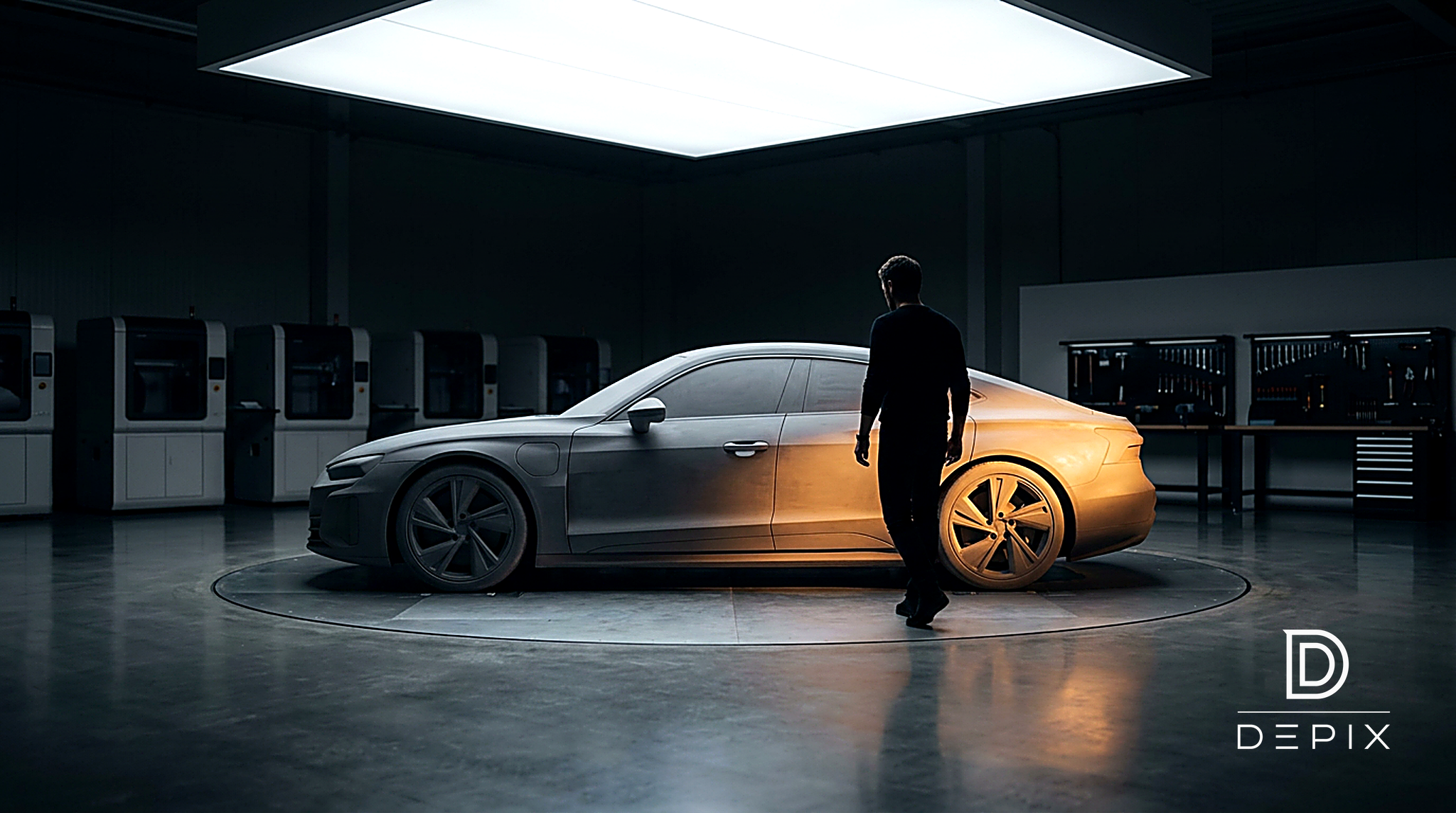
The light tunnel still sees what the render can't.
Every design studio has a room most outsiders never see. No clay, no screens, no plotters. Just a long dark corridor lined with arcs of overhead light, a slow turntable, and a single rule: walk the length of it and watch what the highlight does. This is the light tunnel, and for forty years it has been the place where a surface is finally judged true or sent back. In 2026 a quiet argument is running through every studio about whether that room still earns its floor space.
The case against it is strong and getting stronger. Real-time ray tracing has stopped being a marketing demo. Studios are now reviewing surfaces inside engines like Unreal, driven by NVIDIA RTX hardware, that resolve reflections, soft shadows and material response at interactive speed. Spectral renderers such as Eclat Digital push it further, simulating the actual physics of light through paint flake, clearcoat and chrome rather than approximating it. You can drop a virtual body into a tunnel, a showroom, a Tuscan road or an overcast car park and watch the highlights move, without a single panel being painted. The pitch is irresistible to anyone running a budget: why heat, light and staff a physical hall when the GPU shows you the same reflection a week earlier and a continent away?
Because it does not show you the same thing. And the gap is exactly where design decisions get made.
A reflection is not an image. It is a behaviour. The reason a surface gets walked, not photographed, is that the meaningful information lives in motion: the rate at which a highlight slides down a flank as you pass, the precise instant two reflected light arcs pinch together over a shoulder line, the way a slightly hollow section makes the world appear to stretch and snap back. A render shows you a frame. The tunnel shows you the rate of change of the frame, read by an eye that has spent thirty years learning what a good one feels like. Pause-and-orbit on a screen flattens that into a slideshow. The crawl is the signal, and the crawl is what the monitor quietly throws away.
There is also the problem of the perfect lie. A digital surface is mathematically clean before anyone decides it should be. The render obeys the math; it cannot tell you the math is wrong, only that it is consistent. Physical light is indifferent and therefore honest. It does not know what the surface was supposed to do, so it cannot flatter it. That indifference is the whole point of the room. The moment a tool is built to make surfaces look good, it stops being able to tell you when they are not.
None of this is an argument against the screen. It is an argument about sequence. The expensive, slow, physical judgement should be the last thing you spend, not the first. The mistake studios keep making is the opposite: they pour weeks into clay and paint and tunnel time to discover a reflection problem that a good light simulation would have flagged on day three. The reflection room should confirm a decision, not go looking for one.
That is the case for moving the hard surface calls upstream, into the concept phase, where they are cheap to change. Pulling a form into a photoreal, physically lit environment early, and reading how its reflections actually behave before any commitment to clay, is not about replacing the eye in the tunnel. It is about not wasting that eye on problems that should have been caught when the surface was still an idea. Get the reflection conversation started while the body is still a decision rather than an object, and the tunnel goes back to doing the one thing it is unbeatable at: the final, human, walking yes.
The studios winning this argument are not the ones choosing the room or the render. They are the ones who decided which question belongs to each. The screen is where you explore. The tunnel is where you commit. Confuse the two and you either ship a surface the GPU loved and the eye hates, or you burn a month proving something a simulation already knew. The room is not obsolete. It has simply been promoted to the only job no render has earned yet.
Sources
- ●Real-time ray tracing in Unreal Engine — automotive design and visualization
- ●What is real-time ray tracing? — Unreal Engine
- ●Identifying materials and reflections inside a car cabin — Eclat Digital
- ●A Practical Methodology for Accuracy and Quality Evaluation of Structured Light Systems in Automotive Inspection — Machines (MDPI), 2025

One strip of tape still sets the car's whole line.

The whole car is drawn around one point beneath your hip.