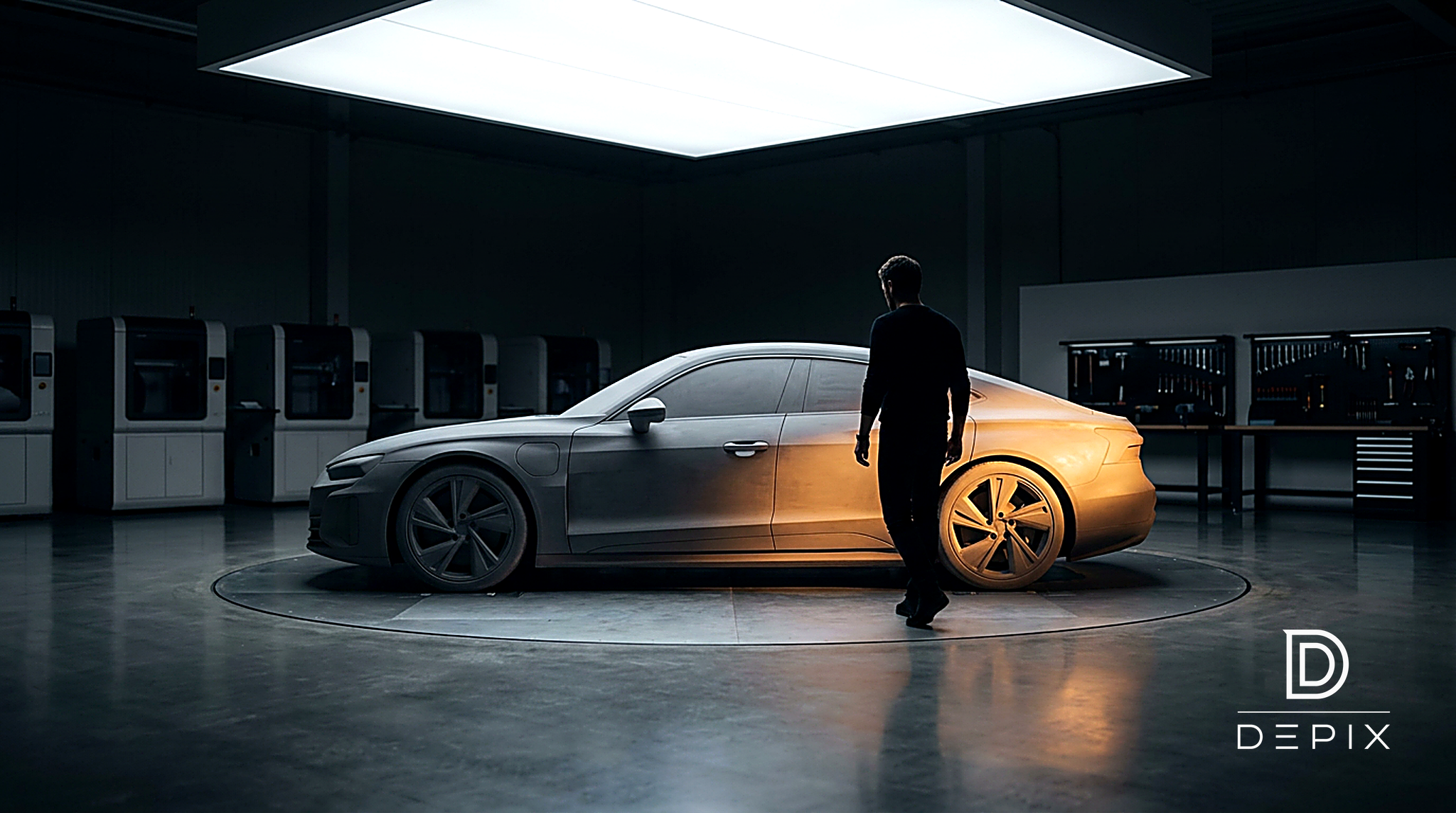
Pixels hide proportion. So studios still build the car.
Every other part of the design studio went digital years ago. Sketching moved to the tablet. Surfacing moved to Alias and ICEM. Review moved to powerwalls and, increasingly, to headsets. And yet, at the most expensive moment in a car programme, studios still do the most analogue thing imaginable: they build the whole car at full size, in the room, in the metal or the foam or the milled clay, and they walk around it in daylight. In 2026, with rendering this good, that should be an embarrassment. Instead it is the quiet consensus of the trade.
The reason is brutally simple and worth saying plainly: a screen lies about proportion. A monitor flattens the very thing a car designer is paid to judge. Stance, the relationship of wheel to arch, the fall of a shoulder line across six metres of bodyside, the way a roof tapers as you move past it, the honest volume of a haunch under a real sky, none of these survive the trip through a 24-inch panel and a fixed focal length. The render looks resolved. The full-size model reveals that it isn't. Tactile, walk-around, light-and-shadow feedback settles arguments that software leaves permanently open.
What has actually changed is not whether studios build, but how fast and how cheaply. The hand-sculpted clay buck has not disappeared, but it now shares the floor with a printer farm. Look at a contract studio like the UK's Vital Auto, which turns OEM concepts into physical form for brands that don't have the time to experiment themselves. Its model shop runs more than a dozen large-format FDM machines alongside SLA and SLS printers, churning out full-size design prototypes, assembly fixtures and ergonomic jigs in days rather than the weeks a traditional milling schedule used to demand. The clay model and the printed model are no longer rivals. A refined digital surface is often a scan of a hand-sculpted clay; a printed buck is often the fastest way to interrogate a digital surface. The loop runs in both directions.
That loop is the real design-intelligence story, and most teams are getting the economics of it wrong. The temptation, with additive manufacturing this capable, is to print everything and print early, treating the physical model as a glorified output device for whatever the CAD spat out last night. That is expensive theatre. A full-size print of an unresolved proportion teaches you only that the proportion was unresolved, at the cost of a cubic metre of polymer and three days. The studios that win treat the physical build as a verdict, not a draft. They resolve as much as they honestly can in the digital model, then commit to the metal precisely when the decision genuinely needs a body in the room to be made.
Which is exactly where the concept phase quietly decides a programme's cost. The most ruinous mistake in modern car development is carrying three or four proportionally similar themes deep into the build stage because nobody could tell, on screen, which one actually had the stance. Every printed buck that exists only to break a tie you should have broken earlier is a tax on indecision. This is the work DEPIX is built for: pushing the proportion fight as far as it can honestly go in the concept phase, so the full-size model arrives to confirm a strong direction rather than to referee a vague one. The physical build is most valuable when it has the fewest jobs to do.
So the future of the studio is not the death of the physical model. It is the opposite. Faster printers mean studios will build more often, in more variants, earlier in the timeline, precisely because the model is the only instrument that doesn't flatter the design. The skill that becomes scarce is not modelling. It is judgement: knowing which decisions a screen can be trusted to make, and which ones still demand a body in the room and a designer walking around it with the light moving across the surface.
The render is the argument. The full-size model is the ruling. Pixels will keep getting more beautiful, and they will keep hiding proportion, and that is precisely why the most digital studios on earth still build the whole car before they believe it.
Sources
- ●Why clay modeling still shapes 2026 car design in studios
- ●What is the future of clay modelling? — Car Design News
- ●Road to the 3D Printed Car: How 3D Printing is Changing the Automotive Industry — Formlabs
- ●2026 Guide to 3D Printing Automotive Parts: Processes and Materials — RapidDirect
- ●Automotive 3D Printing Solutions — Stratasys

The whole car is drawn around one point beneath your hip.

AI can build the surface. It can't decide it's right.
