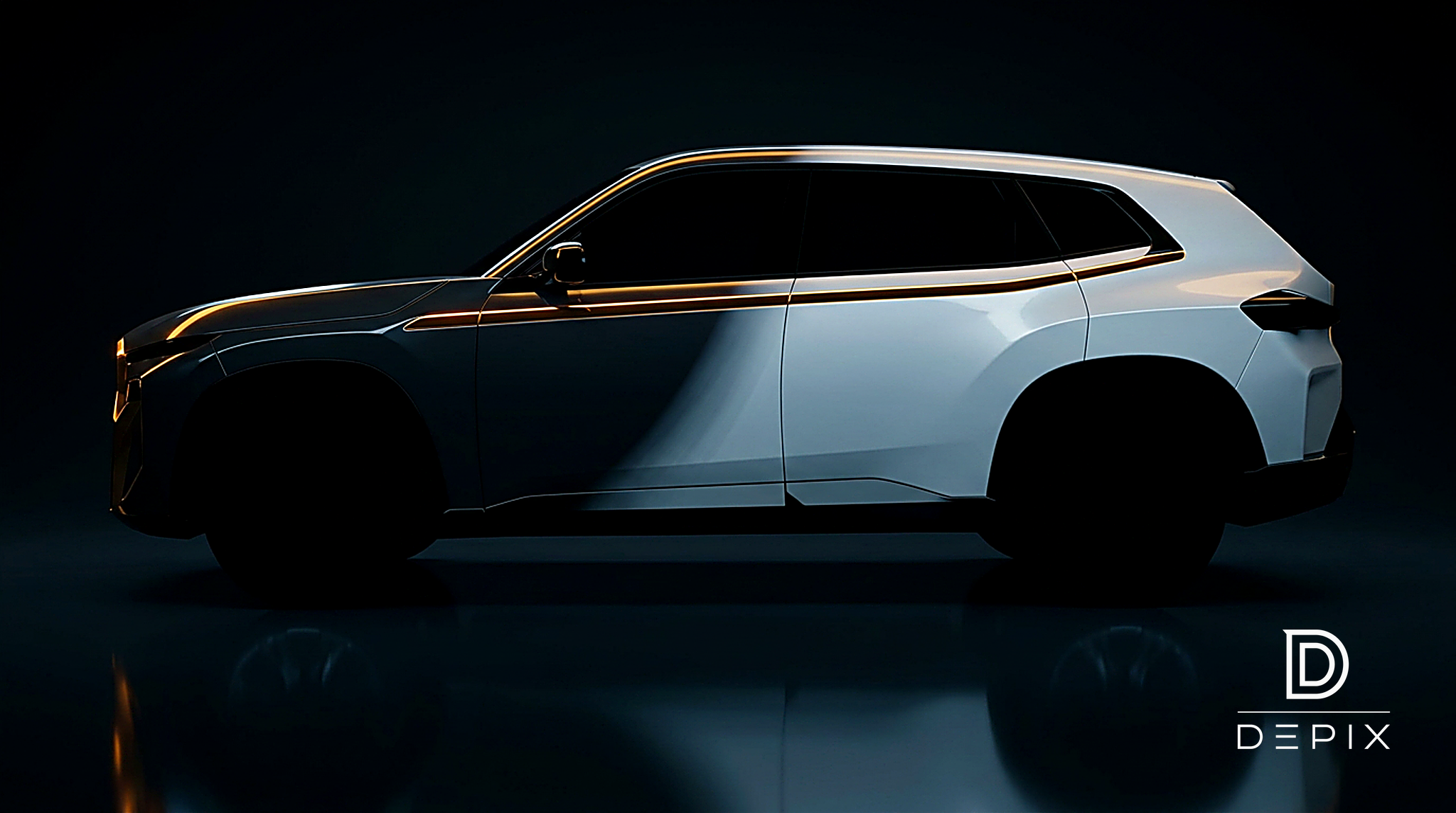
The grille has no job left — so the studio gave it the hardest one on the car
The opening that cooled the engine for a hundred years no longer cools anything. The electric car deleted the function and kept the face — then turned the most-photographed surface on the vehicle into a 942-pixel light show. There is just one problem with the glowing grille every brand is now racing to build: in most of the world it is illegal to switch it on while you drive. The render shows it lit. The road shows it dark.
For a century the grille had exactly one job and everyone understood it. It was a hole. Air went through it, over a radiator, and the engine didn't melt. The shape of that hole became, almost by accident, the single most powerful piece of brand recognition ever stamped into metal — the BMW kidney, the Mercedes louvre, the Cadillac egg-crate, the Jeep seven slots. You could identify a car at 200 metres, in the dark, from the front, by a pattern of negative space designed to do nothing but let air past.
Then the electric car arrived and quietly removed the one reason the hole existed. An EV battery and motor still need cooling — but far less of it, channelled through a small managed inlet, not a barn door across the whole nose. The function evaporated. The face did not. And so the grille became the strangest object in the design studio: a hundred-year-old brand signature with no remaining purpose, sitting on the most valuable real estate on the car, waiting for someone to decide what it is now for.
A peer-reviewed study already found the front fascia is now the dominant carrier of EV brand identity. So this is not a small decision. It is the decision — the face of the brand, made of a part that no longer does anything. And the industry has produced four mutually exclusive answers, all of them shipping in 2026, all of them looking magnificent in exactly one state: the still photograph.
Four answers to "what is a grille for now?"
Light it up. This is the loudest answer and the fastest-growing. Mercedes' new electric GLC wears an illuminated grille of 942 individually lit square segments — a backlit lattice that nods to the W108/W109 proto-S-Class mesh of the 1960s, optional with a "smoked-glass effect" (InsideEVs / Motor1, 8 Sep 2025; Auto Express, 9 Sep 2025). Mercedes has made it doctrine: the lit grille will spread to the electric C-Class (2026) and E-Class — and crucially, it is now applied to combustion cars too, so the EV and ICE versions "look the same" on the skin (AOL, 8 Sep 2025). BMW is going further still, killing chrome across the Neue Klasse in favour of its "Iconic Glow" lit kidney — already on the X3, X5, X6, 5 Series and 7 Series. BMW Neue Klasse lead designer Sebastian Kroes put the entire thesis in five words: "Chrome doesn't work at night. Light does." (AOL, 19 Mar 2026). Cadillac's Escalade IQ ships a fully illuminated crystal grille with choreographed approach-and-exit lighting (EVsoup, 14 Apr 2026).
Seal it shut. The opposite answer: delete the grille entirely, body-colour the whole nose into one smooth aerodynamic shield, and let the lighting signature live in the headlamps. This is the efficiency play — a closed face is a faster face — and the one a peer-reviewed front-fascia study says now carries the brand. The risk is sameness: with no hole to shape, every sealed EV nose drifts toward the same smooth egg.
Fake it. Keep a grille-shaped texture — a moulded mesh, a pattern, a "grille" that is a closed plastic panel pretending to be an opening — because the recognition cue is worth more than the honesty. This is the most-mocked answer (the "vestigial grille," the grille on a car that has nothing behind it) and quietly the most common, because deleting the brand's most recognisable feature is a risk no product planner wants to sign.
Hide the machines behind it. The newest answer, and the one that will win on engineering merit: the front face is no longer a cooling hole or pure decoration — it is the housing for the car's senses. Radar, the forward camera, the cleaning nozzles, and the active grille shutters that open and close on demand all live behind that surface. The active-grille-shutter market alone was $2,920.98 million in 2025, on its way to $4,846.04 million by 2032 at a 7.5% clip (Reanin, "Automotive Active Grille Shutter Market," accessed Jun 2026) — proof that the "deleted" cooling function didn't vanish, it went behind a motorised flap the customer never sees move. The face has to be sensor-transparent, thermally functional, and beautiful, all at once.
The thing the render gets exactly, perfectly wrong
Here is the trap, and the illuminated grille walks straight into it.
Every reveal image, every configurator hero, every billboard shows the grille lit — pixels blazing, crest glowing, the welcome sequence frozen at its most theatrical. It is the entire reason the feature exists: a face you recognise in the dark. And it is the one state the law will not let you drive in.
In the United States, FMVSS 108 governs what colour and kind of light may show from the front of a moving vehicle — broadly white or amber — and the agency's standing position is that added lighting must not interfere with required lamps or create glare; many US states layer their own restrictions on decorative front lighting on top of that. In Europe, every forward-facing lamp must be UNECE type-approved by function and colour; an arbitrary glowing panel is not an approved lamp. The manufacturers know this, which is why the feature is engineered to defeat itself: BMW's Iconic Glow switches off the instant you start the car. It illuminates on approach, glows while the car is parked and unlocking, and "the lighting goes out automatically as soon as all doors are closed and the engine is started" — and on certain models, "for reasons of approval, the light carpet must be deactivated on one side" with "diffuser foils... glued in the lower part of the kidney frame" to pass homologation (BMW configuration/approval guidance via Passport BMW, accessed Jun 2026).
Read that again. The single most expensive, most marketed, most brand-defining surface on the new car — the glowing face that is the entire point of the redesign — is, by law, off the moment the car is in motion. The recognition cue works in the showroom, in the driveway, in the press photo, and in precisely none of the situations where one driver actually sees another car coming. The grille is a brand signature that is legally required to go dark whenever anyone is in a position to be impressed by it on the road.
None of that is in the render. The render shows the one frame — lit, parked, glowing in a dark studio — that the regulation specifically prohibits in the one context the feature was sold to win. This is the gap between the face looked unmistakable in the reveal film and every car on the motorway has the same dark plastic panel.
Which leaves three calls on the design chief's desk — none of them neutral
- ●Build the light show and own that it's a parked-only feature. Commit the engineering, the cost, the 942 LEDs — and tell the truth internally: this is a welcome ritual and a press-photo asset, not a driving signature. Design the unlit grille to carry the brand on its own, because that is the version every other driver will ever see. If the dark panel is anonymous, you spent the budget on a feature the road never displays.
- ●Seal the face and win the drag number. Delete the hole, body-colour the nose, move recognition into the headlamps and the silhouette. Cleanest, most efficient, most honest about what an EV is — and the fastest route to the "rolling bar of soap" sameness an actual designer just named on LinkedIn. You trade a century of front-end recognition for range and risk anonymity.
- ●Stop pretending the grille is decoration and design it as the sensor face it now is. Make the surface radar-transparent, camera-clean, thermally honest about the shutters behind it, and then beautiful — in that order. This is the only answer that survives contact with the autonomy stack, and the hardest to make look like a brand instead of a kitchen appliance.
There is no option that doesn't redefine the front of the car — because the grille is the one surface where the photograph and the law point in opposite directions.
Where the decision actually goes wrong — and what we do about it
The failure mode here is not bad taste. The 942-pixel grille is gorgeous. BMW's Iconic Glow is gorgeous. The failure mode is that the grille is a decision the studio is structurally equipped to get backwards, because the one image it makes to approve the face — lit, parked, glowing in a dark room — is the exact state the law forbids on the road, and says nothing about the unlit dark-plastic face every other driver will actually meet.
This is the gap DEPIX Design Intelligence is built for. Not to wire the LEDs — to put the bold front-end call (light it / seal it / sensor-face it) in front of the chief as photoreal evidence in the states the reveal render structurally hides: the grille unlit and in motion, the way it is legally required to appear on every road; the sealed nose against the "soap-bar sameness" risk, next to three rivals' equally smooth faces; the sensor-transparent surface read at the angle a radar and a camera actually see — while it's still a sketch and not a tooled, homologated, brand-defining liability.
The point of design intelligence is to use the intelligence of AI to make the better design decision before the fascia is tooled and the homologation file is closed. Render the glowing hero, yes. Then render the same face dark and moving — the only state the law permits at speed — and the brand's unlit recognition next to four competitors who all deleted their grille the same year. At decision time, side by side, while the answer is still cheap to change. Pressure-test the divisive call against the version of the car the road actually shows, not the one the reveal film wants. The photoreal output is the evidence. The decision is the product.
For a hundred years the grille was a hole that cooled an engine and accidentally became a face. The engine is gone, the hole is sealed, and the face is now a light show that the law turns off the moment you drive. That is a design decision. And it is being made, right now, on a photograph of a grille that is glowing, parked, and standing perfectly still.
Sources
- ●Mercedes illuminated grilles here to stay as brand aligns EV and ICE design — Auto Express (9 Sep 2025)
- ●Mercedes Hopes Its EVs Stand Out With a New 'Pixelated' Grille (942 segments) — Motor1 / InsideEVs (8 Sep 2025)
- ●The 2027 GLC EV's Glitzy Grille Will Spread to Other Mercedes EVs, Including the C-Class EV — AOL / Autoblog (8 Sep 2025)
- ●BMW Says Chrome Is Out — Light-Up Grilles Are the Future ("Chrome doesn't work at night. Light does." — Sebastian Kroes) — AOL (19 Mar 2026)
- ●The Glowing Grille Trend Started Long Before BMW and Mercedes Made It Fashionable (Chrysler 300L 1965 origin) — AOL (23 Mar 2026)
- ●Cadillac Escalade IQ Front Fascia Exposed: Illuminated Grille & Lighting Breakdown (Munro Live × A2MAC1) — EVsoup (14 Apr 2026)
- ●EV designers are seeing grilles in a whole new way — Automotive News (3 Jul 2021)
- ●How to configure your BMW Kidney Grille Iconic Glow (lighting goes out when the engine starts; approval/diffuser-foil note) — Passport BMW (accessed Jun 2026)
- ●Automotive Active Grille Shutter Market ($2,920.98M 2025 → $4,846.04M 2032, 7.5% CAGR) — Reanin (accessed Jun 2026)
- ●An Overview: Vehicle LED Lighting Regulations in the US (FMVSS 108 colour rules — white/amber front) — J.W. Speaker (accessed Jun 2026)

The roof you chose for the view is the one engineered to come apart over your head

The tailgate can't decide how to open — and the studio shipped all four answers