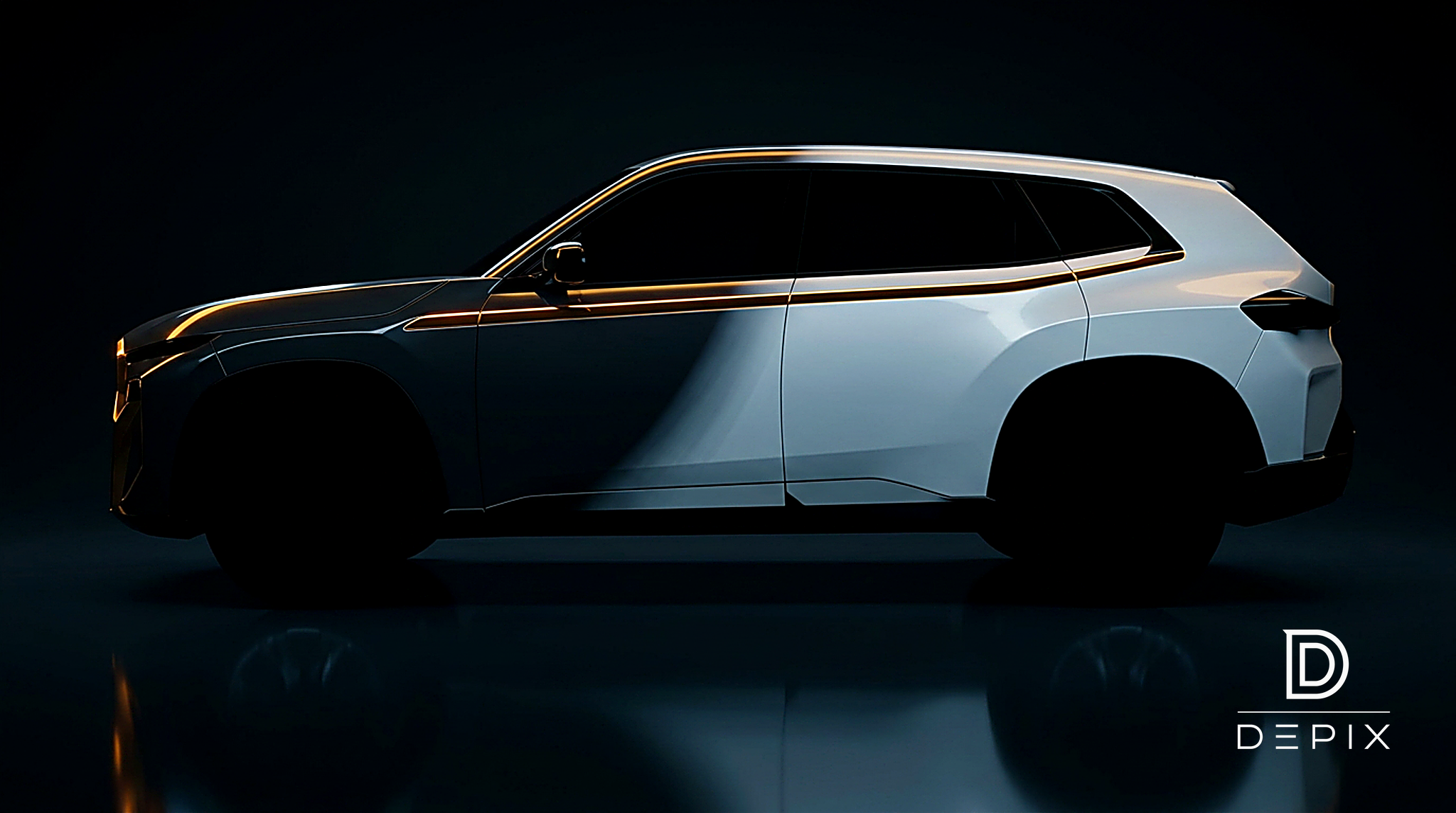
The car that changes its mind about what colour it is
The car that changes its mind about what colour it is
BMW just cleared a body panel that changes colour on a slider. Which means the single most-protected decision in the building — the brand colour, the hero hue, the thing the launch film is lit around — is now a setting in a menu. Nobody has decided whether that is the most personal car ever built or the end of a car having a colour at all.
There is a number a design studio fights over harder than almost anything else, and you will never see it on a spec sheet: the hero colour. The exact hue the launch car is painted, the one the photographer lights for, the one that ends up on the billboard and the configurator's default tile and, eventually, in your memory of the brand. Porsche has its Guards Red. A Range Rover is a colour before it is a shape. Designers spend months in a paint shop arguing over a metallic flake you would need a loupe to see, because the colour is the first thing anyone decides about the car and the last thing they forget.
In late April 2026, at Auto China in Beijing, BMW deleted that fight. The iX3 Flow Edition wears a body skin of E Ink Prism — electrophoretic digital paper, the same microcapsule technology as an e-reader, scaled up and wrapped around a production SUV — and it changes colour on command (Digital Trends, 24 Apr 2026; DigiTimes, 26 Apr 2026). A month later, at Computex 2026, BMW confirmed the panel had cleared its automotive production standards — the first series-ready electrophoretic car exterior, after more than four years of concept-only demos (Tech Times, 26 May 2026). By early June, E Ink was telling the market it was "preparing to bring its color-changing vehicle technology to market after overcoming key regulatory and technical hurdles with BMW" (DigiTimes, 4 Jun 2026).
The 2022 concept could only do greyscale — white pigment and black pigment, a gradient of greys in between (Electrek, 5 Jan 2022). The 2026 production version does full colour, with eight curated animation styles built in. The car can wear one colour to work and another to dinner. It can ripple. It can, in principle, never have a single colour again.
So here is the question no one in the room has actually answered: when the colour is a setting, what is the brand's colour?
The decision the colour-changing panel actually is
A paint colour looks like a finish. The colour-changing panel is, in fact, four decisions stacked under one skin — and they pull in four directions.
The brand strategist wants the hero hue to mean something. The whole apparatus of automotive identity assumes the car arrives in a colour you chose for it, that signals what it is. A BMW that can be any colour on a Tuesday is a BMW that has surrendered the most efficient brand cue it owns. Infinite choice is the enemy of a signature. If every car can be every colour, no colour is the brand's.
The product designer wants the feature to be the feature. This is the most personal thing a car has ever offered — colour as mood, colour as season, colour as the owner's daily decision rather than the factory's permanent one. It is, by demo-reel volume, the single most shareable thing on the car. The animation styles are the product. The point is that it doesn't hold still.
The safety engineer wants the car to be legible to everyone else on the road. A vehicle is a fixed visual object that other drivers, pedestrians, and increasingly camera-based driver-assist systems read in a fraction of a second. A body that can shift shade — or worse, ripple — while the car is in view is a moving target for every system tuned to recognise a stable one. The reporting is blunt about the guardrail: colour changes "should only be permitted while the car is stationary, to avoid distracting other drivers" (Tech Times, 26 May 2026).
The regulator — who, as ever, was never in the design review — has not arrived yet, and that is the problem. "No regulatory framework governing dynamic vehicle exteriors currently exists in the United States or Europe" (Tech Times, 26 May 2026). The same Euro NCAP that is forcing physical buttons back into cabins for 2026 on driver-distraction grounds has not yet looked at the outside of the car (Hagerty UK, accessed Jun 2026). It will. Vehicle colour is a field on every registration document and insurance policy in the world; "what colour is the car" is a question with a legal answer, and BMW just shipped a car for which the honest reply is which day.
Four people optimised four words — signature, expression, legibility, lawful — and shipped a panel that satisfies the first two beautifully and leaves the last two as someone else's problem, after the tooling is committed.
The thing the render gets exactly, perfectly wrong
Here is the trap, and it is sharper for this feature than for almost any other, because the studio's most powerful tool is the render of a car in a colour.
Every design review, every configurator, every billboard is a still image of the car wearing one colour, lit to flatter that colour. The render is, definitionally, a single state. And the entire point of the colour-changing panel is that it has no single state — it is the one feature whose actual product is the transition, the range, the in-between, the way the third colour you didn't plan for looks under a sodium streetlight at the moment a pedestrian glances up.
So the studio approves the car the way it always has — a gorgeous hero still in the launch hue — and signs off on a feature whose real behaviour lives entirely outside the frame it just approved. You learn whether the mid-grey transition reads as "premium shimmer" or "cheap LCD wash," whether the rippling animation reads as delight or as a malfunction, whether the car is even recognisable as a BMW when it isn't wearing a BMW colour — at the one test that matters, which is a real car on a real street that the still image structurally cannot contain.
This is worse than the usual render-only-shows-launch-day problem. For most features the render omits a state. For this one the render asserts the opposite of the product: it shows a fixed colour for a thing whose entire value proposition is that the colour is not fixed.
Which leaves three calls on the design chief's desk — none of them neutral
- ●Make it a true variable. Let the owner change colour freely, lean into expression as the product, and accept that the brand's hero hue becomes a default rather than an identity — a tile in a menu the customer is encouraged to leave behind. The feature is the differentiator. The signature colour, the thing the brand spent fifty years training people to recognise, quietly stops being load-bearing.
- ●Curate the palette down to brand-approved states. Ship the panel but lock it to a handful of sanctioned hues — the way a luxury house controls its colourways — so the car can change its mind but only within the brand's vocabulary. Keeps the identity intact, throws away most of the "infinite personalisation" demo that sold the feature in the first place.
- ●Make it a stationary ritual, not a driving state. Resolve the legibility and regulatory exposure by hard-locking colour to parked-only — a thing the car does in the driveway, the way the welcome-light sequence is a thing it does at the kerb. Honest, regulator-proof, and a quiet admission that the rippling-down-the-motorway fantasy in the launch reel was never going to be street-legal.
There is no option that doesn't change the photograph the brand has been leading with — because for the first time the photograph can't tell you what colour the car is.
Where the decision actually goes wrong — and what we do about it
The failure mode here is not bad technology. E Ink cleared BMW's production bar; the panel works. The failure mode is that a colour-changing car is a decision the studio is structurally equipped to get backwards, because every tool it owns evaluates the car in exactly one of the infinite states the feature exists to escape. The chief approves a hero still. The customer lives in the transitions. The pedestrian and the camera and, eventually, the regulator live in the worst of them. None of those states is the one in the deck.
This is the gap DEPIX Design Intelligence is built for. Not to build the panel — to put the bold call (free variable, curated palette, or parked ritual) in front of the chief as photoreal evidence in the states the single-colour render structurally hides, while it is still a sketch and not a tooled, type-approved, registration-document liability.
The point of design intelligence is to use the intelligence of AI to make the better design decision before it is welded — or in this case, laminated — to the car. Render the hero colour, yes. Then render the same car in the mid-transition grey under a streetlight, in the third-most-likely customer choice, in the animation a competitor will screenshot as "looks broken," beside the camera-system's-eye-view of a body that won't hold still — at decision time, side by side, while the answer is still cheap to change. Pressure-test the divisive call against the version of the car the street sees, not just the one the launch film wants. The photoreal output is the evidence. The decision is the product.
For a century, a car's colour was the one thing about it that never changed after it left the factory. BMW just made it the one thing that can change every day. The technology is settled. What hasn't been decided — by anyone, in any room — is whether a brand that can be any colour still has a colour at all. That is a design decision. And it is being made, right now, on a still image of a car standing perfectly still.
Sources
- ●BMW debuts color-changing iX3 Flow Edition with E Ink exterior at Beijing Auto Show 2026 — Digital Trends (24 Apr 2026)
- ●BMW's color-changing car is no longer a concept — E Ink says it's ready for mass production — DigiTimes (26 Apr 2026)
- ●BMW Color-Changing Car Clears Production Test: E Ink Hood Debuts at Computex 2026 — Tech Times (26 May 2026)
- ●E Ink and BMW advance automotive color-changing tech toward market readiness — DigiTimes (4 Jun 2026)
- ●BMW iX Flow — An E Ink color changing electric car (greyscale concept) — Electrek (5 Jan 2022)
- ●Car Makers Must Bring Back Buttons, Says Europe (Euro NCAP 2026 distraction stance) — Hagerty UK (accessed Jun 2026)
- ●LinkedIn (Unipile, account healthy, identity verified): post-search endpoint returns 404 on this plan (consistent with prior reports); Philip Lunn (DEPIX) "design is decided, not inherited" Design Intelligence anchor used.

The tailgate can't decide how to open — and the studio shipped all four answers

The seat that lies down on the job
