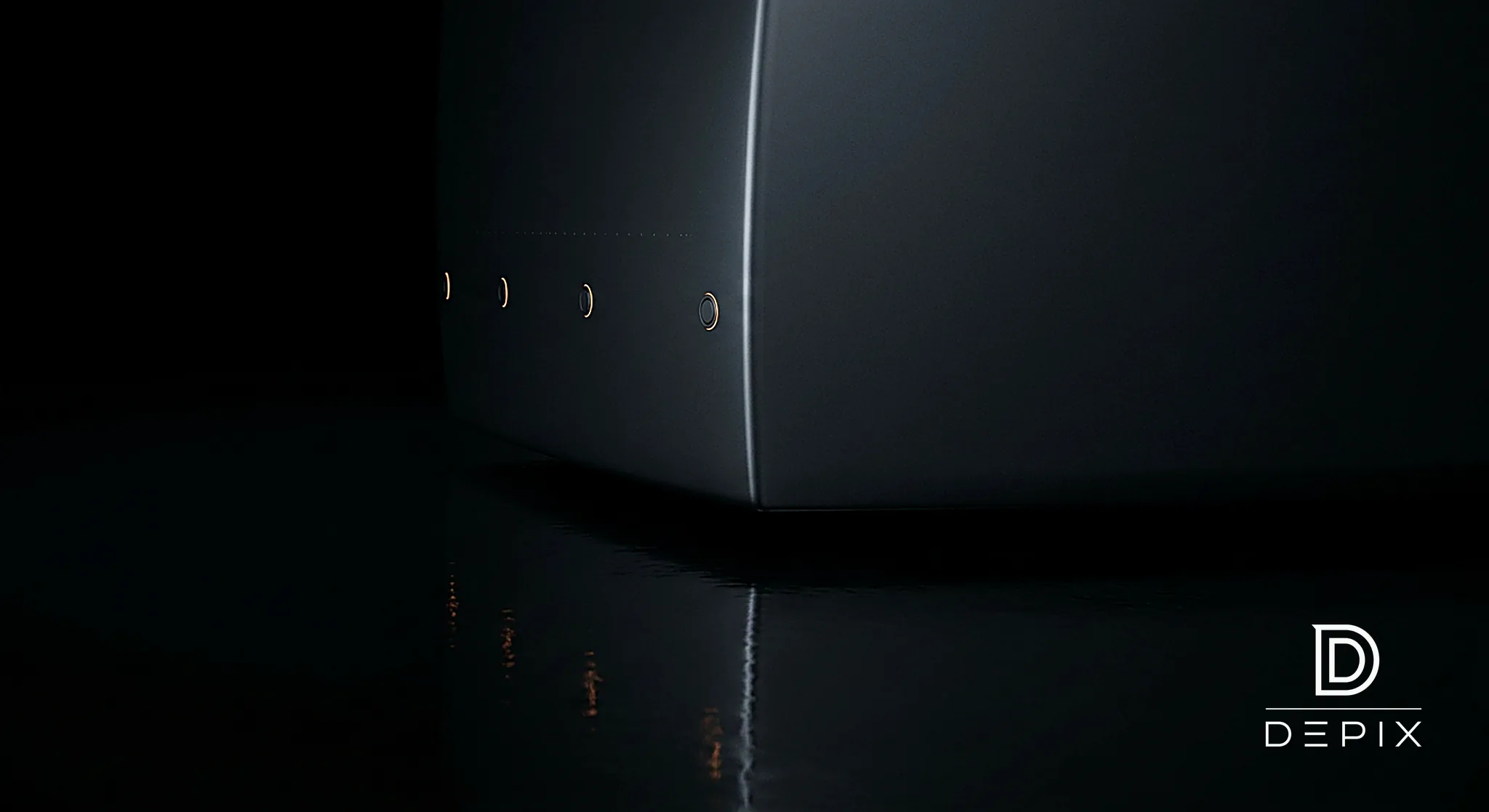
The freckles on the bumper the camera can't see around
There is a feature on the front and rear of almost every modern car that no stylist ever wanted there, that interrupts the one surface a designer fights hardest to keep clean, and that gets quietly deleted the moment an engineer can promise the same job done by a camera instead. It is sold as nothing — it is invisible in the brochure, absent from every hero render, and the marketing department would prefer you never noticed it. And the brand that deleted it first, most loudly, and most completely spent the next two years being told by its own owners, in public, that it had taken away the one thing that stopped them from denting the car in a car park.
It is the ultrasonic parking sensor — the row of small round "freckles" punched into the bumper — and it is one of the clearest cases on the whole exterior of a part four rooms want four incompatible things from, where the beauty shot shows the one state in which the conflict is invisible: a car standing still, in daylight, with nothing behind it.
The thing the designer wants to erase
Start with what the sensor does to the surface, because the surface is the whole fight. To work, an ultrasonic sensor has to sit flush with the outside of the bumper and fire its chirp into open air — which means a hole. A typical install needs a cutout of roughly 18–22 mm in diameter for each sensor, mounted flush so the face is level with the bumper skin and water does not collect behind it (How to Choose and Use Ultrasonic Sensors for Car Parking Assistance, Alibaba Car Interior guide, accessed 18 June 2026). A car with front and rear coverage carries four to six of these per end — a regular dotted line of circles drilled into the most prominent, most colour-matched, most photographed panel on the car.
The aftermarket gives away how badly the industry wishes those holes were not there. There is an entire trade in paintable sensor caps — covers that "accept automotive paint for a flush, OEM-look finish," sold on the promise of "a clean, seamless look that appears factory-installed" — which only exists because the visible sensor is read as a blemish to be camouflaged (Best Car Parking Sensor Systems of 2026, Car Care Total, accessed 18 June 2026). For a design studio that spends a model cycle perfecting an unbroken fascia, a row of grey-rimmed circles punched across it is exactly the kind of detail that does not survive a review. The instinct, the moment it becomes possible, is to delete it.
The room that deleted it
One company acted on that instinct harder than anyone. In October 2022, Tesla began building Model 3 and Model Y for North America, Europe, the Middle East and Taiwan with no ultrasonic sensors at all, extending the deletion to Model S and Model X in 2023, and replacing the sensors' inputs with cameras alone — "Tesla Vision" (Tesla is now building Model 3 and Model Y vehicles without ultrasonic sensors, TechCrunch, 4 October 2022; Tesla is removing ultrasonic sensors from all of its vehicles, Not a Tesla App, accessed 18 June 2026). The bumper got clean. The freckles vanished.
The function vanished with them — temporarily, the company said. For a stretch during the transition, cars built without the sensors shipped with Park Assist, Autopark, Summon and Smart Summon limited or inactive, to be restored later by software once camera performance matched what the sensors had delivered (Tesla abandons ultrasonic sensors in favor of camera-based ADAS, Repairer Driven News, 18 October 2022). That is the central admission hiding in plain sight: the clean bumper shipped before the thing that justified it. The studio's preferred state went into production while the function it replaced was switched off.
The room that proved you needed it
The bill arrived in the one place the render never shows — a car park, up close, slow, with an obstacle the camera could not resolve. When vision-based Park Assist finally rolled out in update 2023.6.9 on 24 March 2023, the verdict from people actually parking with it was unforgiving. Electrek found measurements "surprisingly accurate" in a well-lit lot but the on-screen visualization "quite wiggly" compared with the ultrasonic version, and — the killer line — concluded that "the visualization doesn't seem a lot better than eyeballing, which is disappointing six months after the feature was unceremoniously eliminated," noting the feature deactivated entirely ("park assist unavailable") at the moment a driver was trying to ease up to a trash can (Tesla rolls out vision-based park assist, but it could still use some work, Electrek, 24 March 2023).
Owners catalogued the failure modes precisely, and they were exactly the conditions ultrasonics did not care about. Park Assist "works normally during daytime but suffers at night if the car or object is dark black and under limited light"; one owner reported the camera failing to reveal a black car behind them after dark with no alert at all. Others reported "park assist not available" whenever it rained (Tesla Park Assist Unavailable: Why it Happens & How to Fix It, EV Help Hub, accessed 18 June 2026; Model Y — Tesla Vision — Park Assist, Tesla Owners Online forum, accessed 18 June 2026). The physics is unromantic: an ultrasonic chirp does not need light, does not care about colour, and does not care about rain on a lens. It reads distance by time-of-flight directly. A camera infers distance from an image it first has to be able to see — and a black object at night, a dirty lens, or a wet windscreen is precisely the picture it cannot read. As owners noted, "radar or lidar would have picked up obstacles even in poor lighting" (Tesla Motors Club, How accurate is the Vision-based Park Assist?, accessed 18 June 2026).
There is also a near-field blind spot the camera architecture cannot wish away. Ultrasonics resolve down to a short range from the bumper; a wide-angle camera mounted on the body cannot see the last few centimetres of its own car's painted corners — the exact zone where a kerb post, a low bollard or a tow ball lives, and the exact zone parking assistance exists to protect. The clean bumper is most vulnerable precisely where the deleted sensors used to watch.
The room that makes it disappear without deleting the function
Here the story turns, because the designer's wish — make the holes go away — turns out to have an answer that is not "switch the safety net off." The answer is to change the sensing technology, not abolish it. Two of them are already in production logic.
The first is millimetre-wave radar. Unlike an ultrasonic sensor, a radar module does not need to face open air through a hole; it can sit behind the bumper skin and see through it. NOVELIC's ASPER200, a 79 GHz park-assist radar shown ahead of Auto Shanghai 2025 (announced 8 April 2025), is pitched in exactly the studio's language: rather than "multiple cutouts for 4–6 ultrasonic sensors," a single radar module integrates "seamlessly behind or above the bumper, allowing for sleeker car designs," while detecting objects closer than 5 cm and reading low-height obstacles more reliably than ultrasonics (NOVELIC set to make its China debut … 180° radar park assist technology at Auto Shanghai 2025, NOVELIC, 8 April 2025; mmWave Radar vs. Ultrasonic Sensors: A New Parking Solution?, NOVELIC, accessed 18 June 2026). The aesthetic prize the designer wanted — an unbroken bumper — arrives with the function intact rather than amputated.
The second answer is older, European, and even more pointed. The Turin firm Proxel has sold an electromagnetic parking sensor "for over 20 years" whose entire premise is in its tagline: no holes on the bumper. A flexible aluminium strip is bonded to the inside of the bumper; energised, it generates an electromagnetic field that an approaching object disturbs, triggering the warning at roughly 70–80 cm. The company states plainly that "the outer surface of the bumper maintains its visual integrity, without undergoing any aesthetic alteration," the antenna staying "completely invisible" inside the skin (Proxel — Electromagnetic Parking Sensor — NO holes on the bumper!, Proxel S.r.l., Turin, accessed 18 June 2026). The fact that a no-holes solution existed for two decades is the quiet rebuke to the whole episode: the designer never actually needed to delete the function to get the clean surface. They needed a different sensor.
Why the render hides the conflict — and what to do about it
Look at where each room's truth lives, and the pattern is the same one that catches studio after studio. The designer is right that a dotted line of holes spoils the fascia — and they are right in the exact medium the decision gets signed off in: a hero still of a stationary car in good light, where parking is not happening and nothing is behind the bumper. The safety/usability truth — the black car at night, the kerb in the rain, the deactivation message the moment you need it — lives only in motion, up close, in bad conditions: states a glamour render structurally cannot contain. The technologist is right that the function can be made invisible — but only if someone insists the brief is "delete the holes," not "delete the sensing." And the owner, the one not in the room, renders the verdict last, at the body shop, after the clean bumper meets a bollard the camera could not see.
This is the trap Design Intelligence exists to spring early. The bumper-sensor call gets made the way every "we'll handle it in software later" call gets made: as a surface decision in a sunlit still, validated by how clean the fascia looks, and lived in a dark, wet, crowded car park months after the tooling is cut. DEPIX puts that decision in front of a design chief as photoreal evidence across the states the still cannot show — the dotted bumper versus the clean one, yes, but also the clean one as it behaves at a kerb at night, and the radar-behind-the-skin and electromagnetic-strip alternatives that buy the clean surface without switching the safety net off. The point is not that holes are good. The point is that "make it disappear" and "make it stop working" are two different decisions that look identical in a beauty shot — and the only honest way to tell them apart is to see the car in the state where the difference shows, before the fascia is frozen.
The freckles were never the problem. Believing the brochure photo was the design review was the problem.
Sources
- ●Tesla is now building Model 3 and Model Y vehicles without ultrasonic sensors, TechCrunch, 4 October 2022
- ●Tesla is removing ultrasonic sensors from all of its vehicles, fully transitioning to Tesla Vision, Not a Tesla App, accessed 18 June 2026
- ●Tesla abandons ultrasonic sensors in favor of camera-based ADAS, Repairer Driven News, 18 October 2022
- ●Tesla rolls out vision-based park assist, but it could still use some work, Electrek, 24 March 2023
- ●Tesla Park Assist Unavailable: Why it Happens & How to Fix It, EV Help Hub, accessed 18 June 2026
- ●Model Y — Tesla Vision — Park Assist, Tesla Owners Online forum, accessed 18 June 2026
- ●How accurate is the Vision-based Park Assist?, Tesla Motors Club, accessed 18 June 2026
- ●How to Choose and Use Ultrasonic Sensors for Car Parking Assistance, Alibaba Car Interior guide, accessed 18 June 2026
- ●Best Car Parking Sensor Systems of 2026, Car Care Total, accessed 18 June 2026
- ●NOVELIC set to make its China debut with in-cabin monitoring and 180° radar park assist technology at Auto Shanghai 2025, NOVELIC, 8 April 2025
- ●mmWave Radar vs. Ultrasonic Sensors: A New Parking Solution?, NOVELIC, accessed 18 June 2026
- ●Proxel — Electromagnetic Parking Sensor — NO holes on the bumper!, Proxel S.r.l., Turin, accessed 18 June 2026

The glovebox the screen locked you out of — the one box on the car a designer keeps trying to delete, that a traffic stop proves you still need

The pillow the law shoves into your sightline — the one cabin object a designer can't lower, a passenger can't legally remove, and a recline quietly defeats
Related posts

The bridge of air where the gearstick used to be — the console the studio floats for the look, that the elbow and the loose phone never agreed to

The clean pad that cooks the phone it charges — the cabin feature sold as the cableless future, that a fifty-cent wire still beats on every metric that matters

The rails on the roof that carry nothing — the one styling cue that promises a life the car will never live, and quietly taxes the range to do it