Right Idea, Wrong Decade: The Smart #2 and the Return of the Two-Seater
Twenty-eight years ago, at the 1998 Paris Motor Show, a car barely two-and-a-half metres long rolled onto a stand and quietly proposed a radical idea: that a car for a city need not be a shrunken version of a car for a country. The original smart city-coupé, soon renamed fortwo, was rear-engined, strictly two-seat, and built around one stubborn conviction — push the wheels to the extreme corners, wrap two people in a rigid safety cell, and throw away everything else. It was one of the boldest packaging bets in modern car design.
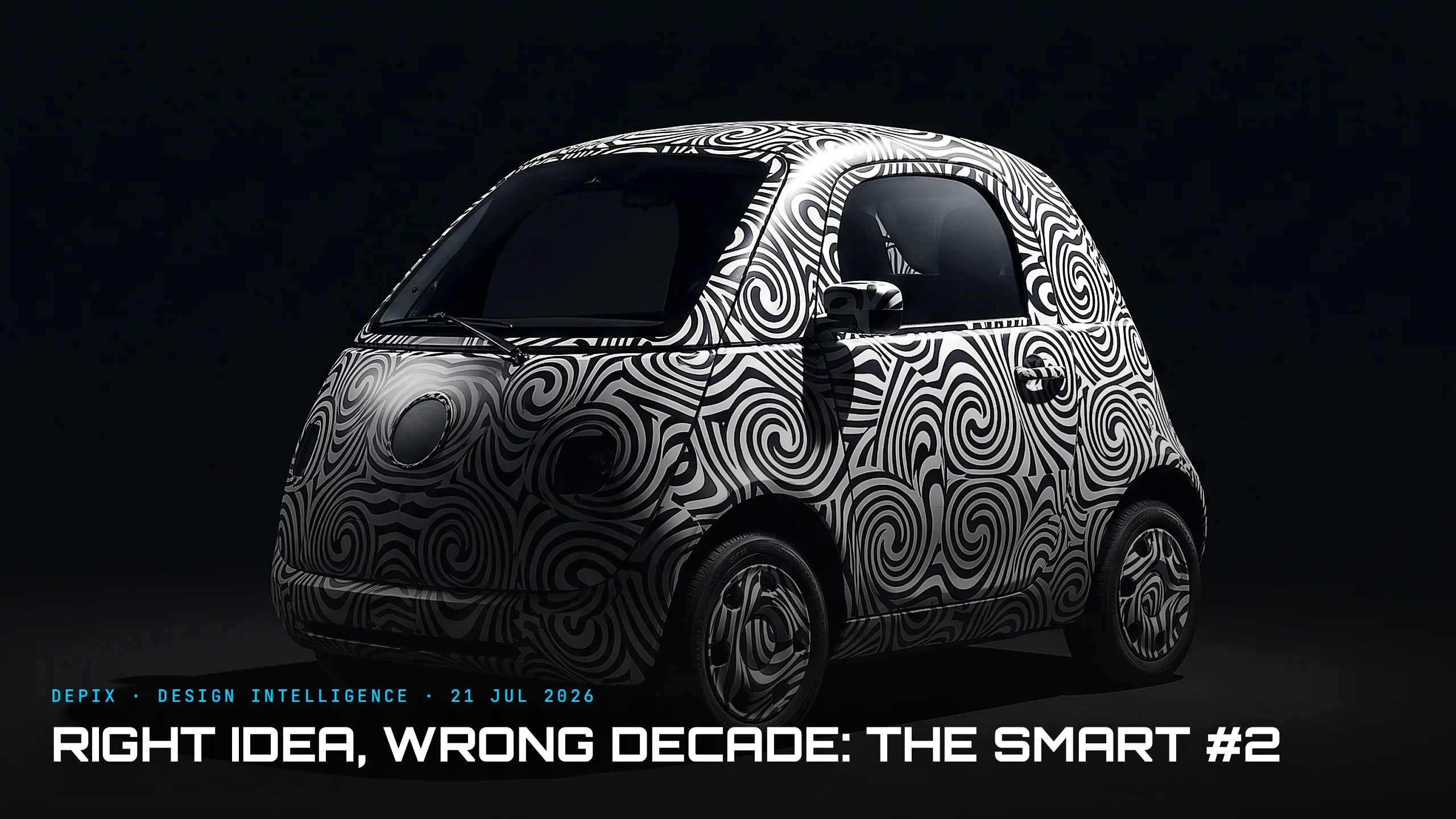
This October, on the very same Paris stage, Smart returns to that bet with the #2 — an electric two-seater now finishing a global test programme under black-and-white camouflage drawn by the Mercedes-Benz design team. What makes this more than nostalgia is that Smart spent the last five years doing the exact opposite of the fortwo — and is now, deliberately, un-learning it.
What changed since the first generation. The 1998 car was a combustion two-seater sold at first only in Europe; across three generations and seventeen years it managed over 1.7 million units — a cult, never a blockbuster, and one that never comfortably made money. The problem was structural: a tiny combustion car costs almost as much to engineer, crash-test and homologate as a big one, yet can only be sold for a little. The economics of the A-segment punished precisely the cars that were best for cities. The #2 inverts every one of those constraints. It keeps the sacred wheels-at-the-corners silhouette — the one piece of fortwo DNA worth preserving — but is now fully electric, 2,792 mm long, with a 35.7 kWh battery and around 300 km of range, able to fast-charge 10–80 % in under 20 minutes. And crucially it is designed by Mercedes-Benz, engineered and built by Geely in China) and sold globally from day one — not the France-built, Europe-first artisan project of 1998.
The market segment, worldwide. Here is the strategic irony. In the combustion era the small city car became commercially radioactive: the Volkswagen up!, Ford Ka and a dozen others were killed off because tightening safety and emissions rules made tiny cars unprofitable, and buyers drifted to small SUVs. The A-segment did not die because people stopped wanting small cars; it died because the industry could not build them at a profit. Smart itself fled upward, replacing the fortwo with a range of electric crossovers — the #1, #3 and larger #5) — chasing the same SUV money as everyone else. Electrification quietly reopens the door the combustion era slammed shut. A city car's greatest weakness — short range — becomes irrelevant when the car is only ever meant for the city, and a small battery turns into a genuine advantage: cheaper, lighter, faster to charge, and less of the one component that dominates an EV's cost. In the dense megacities of China, Europe and Southeast Asia, a two-seat footprint is worth more than ever. The #2 is a bet that the ultra-compact EV is the segment the whole industry abandoned one generation too early.
Expected sales. Smart has not published a #2 volume target, and it would be unwise to invent one. What the numbers do say is this: the brand delivered nearly 130,000 vehicles globally in 2024, up 7 %), entirely on the strength of its SUVs, and is now live in 34 markets and expanding. The #2's job is to add a lower, younger, city-first entry point beneath that range — to widen the funnel back toward the buyer who made smart famous in the first place. For context, the original fortwo's best years ran at roughly that same ~130,000-a-year pace on its own; a modern, global, Geely-costed EV two-seater is engineered precisely to clear that bar rather than flirt with it.
The design lesson. The fortwo was never a bad idea; it was a right idea in a wrong decade, strangled by the economics of its powertrain. The most valuable thing a design team can do is recognise when that is true — when a concept keeps failing not because it is wrong but because the surrounding technology has not caught up — and keep it ready for the moment the constraints flip. Smart spent twenty-eight years walking away from its best idea. The #2 is the company betting that the idea was never the problem. The engine was.
Sources:
- ●smart Fortwo — Wikipedia
- ●smart returns to the bet with the #2 — Destination Charged
- ●smart #2 undergoes global testing ahead of Paris — smart media
- ●smart fortwo — 1.7M units across three generations — autoevolution
- ●smart #2 extensive global testing — Electric Cars Report
- ●smart #2 — 35.7 kWh battery, ~300 km range — The Electric Viking
- ●smart #2 — 10-80% in under 20 minutes — CarNewsChina
- ●smart (marque) — history, ownership, 2024 volume — Wikipedia)
- ●smart's push into new markets (Geely/Mercedes-Benz) — TechNode

Design the Carbon Out: Dacia's Hipster and the Footprint You Decide in Week One

Peugeot Is Showing Two Concept Cars. That's the Whole Strategy