
AI can build the surface. It can't decide it's right.
Walk any car studio and you will meet a designer almost no one outside the building has heard of. Not the sketcher whose renderings end up on Instagram. Not the clay sculptor the press loves to photograph. The Class-A surfacer: the person who takes an approved shape and rebuilds it, millimetre by millimetre, until the reflection running down the body side flows like poured water and never stutters. It is the most senior, best-paid, least visible craft in the room. And in 2026 it is the one the software companies have decided to automate.
Autodesk's Alias 2026, shipped last autumn, leans hard into faster surfacing, cleaner outputs and "more control over complex surfaces" with assisted tooling baked in. Dassault's new ICEM Design Experience app promises CAS and Class-A modellers "unlimited design freedom, precision and automation," mixing explicit and parametric maths in one workflow. The pitch is seductive: surfacing is repetitive, experience-bound and slow, so let the machine carry the tedium. Much of the work genuinely is mechanical. Matching tangency across a patch boundary, holding curvature continuity, chasing a kink out of a fillet — a model can do that, and increasingly will.
Here is the part the demos skip. The hard part of Class-A was never building the surface. It was deciding the surface was right.
A highlight is not a calculation. When a senior surfacer drags a control point a fraction of a millimetre, they are not satisfying a continuity check — that already passed three iterations ago. They are watching how light will peel off that fender at dusk, in a showroom, in a customer's driveway, and judging whether it reads as taut or soft, expensive or cheap, confident or nervous. Two surfaces can be mathematically flawless — G3 continuous, zebra stripes perfectly aligned — and one will look like money while the other looks like a rental. The difference is a decision, made by a trained eye, that no curvature plot will ever surface for you.
This is the quiet danger in automating the craft. When the tool generates a "valid" surface in seconds, the temptation is to accept it because it passed the math. Studios that do this will ship cars that are technically perfect and emotionally flat — bodies that survive the zebra analysis and die in the showroom. The continuity was never the product. The judgment was.
The smarter studios are reading the new tools correctly: not as a replacement for the surfacer's eye, but as a way to put more options in front of it. If the machine can produce five legitimate surface treatments of a shoulder line in the time it used to take to build one, the senior designer's day stops being about executing a single answer and becomes about choosing between many. The bottleneck moves from the hand to the head — which is exactly where a design organisation wants it. The scarce resource was never modelling hours. It was discernment.
That is the shift worth naming. The value of a design decision is moving upstream and getting concentrated. The people who can look at a generated surface and say, instantly, "that one, not that one, and here's why" become more important, not less. Automation does not retire taste. It raises the price of it.
At DEPIX we build for that moment. The point of putting more photoreal, decision-grade options on the table earlier is not to remove the designer — it is to spend their judgment on the choices that actually set the character of the car, instead of burning it on rework the machine should have carried. The surface can be generated. Whether it is right is still, and will remain, a human call.
The studios that win the next decade will not be the ones with the fastest surfacing software. They will be the ones who still know what they are looking at when it finishes.
Sources
- ●What's new in Alias 2026: A new era of design, surfacing, and visualization (Autodesk)
- ●ICEM Surf Advanced Surface Modelling (Dassault Systèmes)
- ●AI in car design 2026: tools, workflows and models (Car Design News)
- ●CAS Design and Class A Modeling: The Complete Guide (PSH Design)
- ●Class A surface (Wikipedia)
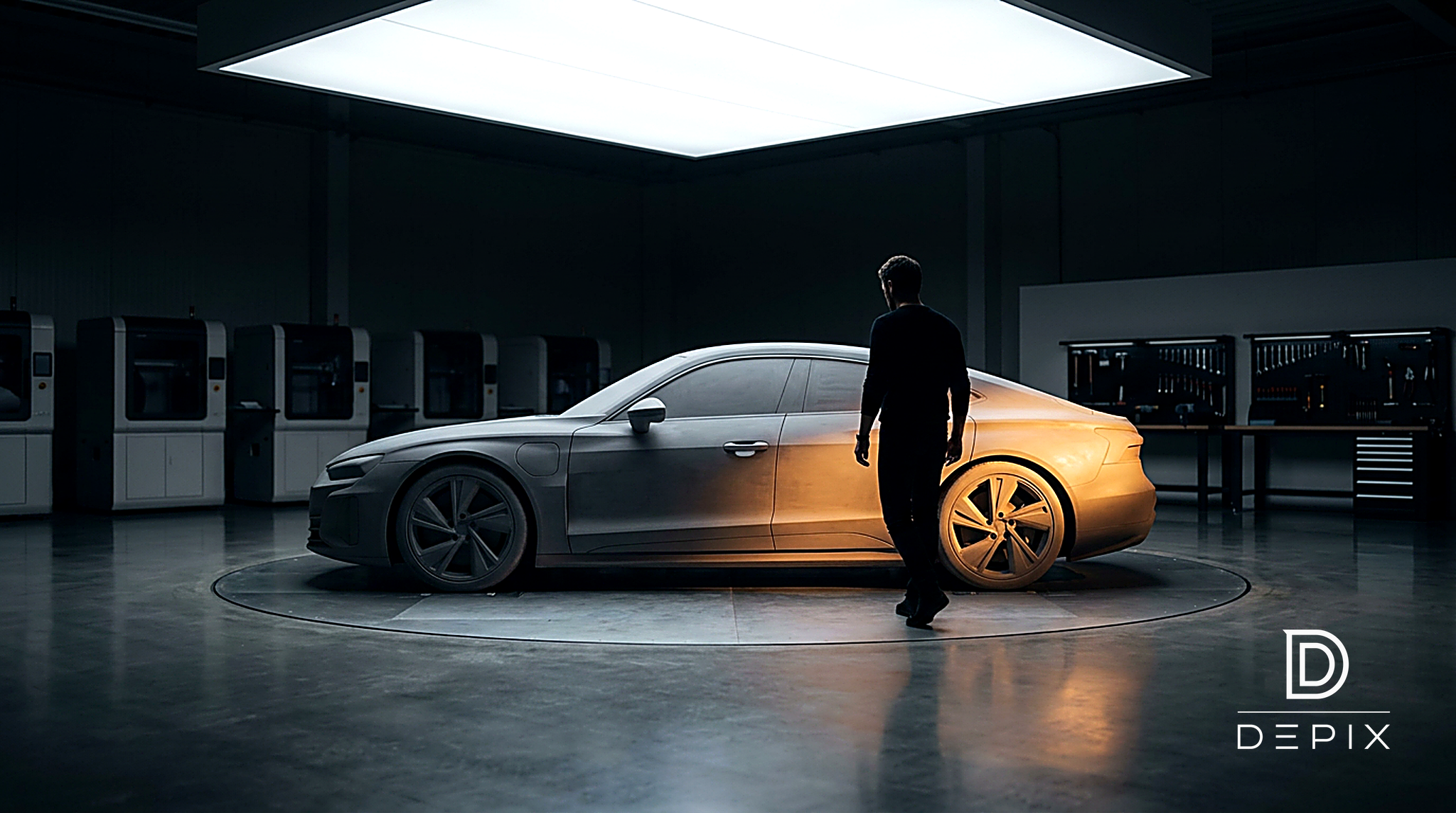
Pixels hide proportion. So studios still build the car.

Clay no longer decides the car. The headset does.
