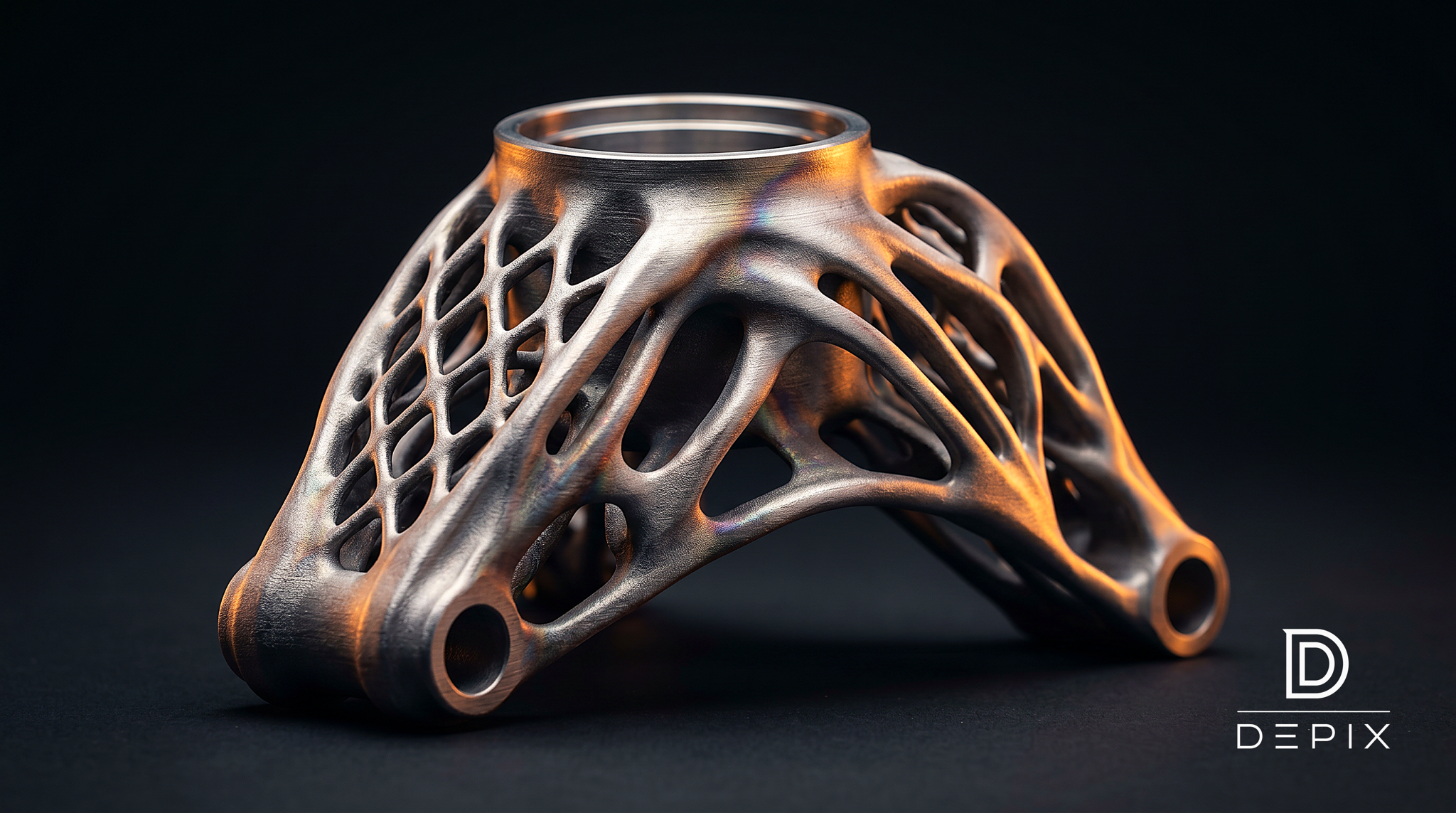
Nobody drew Bugatti's chassis. An algorithm grew it.
The most radical decision in the Bugatti Tourbillon is not the naturally aspirated V16 or the €3.8 million price. It is that no human being drew the parts holding the car together. The chassis and suspension were designed, engineered, 3D-printed in aluminium and robotically assembled by Divergent's DAPS system — software that takes the loads, the attachment points and the package envelope, and grows the structure to fit. The result is an organic, web-like suspension arm and upright that saves 45% of the Chiron's suspension weight. It looks like bone. It was, in a sense, cultivated rather than styled. With 250 Tourbillons entering customer hands in 2026, and McLaren, Aston Martin and Bugatti Rimac all now on Divergent's line, this stops being a lab curiosity and becomes a working method.
Here is the part the beautiful renders never show. Generative design inverts the oldest job in the studio. For a century, a designer drew the surface and an engineer drew the bones beneath it — both by hand, both able to argue. In the DAPS model the human draws almost nothing structural. You write the brief: these are the loads, these are the fixings, this is the space you may occupy, do not exceed this stress. The algorithm then removes every gram of metal that isn't earning its place, and prints what survives. The organic lattice that results looks like nature. It is pure arithmetic, executed flawlessly against whatever numbers you fed it.
That is the whole risk, and it is a design risk, not a printing one. A generative optimiser is only ever as honest as its constraint set. It does not know the load case you forgot. It cannot picture the pothole strike, the kerb mount, the decade of corrosion, the crash pulse from an angle no one specified. It will confidently delete exactly the material that would have caught the case you didn't describe — because you told it that material was waste. The machine has no taste, no doubt, no instinct to leave a little extra where a veteran engineer would. Garbage in is not merely garbage out here; it is a gorgeous, weight-optimal, structurally elegant answer to the wrong question.
So the authorship moves. It doesn't disappear — it relocates, from geometry to specification. The most consequential creative act on the Tourbillon's chassis is no longer a line on a screen; it is the decision about which loads, which states, which lived realities go into the brief before the optimiser runs. Get the brief right and you get a part lighter and stronger than any human would dare draw. Get it thin and you get a sculpture that fails in a way nobody modelled. And once the part is printed and the tolerances are baked into a one-off organic geometry, you cannot casually add a rib back the way you'd thicken a milled bracket. Like a casting die, the decision hardens early and resists revision.
This is why the concept phase quietly becomes the entire game. When the machine designs the structure, the human's leverage is front-loaded into defining the problem completely — every load path, every worst-case state, every way the object will actually be used and abused — before a single node is grown. The discipline shifts from drawing well to briefing completely. The teams that win with generative design won't be the ones with the prettiest lattices; they'll be the ones who pressure-tested the constraint set against real and worst-case conditions before they let the algorithm start deleting metal.
That is exactly the work Depix is built to make cheap and fast at the front of the process: rehearsing a decision across its real, lived, ugly states while it is still free to change, so the brief you hand the machine describes the world the part will live in — not the tidy world you hoped for. The organic hero shot is the evidence. The completeness of the brief is the product. When an algorithm grows the bones of a €3.8 million car, the only thing left for a designer to get catastrophically right is the question.
Sources
- ●Divergent Announces Partnership with Bugatti for Design and Manufacturing of Tourbillon Structures (PR Newswire)
- ●Bugatti Leverages Divergent to 3D Print Chassis and Suspension Parts for Tourbillon Hypercar (3DPrint.com)
- ●New Bugatti Tourbillon to integrate Divergent's 3D printed parts (VoxelMatters)
- ●McLaren Teams with Divergent for Advanced 3D Printing in Supercars (3DPrint.com)
- ●Divergent Technologies Eyes High-Volume, Optimized Automotive Production Through Additive (Additive Manufacturing Media)
- ●Generative Design for Additive Manufacturing 2026 (PatSnap)

When the battery becomes the body, the designer loses the floor

Carmakers spent 40 years designing around robots. Humanoids end that.
