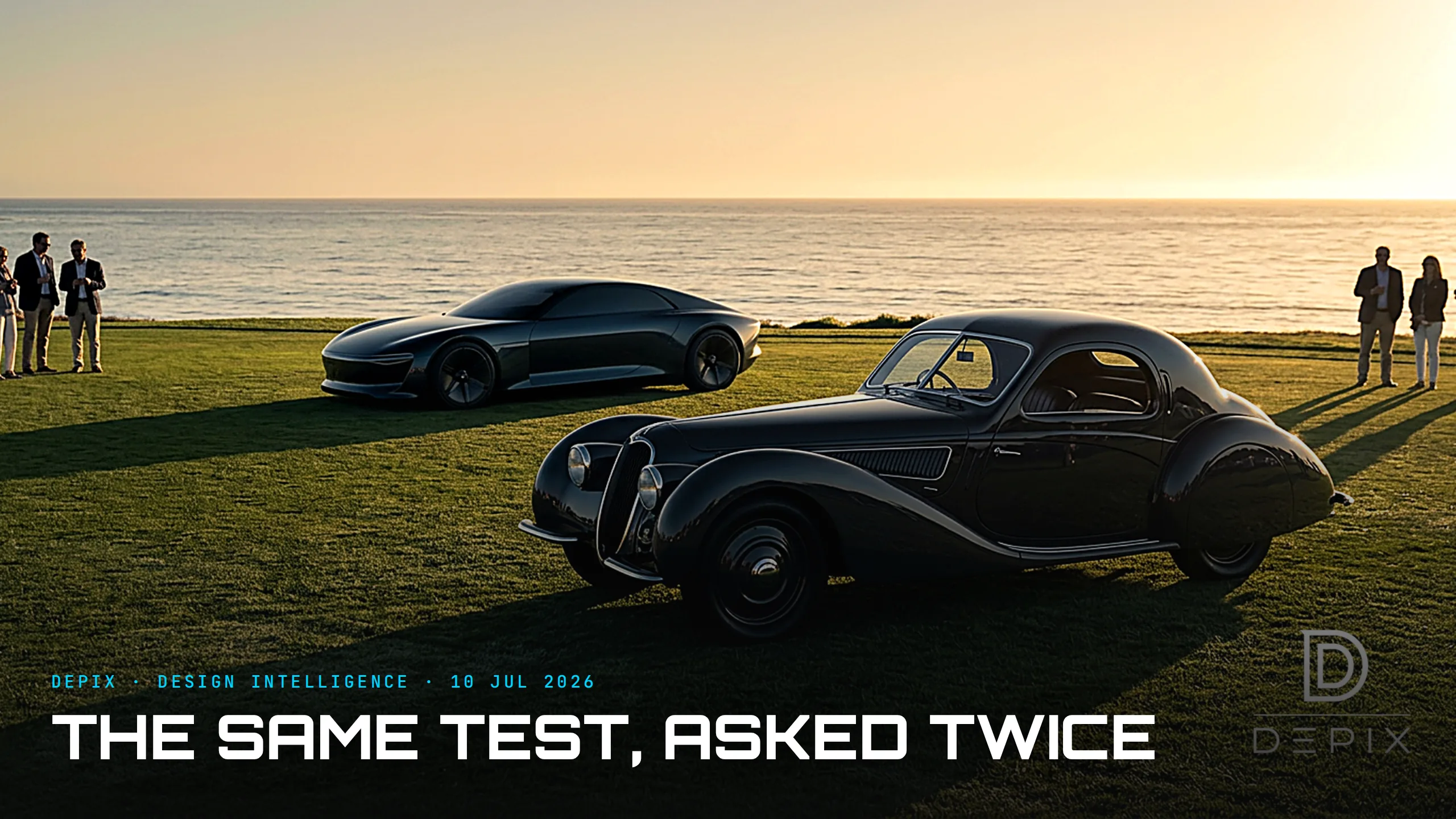
London Design Festival Shows You the Object. The Decision That Mattered Happened in a Room No One Photographs.
Every September, London becomes a design exhibition. The 24th London Design Festival runs 12-20 September across eleven Design Districts - hundreds of installations, launches and showrooms, from Mayfair to the new Soho district, with the Global Design Forum returning to the V&A. For nine days the city fills with objects on plinths, and everyone photographs them.
Here is the uncomfortable thing about a photograph of a finished object: it shows you the answer, not the question. The chair, the lamp, the material sample you are admiring is the OUTPUT of a design process. The decision that actually mattered - what this thing should even BE, and whether it is true to the idea behind it - was made months earlier, in a room no one photographs: the concept phase.
And that room is suddenly the most contested territory in design, because it is exactly where AI has moved in.
The festival's own programme now spans technology, materiality and digital design alongside the furniture and crafts, because the tools underneath have changed. Generative AI has collapsed the cost of the early phase. Adobe reports up to a 60% reduction in concept-creation time; studios report product-development time cut by up to half, and Deloitte finds 20-30% faster time-to-market among teams that have adopted AI-assisted systems. Used well, the tools do something genuinely useful: they mitigate design fixation and flood the concept phase with more options, faster, than any single designer could ever sketch.
But here is the catch that every serious study keeps arriving at. AI can generate a thousand concepts; it cannot tell you which one is right. Feasibility and coherence - whether a proposal actually serves the intended idea - rely on the designer's critical judgment, an evaluative task that sits stubbornly beyond the tool itself. The 2026 industrial-design trend reports say the same thing in different words: AI proposes; the human decides what is essential.
That inversion is the real story of this festival, and it is bigger than any single installation. When generating options was expensive, the scarce skill was fluency - the ability to produce a good concept at all. Now that generating options is nearly free, the scarce skill is judgment: knowing which of the thousand is worth building, and holding it coherent to the original intent all the way to the plinth. The value did not disappear; it moved upstream and concentrated. The concept phase used to be where you made things. Now it is where you decide, under a firehose of AI-generated possibility, what deserves to exist at all - and where a weak idea, accelerated, simply becomes an expensive mistake made faster.
This is precisely the discipline Depix is built around. We think the concept phase is the highest-leverage room in any design process - the moment identity, intent and essential form are decided, when the idea is cheapest to change and most expensive to get wrong. AI belongs in that room: it should make exploration fast and fearless. But it is a co-pilot for possibility, not a substitute for conviction. The team still has to look at a hundred credible options and say this one - and be right.
So when you walk the districts in September, enjoy the objects, but do not mistake them for the design. The finished piece is the easy part now; any capable studio with the right tools can render a beautiful one. The hard, human, irreplaceable part happened earlier, off-camera - in the room where someone stared at a wall of AI-generated possibilities and decided what the thing should mean. That decision is the design. Everything on the plinth is just its proof.
Sources:
- ●London Design Festival 2026 (official)
- ●LDF 2026 programme & Design Districts
- ●A first look at LDF26 (Global Design Forum)
- ●London Design Festival - background
- ●LDF 2026 dates & agenda (WorkflowMax)
- ●AI industrial design: applications & benefits (Neural Concept)
- ●How AI tools are transforming product design in 2026 (CADD Centre)
- ●Top industrial design trends for 2026 (Eckstein Design)
- ●AI in Design Report 2026 - Tools
- ●AI tools for designers in 2026 (RGD)
- ●Integrating Generative AI into Conceptual Design (research)
- ●Depix - design intelligence at the concept phase
Four Events, One Room: The Day Design Intelligence Pointed Upstream

Every Superyacht Is a Concept Car That Actually Gets Built