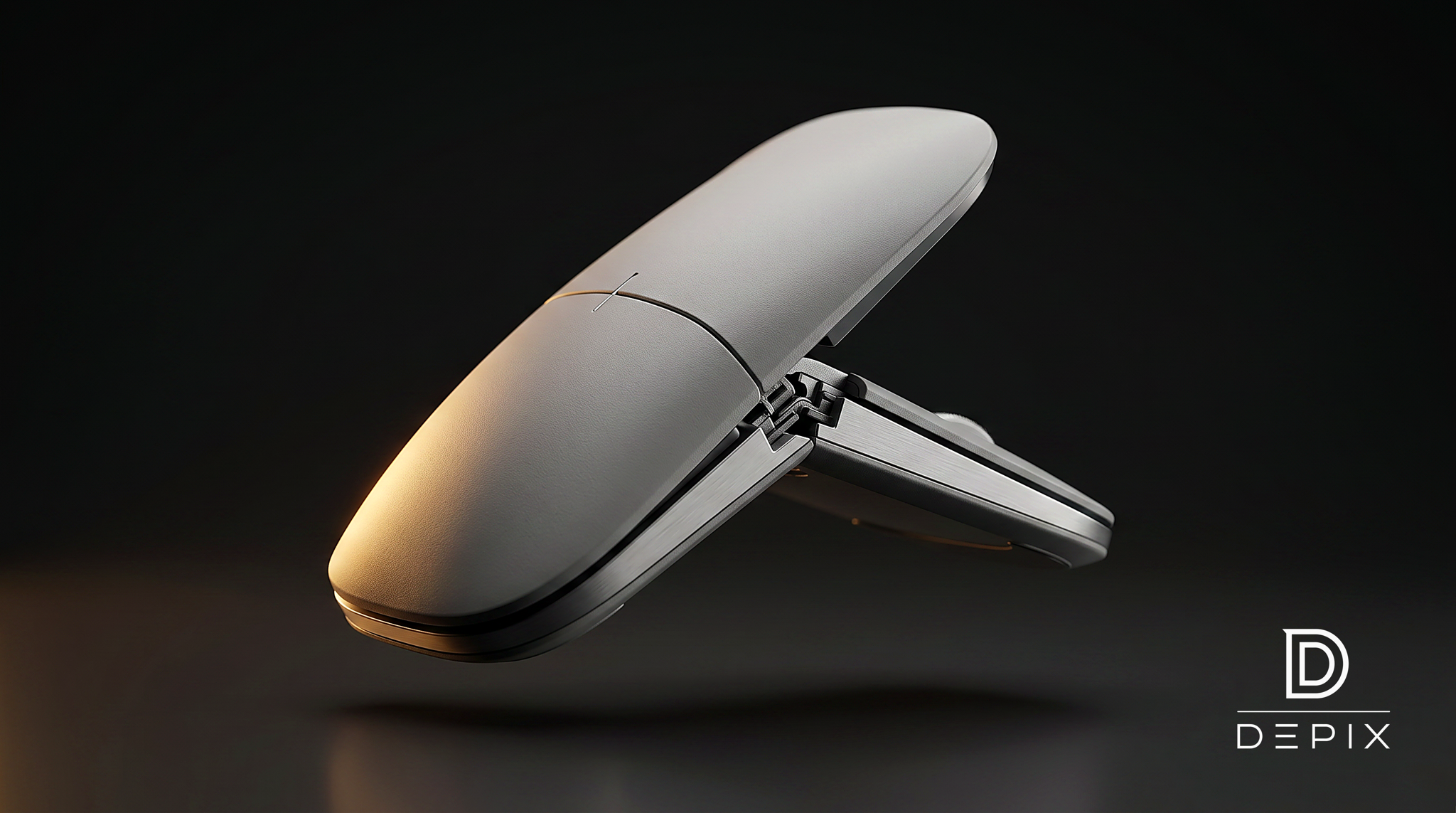
Logitech's mouse dropped the power button. The fold turns it on.
Logitech shipped a mouse this month that does something almost no consumer electronics team is brave enough to do: it removed a control instead of adding one. The Mobi Fold, unveiled on 11 June and formally launched on 24 June, folds in half to sit in a shirt pocket and unfolds into a full ergonomic shell. The headline is the hinge. The real story is what the hinge let the team delete.
There is no power button. Opening the mouse switches it on. Folding it shut switches it off. The design team has said the whole product turned on a single rough side-view sketch — unfolded marked "ON," folded marked "OFF." That sketch is the entire concept-phase decision. Once you accept that the object already has two unmistakable physical states, a separate switch becomes redundant. The gesture that makes the thing portable is the same gesture that controls its power. One motion, doing two jobs, with nothing left over to explain.
This is harder than it sounds, and most teams get it exactly backwards. The default reflex in a product review is additive: another button, another mode, another light, another setting in the companion app. Every addition feels like value because it is visible and it is easy to justify in a spec sheet. Subtraction is the expensive move. It requires someone to argue that the absence is the feature — that a mouse with no discoverable "off" is better than one with a satisfying click switch on its belly. That argument almost always loses to the safe instinct to keep the switch "just in case."
The interesting design-intelligence lesson is not the fold. Foldable input devices have existed for years and most were forgettable, because folding was treated as a storage trick bolted onto a normal product. What Logitech did was let the fold become the interface. The form is not decorated with controls; the form is the control. When the primary shape of the object carries the primary state of the object, you get the thing every designer claims to want and rarely achieves: an interaction with no learning curve, because there is nothing to learn. You already know how to open and close a folding thing.
It is worth being honest about the cost, because a good decision is one made with eyes open. A hinge in the middle of a precision pointing device is a compromise. It introduces a seam, a wear point, and a rigidity penalty right where your palm expects a solid shell. Under 80 grams and a single fold is elegant on a sketch; over three years of daily commutes it is a mechanism that has to survive tens of thousands of open-close cycles without developing slop. Logitech is betting that the mobile professional will trade a sliver of desk-mouse solidity for something that vanishes into a jacket. That is a real trade, not a free lunch, and pretending otherwise is how "innovative" products quietly fail at month eighteen.
But the trade is legible, and that is what makes it a design decision rather than a gimmick. The team knew precisely which constraint they were protecting — pocketability and one-motion simplicity — and which one they were spending down — the monolithic rigidity of a fixed shell. They did not hide the compromise behind a feature list; they built the entire product around owning it. The power-button deletion is the tell. You only earn the right to remove a component when the rest of the object is confident enough to carry its meaning.
This is the muscle that matters long before anything gets tooled. The decisions that define a product are made at the concept phase, in the language of rough side-view sketches, when someone looks at two states of a form and asks what the form could be made to mean. Get that right and the manufacturing, the firmware, the app all fall into line behind a single idea. Get it wrong and you spend the next two years adding buttons to cover for a shape that never decided what it was. The best evidence a design team is thinking clearly is not the feature it announced. It is the one it was disciplined enough to leave out.
Sources
- ●Logitech Launches Mobi Fold, Its First Ultra-Portable Foldable Mouse (investor press release)
- ●How Logitech Designed a Mouse that Fits in Your Pocket (Logitech Blog)
- ●Logitech Unveils Mobi Fold, Its First Foldable Mouse Designed for Mobile Professionals (NXT Mag)
- ●Logitech Mobi Fold hands-on impressions (The Point Online)

Xbox made its console see-through. You still can't get inside.

AI glasses all hide the camera. That's the whole problem.
