The Face Is a Decision: What the Humanoid-Robot Boom Reveals About Designing How Human to Be
This summer, humanoid robots stopped being a demo and started being coworkers. Figure AI's Figure 03 arrived on the floor at BMW Group Plant Spartanburg, taking over complex logistics sequencing — picking parts from large unsorted containers and loading trolleys for just-in-sequence delivery. It follows Figure 02, which spent ten months helping build more than 30,000 BMW X3s in the body shop. BMW calls the strategy "Physical AI": digital intelligence wired into a machine that shares your workspace.
The engineering headlines write themselves — tactile-sensor hands, palm cameras, whole-body control. But the most consequential decision on any of these machines is not in the actuators. It is a question the engineers cannot answer and the designers cannot avoid: how human should it look?
That dial — call it the anthropomorphism setting — is turned at the concept phase, before a single joint is specified, and it decides whether the person standing next to the robot feels safe, unsettled, or actively repelled. Turn it too far toward "human" and you fall into the uncanny valley: the well-documented dip where a not-quite-human figure reads as a corpse or an impostor rather than a helper. Turn it too far toward "machine" and you lose the intuitive legibility that makes a humanoid worth building at all — the reason it can use human tools, climb human stairs, and be understood at a glance.
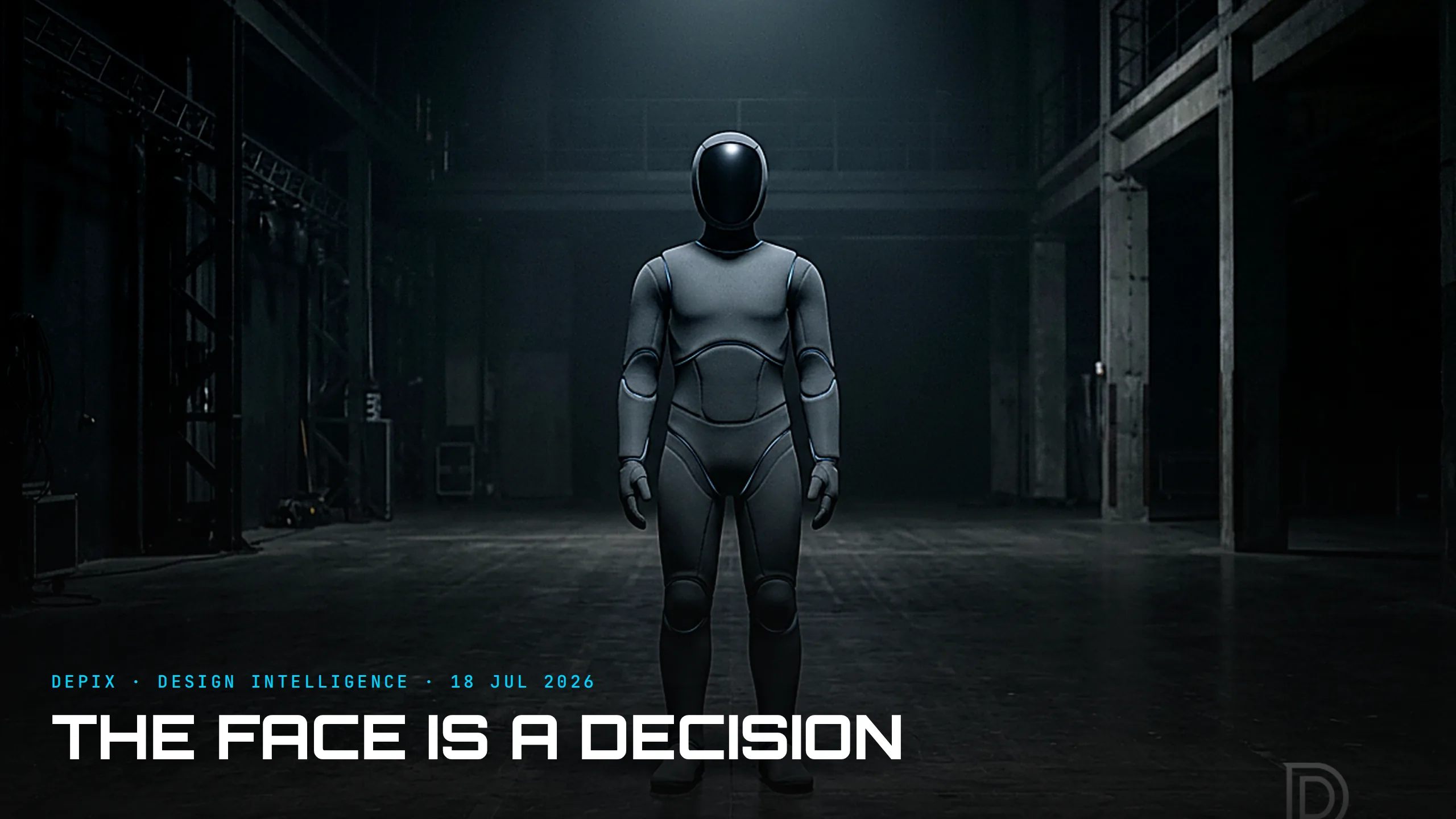
Here is the contrarian part. The popular assumption is that the industry is racing toward more human — more realistic faces, warmer skin, more expression. Some are: a new Chinese home robot, Moya, wears soft "muscle" materials and a lifelike expressive face explicitly to escape the "steel image." But the machines actually being deployed at scale — the ones going into factories — are doing the opposite. Figure 03 deploying into real production has no face at all. Where a head would be there is a calm, featureless dark visor: no eyes, no mouth, nothing to misread. Its exterior is soft and matte, softly curved with eased edges rather than sharp corners and threatening musculature. It is deliberately, strategically less human than it could be.
That is not a failure of ambition. It is a design decision, and a sophisticated one. In a workplace you do not want the illusion of a colleague; you want an unmistakable, trustworthy tool whose intentions you can read instantly. Removing the face removes the lie. A dark visor makes no promises it cannot keep, triggers no expectation of empathy, and never lands in the valley because it never pretends to climb out of it. A whole strand of design research calls this exact move reducing the uncanny valley by dehumanizing the robot — leaning into the machine, not away from it.
So the real lesson is not "make robots cute" or "make robots human." It is that the uncanny valley is not a bug to engineer past — it is a boundary to design around, and where you place yourself relative to it is a strategic choice tied to where the robot will live. A factory logistics robot and a home-care companion sit on opposite sides of that boundary, and they should look nothing alike — not because of styling taste, but because they are making different promises to different people. The design of an at-home robot is uniquely hard precisely because it must be accepted by everyone in the house, including the family members most sensitive to the uncanny effect.
This is the part designers have always known and engineers are now rediscovering: form communicates intent before function is ever demonstrated. You judge the robot the instant you see it — safe or threatening, tool or impostor, mine to command or something to back away from — and that judgment is set by silhouette, face, material and proportion, all decided at the concept phase. The team that makes Figure 03 lift a heavy cart is doing engineering. The team that decided it should have no eyes is doing design intelligence, and their decision is the one that determines whether anyone will stand beside it.
At Depix, that is the phase we care about most: the moment, long before the thing is built, when its form is quietly deciding how the world will feel about it. A humanoid robot is simply the most literal example yet. The face — or the deliberate absence of one — is a decision. Make it on purpose.
Sources:
- ●BMW Group — Advancing Physical AI in production with the Figure 03 project in Spartanburg
- ●Automotive World — BMW Group brings Figure 03 humanoid to Spartanburg
- ●Interesting Engineering — BMW deploys Figure 03 humanoid at smart factory for logistics
- ●BMW Blog — BMW Figure 03 Humanoid Robot Joins Spartanburg Plant
- ●The AI Insider — BMW to use Figure 03 for logistics work at US factory
- ●Humanoid Robotics Technology — Figure deploys Figure 03 at BMW Plant Spartanburg
- ●RoboZaps — The Uncanny Valley Explained (2026)
- ●BGR — This new Chinese robot brings the uncanny valley to your home (Moya)
- ●Springer — Facing the Uncanny Valley: Ambiguity as a Design Strategy for Human–Robot Interaction
- ●ScienceDirect — Reducing the uncanny valley by dehumanizing humanoid robots
- ●Interconnects (Nathan Lambert) — The uncanny world of at-home robots
- ●Medium (M. H. M. Farimani) — Uncanny Valley Theory in the Design of Robots

Read at a Glance: What Geneva Watch Days Reveals About the Lost Discipline of Legibility

The Reference Turns Inward: What Shanghai Fashion Week Reveals About Designing for Yourself