
Ford lost at Le Mans on purpose, and that's strategy.
Two Ford Mustang GT3s lined up at the Circuit de la Sarthe for the 94th 24 Hours of Le Mans on 13–14 June 2026. Neither finished on merit. The No. 88 car, shared by Logan Sargeant, Giammarco Levorato and Stefano Gattuso, was classified 17th in the LMGT3 class after retiring at 323 laps. The No. 77 — Sebastian Priaulx, Ben Tuck and Eric Powell — was running competitively until a gearbox failure ended its race after roughly 17 hours, leaving it 21st. Toyota took the overall win, its sixth, with the No. 7 Hypercar. On the scoreboard, it was a quiet weekend for the Blue Oval.
Read it as a result and it stings. Read it as a plan and it looks deliberate. Ford is not at Le Mans this year to win the race in front of it. It is there to learn its way into the one that matters: a return to the top-tier Hypercar class in 2027, after more than five decades away from the overall fight it last won in 1966.
Racing as a development tool, not a trophy hunt
The LMGT3 Mustang programme, run by Proton Competition, is doing exactly what a smart concept team does before a big launch — failing cheaply and on purpose. A 24-hour race is the most punishing reliability test in motorsport. A gearbox that lets go at hour 17 is not a wasted weekend; it is a data point Ford would far rather discover now, on a customer-class car, than in 2027 when a clean-sheet Hypercar carries the whole brand's name. Ben Tuck, ahead of the race, said simply: "I feel like we are going to have a good one this year." The honest version is that Ford is buying experience at the Sarthe's specific, unforgiving rhythm — the long Mulsanne straights, the brutal kerbs, the temperature swings across a full day and night — and paying for it in finishing positions.
The question a Ford design chief should ask is sharper: is the organisation actually capturing what each of these hard weekends teaches, or just absorbing the bruise? Endurance racing only compounds into design advantage when the failure data flows back into the people drawing the next car. That feedback loop is the real asset, and it is invisible on the timing screens.
The 2027 plan is more interesting than the 2026 result
Ford's Hypercar will be built on a chassis from French specialist ORECA, paired with a Ford high-performance powertrain, with the project led by Dan Sayers — drawn from the Red Bull Ford F1 power-unit effort. ORECA has underpinned multiple manufacturers' Hypercar campaigns, so Ford is buying proven prototype architecture rather than reinventing the tub. That is a confident, unsentimental call: spend your originality where it differentiates the brand — powertrain character, aero signature, the way the car reads as a Mustang — and rent the parts that are simply hard engineering.
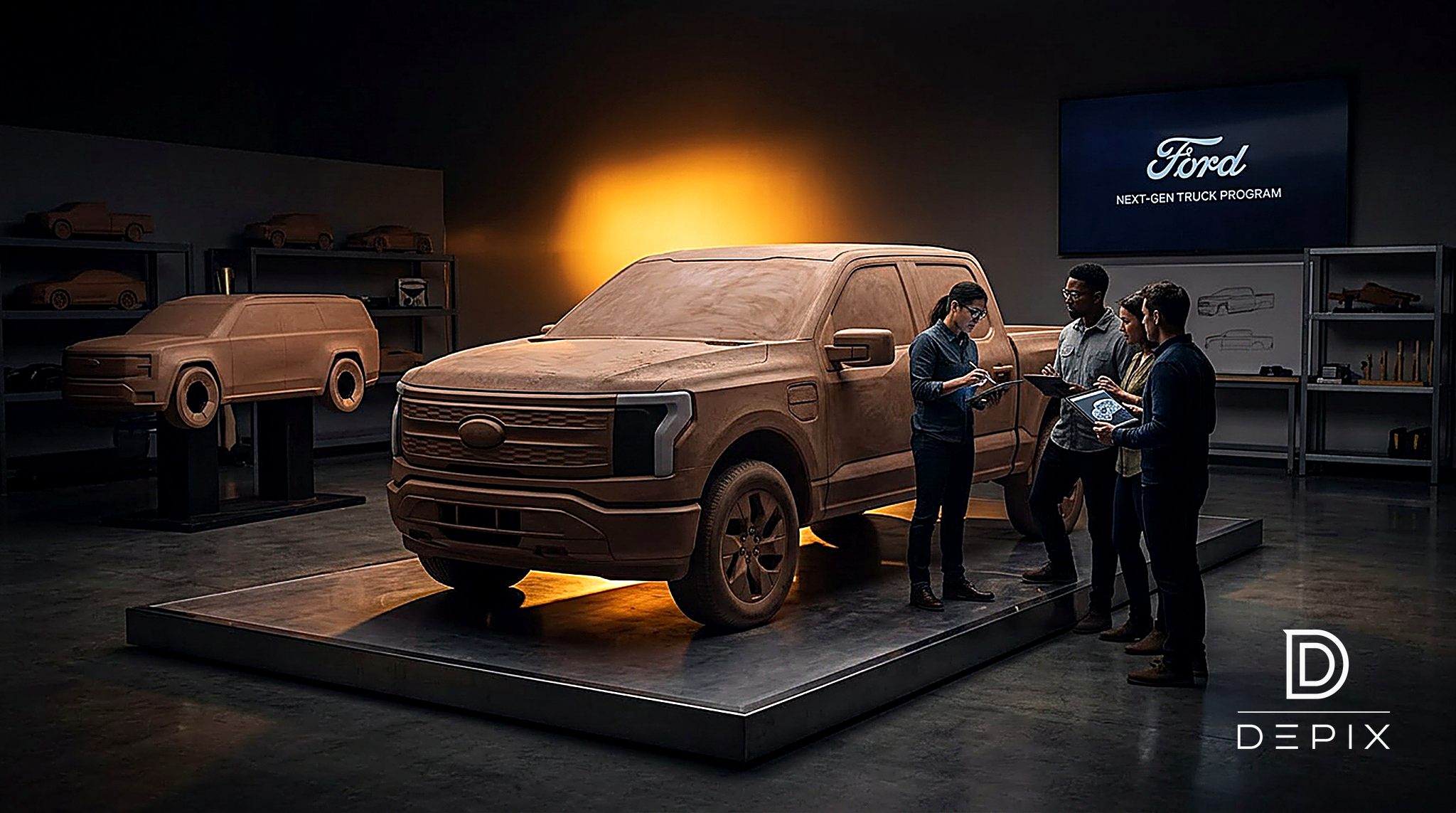
This is where the design-intelligence value sits. A halo racer is the purest expression of a brand's form language, and everything Ford learns about aero surfaces, cooling, proportion and stance on the GT3 car becomes vocabulary for the Hypercar — which in turn trickles down to road-car styling cues the public actually buys. The Mustang's road and race identities are meant to rhyme. Getting that visual through-line right, early, is a concept-phase decision, not a late-stage wrap.

Where the patience could go wrong
Supportive does not mean uncritical. Two risks are worth naming. First, "we're here to learn" is a story that only holds for so long; by 2027 the results have to come, or the patience narrative curdles into an excuse. Second, leaning on ORECA for the chassis means Ford's distinctiveness rests almost entirely on powertrain and bodywork — so the design and aero teams carry disproportionate weight in making this car feel like Ford, not a rebadged prototype. That is a brief worth pressure-testing in simulation and clay long before the first ORECA tub arrives.
For now, the smart read is that Ford did not lose at Le Mans so much as it spent a weekend buying tuition. The bill comes due in June 2027.
Sources
- ●2026 24 Hours of Le Mans — A Learning Experience for Ford Racing Driver (Ford Authority, 16 June 2026)
- ●Ford Mustang GT3 Takes On Le Mans (Ford Racing, 8 June 2026)
- ●2026 24 Hours of Le Mans (Wikipedia)
- ●2026 24 Hours of Le Mans Results (Motorsport.com, 14 June 2026)
- ●Preparing for Le Mans: Ford Officially Announces Its 2027 WEC Hypercar Strategy (NetEase Auto, translated from Chinese, 16 June 2025)
Ford folded design into engineering, and that's a bold bet.

Lincoln's bestseller is built in China, and that's a design win.
