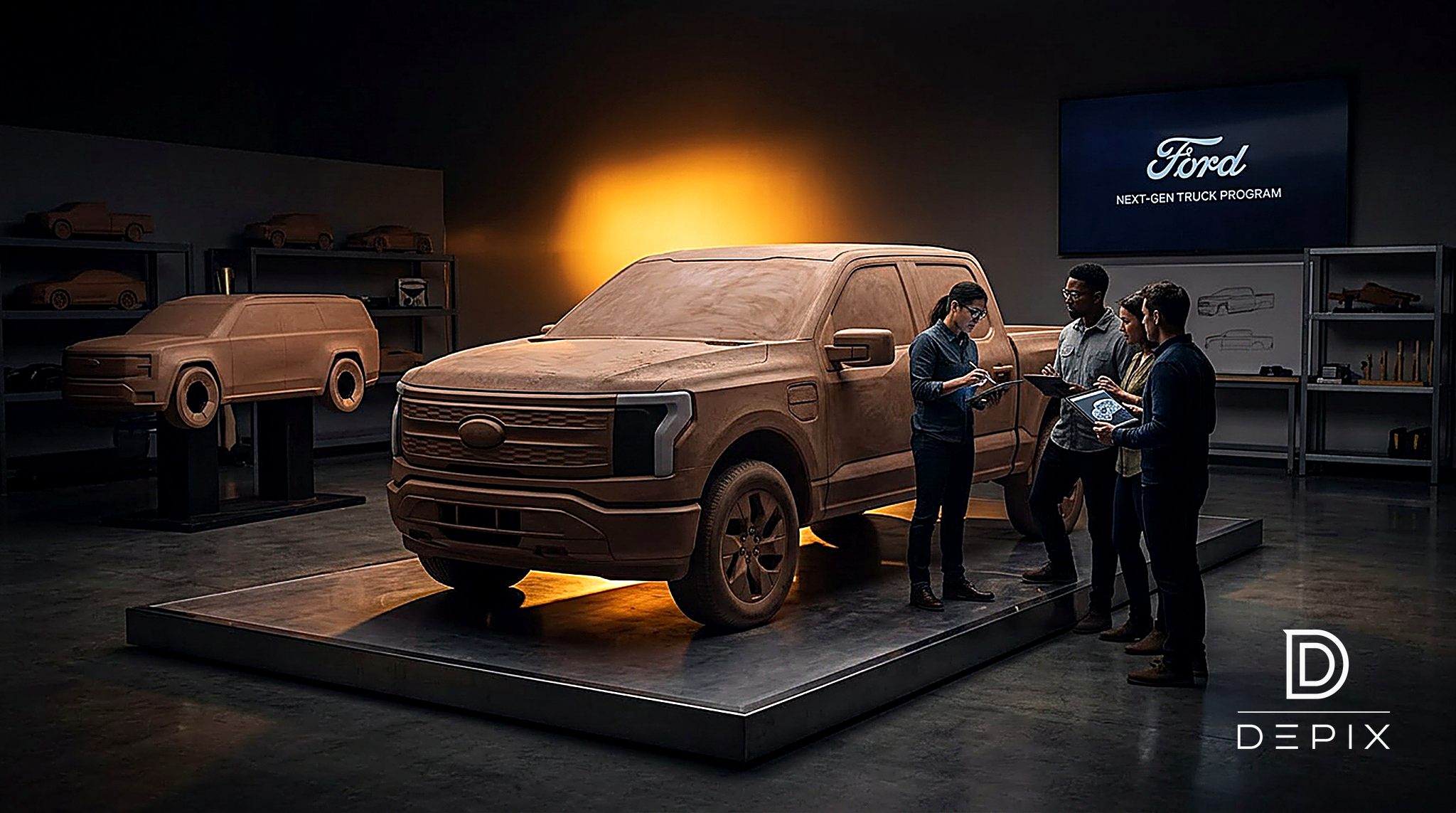
Ford folded design into engineering, and that's a bold bet.
Most reorganisations are plumbing. This one moved a wall.
In April 2026 Ford created a single end-to-end organisation called Product Creation and Industrialization, merging what used to be three separate worlds — Electric Vehicle, Digital, and Design — into one structure with engineering, purchasing, and manufacturing. The whole thing now reports to Chief Operating Officer Kumar Galhotra. At the same time, Doug Field — who arrived from Apple in 2021 as chief EV, digital and design officer, after running Model 3 at Tesla — is leaving the company. Ford Design itself continues under Todd Willing.
Read past the org-chart language and there's a real design question here, one a Ford design chief should be weighing right now: when design stops being its own C-suite function and becomes one input inside a product-and-manufacturing machine, does the work get sharper — or does it get sanded down?
Why Ford did it
The stated logic is speed. Galhotra's framing was blunt: "By uniting advanced technology with industrial execution, we can make decisions faster, eliminate complexity and deliver great vehicles." Jim Farley called it "the culmination of years of work… a talented, unified organisation." The targets behind the words are aggressive — refresh 80% of Ford's North American volume and 70% of its global volume by 2029, hit an 8% adjusted EBIT margin the same year, and by 2030 have 90% of vehicles by volume running updated zonal electrical architectures with in-house software and continuous over-the-air updates.
That is a software-defined-vehicle bet, and SDVs change what "design" even means. The product is no longer just a shape that gets frozen at clay sign-off and shipped. It keeps changing after it leaves the factory — new features, new screens, new behaviours pushed overnight. Design that lives in a silo, handing finished surfaces "over the wall," can't keep up with a vehicle that's never finished. So folding design into the same org as software and manufacturing is, on paper, the right structural answer.

The bet, and the risk
Here's the supportive-but-honest part. The upside is genuine: design decisions made with engineering and manufacturing in the room get costed, packaged, and validated in real time instead of months later. Fewer beautiful concepts die in the gap between studio and plant. For a company chasing a 2029 cost target, that discipline is worth a lot.
The risk is equally real, and every design leader who has lived through a "great integration" knows it. When design reports up through a structure optimised for industrial execution and margin, the things that don't show up on a cost sheet — stance, surface tension, the brand's emotional signature — are the first to get value-engineered out. A truck that's 4% cheaper to build but loses the face that made it a Ford is a bad trade that looks great in a spreadsheet. The Edsel, decades ago, was a lesson in research and committees overruling the designers; the modern version of that mistake wears a software-and-cost badge.
So the question isn't whether Ford was right to merge — it almost certainly was. It's whether design keeps a loud, protected voice inside the merged org, or quietly becomes a downstream service that makes engineering's decisions look nice. Galhotra's challenge is to get the speed and keep the soul.
Where this points
This is exactly the seam DEPIX cares about. In a world of zonal architectures and shared platforms, the engineering is increasingly common across the lineup — which means design is one of the few places left to differentiate. The faster a unified org moves, the more dangerous it is to make those design calls late, on instinct, or under cost pressure with no evidence.
Concept-phase design intelligence is the counterweight: the ability to see, compare, and pressure-test design directions early — before they're locked into a platform and a plant schedule — so the design decision is made on evidence, not defended after the fact. The parallel design team in a box doesn't replace Willing's studio; it gives it the data to hold its ground when the org moves fast.
Ford made the structurally brave choice. The design win now depends on making sure speed and soul aren't a trade-off.
Sources
- ●Ford Establishes New Product Creation and Industrialization Organization
- ●Ford creates new unit to deliver next-gen vehicles, software and services (WardsAuto)
- ●Ford (F) Creates Product Creation and Industrialization Organization Under COO Kumar Galhotra (Yahoo Finance)
- ●Ford Restructures Product Development to Accelerate EVs (ElectricCarsReport)
- ●Ford's new Product Creation and Industrialization Organization to scale next-gen vehicles (Repairer Driven News)
- ●Ford Design careers

Ford makes rally heritage its one design language for Europe

Ford lost at Le Mans on purpose, and that's strategy.
