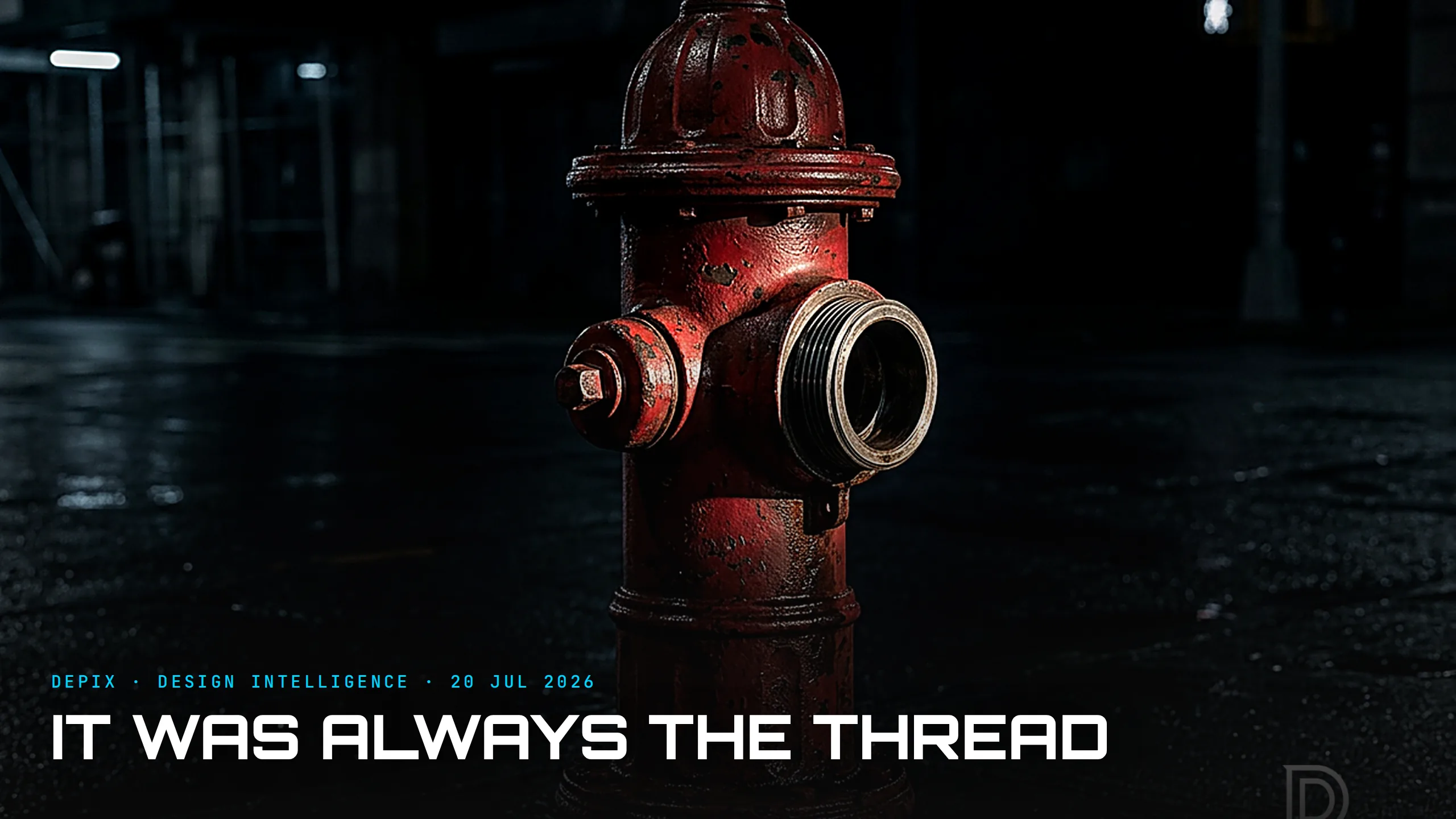
The Most Important Part of a Fire Hydrant Was Never the Hydrant
There is a bright object on almost every street corner that you have completely stopped seeing. The fire hydrant is so ordinary it has become invisible — and that is a shame, because it hides one of the most important lessons in all of design: that the single most consequential decision in an object is often the one part nobody thinks of as "the design" at all.
Consider first how settled the hydrant itself is. The post-type hydrant is usually credited to Frederick Graff, chief engineer of the Philadelphia Water Works, around 1801, and the modern design was patented by Birdsill Holly in 1869 before spreading across the world. There is even a perfect irony buried in its history: the original American patent for the fire hydrant was itself destroyed in the 1836 fire at the U.S. Patent Office, which consumed nearly ten thousand patents. The device we built to help fight fires could not protect its own paperwork from one. As an object, though, the hydrant was solved long ago — a valve, a riser, a couple of outlets, painted a colour you can spot from a moving truck.
The real design problem was hiding somewhere else entirely, and it took a catastrophe to expose it. On 7 February 1904, the Great Baltimore Fire broke out downtown. Crucially, help came fast — fire companies raced in from Washington, Philadelphia, New York, Wilmington and beyond. And then, in front of the flames, many of them discovered they could do nothing. Their hose couplings would not fit Baltimore's hydrants, because the thread sizes did not match. Engines sat useless while firefighters watched. Crews tried lashing and wrapping the mismatched couplings in cloth and canvas to force a seal; nothing held, and the water that could have checked the blaze stayed locked inside hydrants standing a few feet away. The fire burned for more than 30 hours and destroyed roughly 1,500 buildings across some 70 city blocks.
Sit with what actually failed there. It was not the hydrants — they worked. It was not the hoses — they worked. What failed was the interface between them: a thread, a standard, an agreement about a few millimetres of pitch and diameter that nobody in the crisis could see and nobody could fix in time. The most important design decision in the entire firefighting system was invisible in normal use and only revealed itself at the one moment it was catastrophically tested. In the aftermath, the National Fire Protection Association drove the adoption of a National Standard Thread so that a hose from one city could finally couple to a hydrant in another.
Here is the contrarian twist, and it is the part designers should sit with longest: it still isn't finished. More than a century later, the United States is not fully standardised — thousands of jurisdictions still run their own incompatible threads, which is why mutual-aid crews carry bags of adapters, and why engineers keep pushing "sexless" Storz couplings that connect regardless of orientation. Designing the object was easy. Getting everyone to agree on the invisible interface is the genuinely hard problem, and it is never quite solved, because it is a problem of coordination, not engineering.
This is the concept-phase lesson, and it is a big one. Every product lives inside a web of interfaces — the thread it screws into, the socket it plugs into, the format it saves to, the protocol it speaks. Those interfaces are decided early, they are usually invisible, and they are frequently treated as an afterthought precisely because they are not the glamorous part. But the Baltimore fire is the permanent proof that the interface can matter more than the object — that a beautifully engineered hydrant is worthless if the hose can't connect, and that the highest-stakes decision was made, or neglected, at the standards table long before anyone struck a match. Design intelligence means caring about the thread as much as the casting: knowing that the part nobody notices is often the part everything depends on, and that you cannot retrofit an agreement in the middle of the emergency. The most important part of a fire hydrant was never the hydrant. It was always the thread.
Sources:
- ●Wikipedia — Fire hydrant
- ●Wikipedia — Frederick Graff (post-type hydrant, ~1801)
- ●F.F.A.M. — The Saga of the Fire Hydrant (Birdsill Holly, 1869)
- ●Classic City News — The patent for the original fire hydrant was lost in a fire
- ●Commonplace Fun Facts — Fire destroys fire hydrant patent (1836 Patent Office fire)
- ●Interesting Facts — The original fire hydrant patent was destroyed in a fire
- ●Wikipedia — Great Baltimore Fire (1904)
- ●Fire Engineering — 1904: The Great Baltimore Fire
- ●Wikipedia — North American fire hose coupler incompatibilities
- ●NIST — Major U.S. cities using National Standard fire hydrants, a century after Baltimore
- ●QRFS — A guide to FDC thread standards in different jurisdictions
- ●Wikipedia — Storz (sexless hose coupling)
- ●Wikipedia — National Fire Protection Association
- ●ZenTrades — Fire hydrant history and evolution

The Armrest in the Middle of That Bench Was Never for Your Arm

The Most Overlooked Object in the City Is a Quiet Masterclass in Design