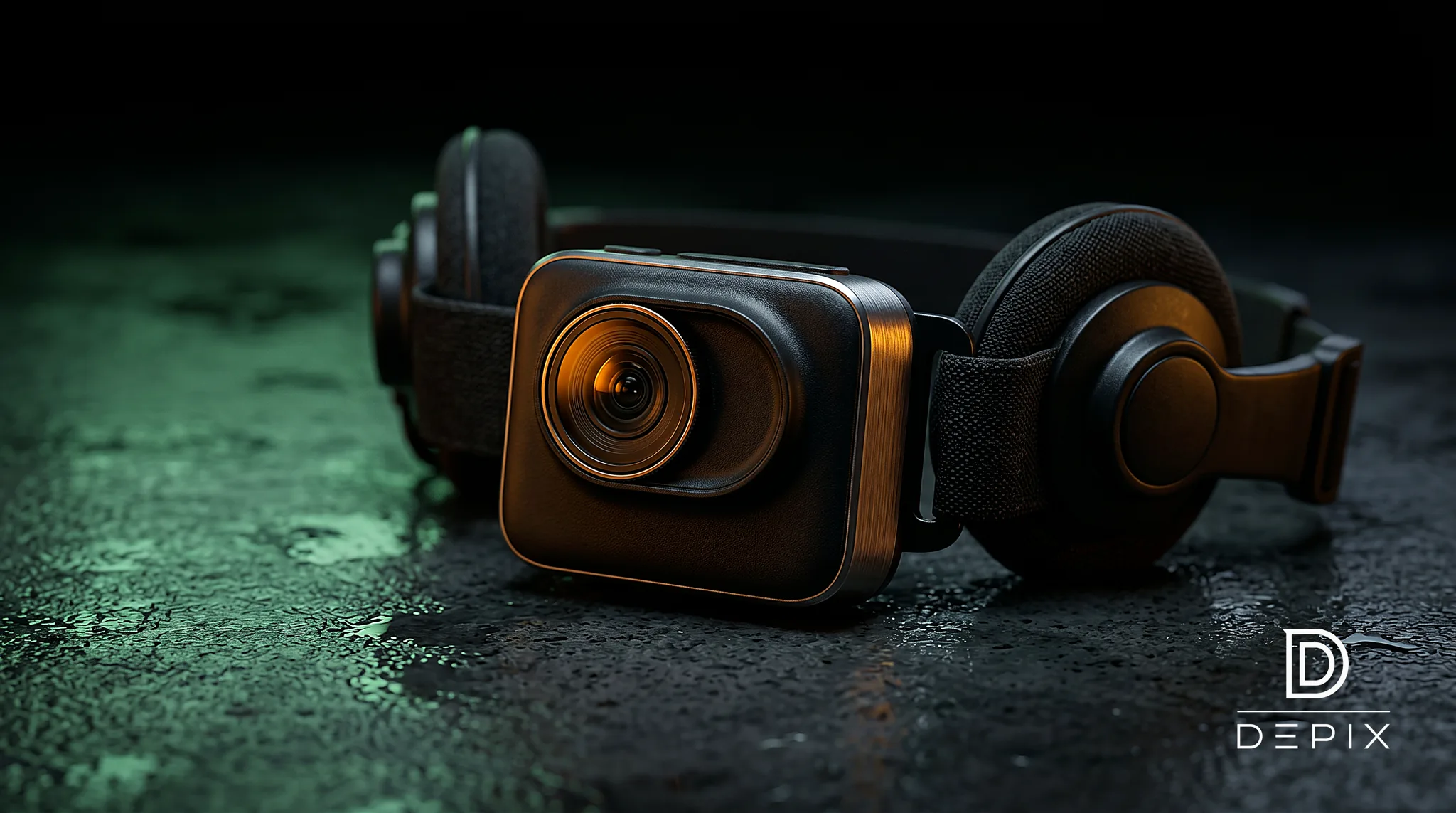
FIFA's ref-cam shows the referee's view, never the wrong calls.
date: 2026-07-06
FIFA's ref-cam shows the referee's view, never the wrong calls.
The most-hyped new object at the 2026 World Cup isn't a boot or a ball. It's a thumb-sized camera clipped to the referee's headset, feeding you the game from inside the whistle. FIFA calls it RefCam, and it is genuinely thrilling television: a striker's shirt filling the frame, the net rippling a metre from your face, the ball arriving at the speed a referee actually sees it. Rolled out across all 104 matches after a quiet 2025 Club World Cup trial that FIFA's Pierluigi Collina said "went beyond our expectations," it is the closest a fan has ever stood to the person who decides the match.
And that is exactly where the design decision hides.
A body camera on an official reads, instinctively, as accountability. Police body-cams exist to be watched back — to settle what happened when the human account and the crowd's account disagree. Put a camera on the one person whose judgment the entire stadium is screaming about, and the obvious brief writes itself: show us the call. Show us what the referee saw when the arm went up.
FIFA designed the opposite. The RefCam feed is not part of the ISO feeds available to broadcasters. FIFA's head of host broadcast production, Oscar Sanchez, said so plainly. The footage travels on a separate private 5G path, gets folded into curated replays, and is released on FIFA's terms — a highlight ingredient, not a review tool. Lenovo's AI even smooths the footage by up to 50%, sanding off the jitter that would make it feel raw. The one angle that could most easily be turned against officiating has been engineered into the one angle FIFA fully controls.
This is not a technical accident. It is a concept-phase decision about what the object is for, made long before a single lens shipped. The same hardware — a camera on a referee's head — can be an accountability instrument, a broadcast spectacle, or a training archive. Those are three different products that happen to share a housing. FIFA chose spectacle, then built the entire distribution system to enforce that choice: separate feed, private network, controlled release, AI polish. The brief was "premium point-of-view content," and every downstream constraint flows from it.
The tell is what RefCam never shows you. It gives you the referee's eyes and withholds the referee's decisions — the disputed penalty from the angle that matters, the offside the human missed, the shirt-pull the whistle waved on. You get immersion without adjudication. It is the feeling of transparency, packaged so it can never actually hold anyone to account. A camera pointed at the most contested judgment in world sport, deliberately aimed away from the judgment.
That is the lesson design teams keep learning the expensive way. The meaning of an artefact is set by what you decide it is for, not by what it physically is — and that decision is nearly free to change while it's still a sentence, and nearly impossible to change once the pipeline is built around it. FIFA could have defined RefCam as officiating transparency for the cost of one line in a spec. Choosing spectacle instead locked the feed architecture, the release policy, and the fan's relationship to the referee for a generation. A camera is neutral. A brief is not.
This is the discipline DEPIX builds for the concept phase: pressure-testing what a design is for — who watches it, what it's used to decide, how it behaves in the real room — while the answer is still cheap to change. See the decision in its actual context before it hardens into infrastructure. Because by the time RefCam is streaming from 45 cameras across 104 matches, the only question left is the one FIFA already answered for you: this was built to be watched, not to be judged.
Sources
- ●Referee body cameras at the 2026 World Cup, explained — Yahoo Sports
- ●FIFA World Cup 2026: RefCam, VAR and 45 cameras per match — RedShark News
- ●FIFA's new referee cameras might be the coolest camera tech at the 2026 World Cup — Digital Camera World
- ●World Cup technology: from ref cams to AI analysts — The Conversation
- ●Ref-Cam at the World Cup: how it works — Wego Travel Blog
The World Cup's most trusted tool works because it's empty.

FIFA gave the World Cup three mascots and no icon.
