Designed to Be Understood
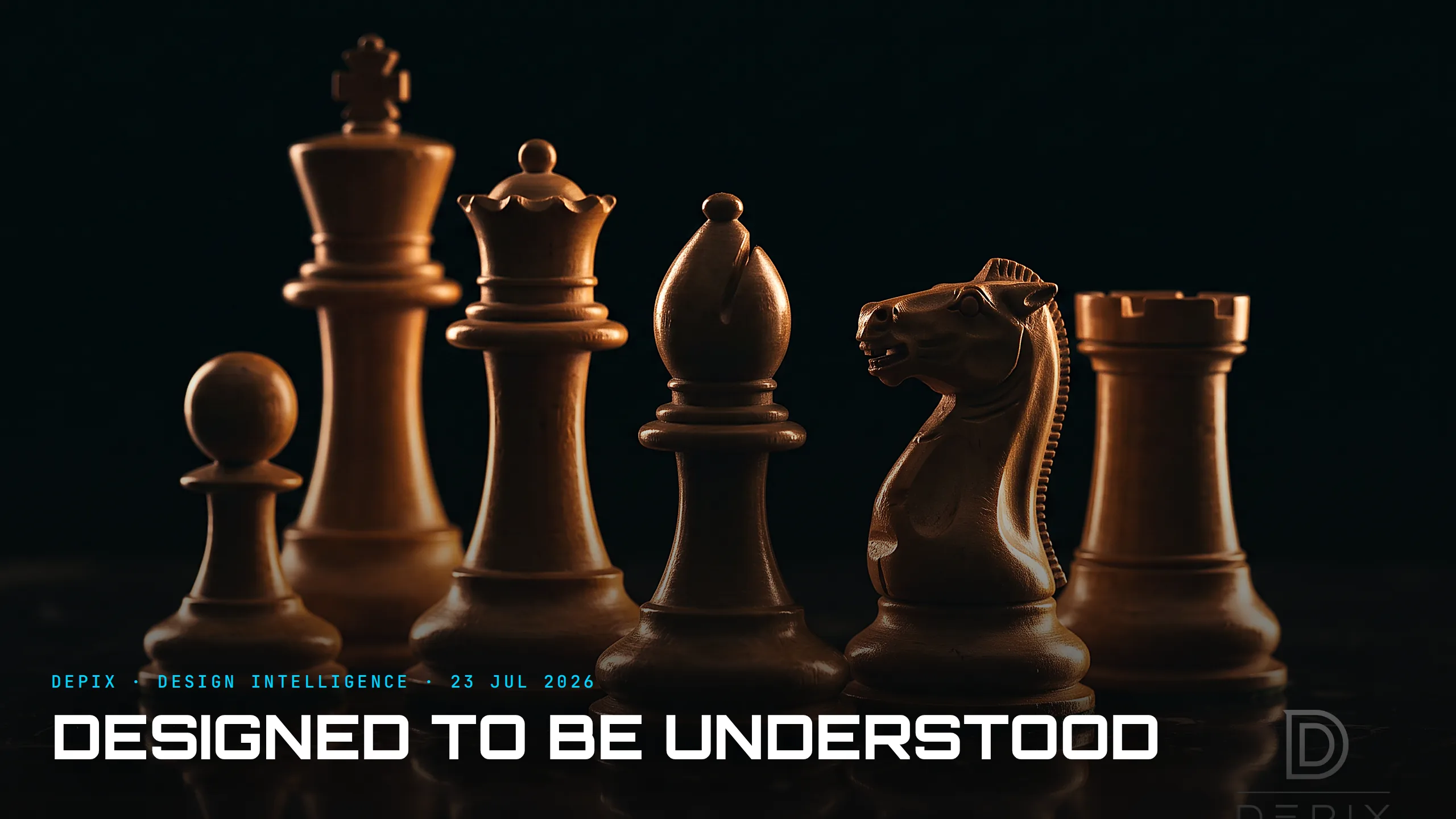
Pick up a knight from a good chess set and you know instantly what it is: a horse's head. The king wears a cross, the bishop a mitre, the rook a castle turret, the queen a coronet, the pawn a simple ball. You never think about why. That effortless recognition is one of the most successful pieces of industrial design ever made — and, like most great design, it is invisible precisely because it works.
It was not always so. For centuries, chess pieces were a chaos of local styles: ornate St George sets, the spindly Régence pattern popular in French cafés, elaborate figurative sets where kings and knights were literal little sculptures — often beautiful, but a practical nightmare. Pieces were top-heavy and toppled; a bishop could be mistaken for a king across the board; every region and every maker had its own idiom, so two players from different cities could barely agree on what they were looking at. As competitive chess grew through the nineteenth century, the sets were actively getting in the way of the game.
The fix arrived in 1849. A design registered by Nathaniel Cook and manufactured by Jaques of London was lent enormous authority by the era's most famous player, Howard Staunton, whose name it still carries. The Staunton set did something quietly radical: it stopped trying to depict and started trying to signify. Each piece was reduced to a single, stable, abstract symbol — weighted with a low centre of gravity and a broad felted base, tall enough to find by hand, distinct enough to read by silhouette alone. It was not decoration. It was disambiguation.
That is the whole design lesson, and it is a subtle one. The Staunton pieces are admired as beautiful objects, and they are — but their beauty is a by-product of clarity. Every choice serves recognition: the height hierarchy encodes rank, the crown motifs separate king from queen at a glance, and the abstraction means a Staunton set reads the same whether carved from boxwood or moulded in plastic, in any language, anywhere on earth — an affordance the hand and eye trust without a manual. The design succeeded by removing ambiguity, not by adding ornament.
Because it removed ambiguity so completely, it became the standard. FIDE, the world chess federation, requires Staunton-pattern pieces for official competition. And the design underwrites the game's shared language: because everyone recognises the same pieces, everyone can use the same notation — Nf3, Bb5 — so a game played in Reykjavík can be read, replayed and studied in Buenos Aires a century later. Standardising the object standardised the whole culture around it. A set of small wooden figures quietly became a piece of global infrastructure.
This is the part worth carrying into any design problem. We tend to equate design with expression — with making something distinctive, ownable, striking. But some of the highest-value design does the opposite: it makes something unmistakable. It resolves ambiguity so cleanly that a system becomes usable by everyone, immediately. Legibility is not the boring cousin of beauty; in a functional object it often is the beauty. The question "what must each element unmistakably communicate?" is a concept-phase question, and it is answered in the fundamental form, not in the finish.
Get that clarity wrong and no amount of craftsmanship rescues it — the gorgeous figurative sets lost to a plainer rival because they were simply harder to play with. Get it right, as Cook and Jaques did, and the design disappears into pure function and lasts the better part of two centuries. The rules of the game were fixed on paper; the legibility of the game — the ability of any two strangers to sit down and simply play — was fixed by the shape of the pieces. Design's quietest superpower is not making things look new. It is making them instantly understood.
Sources:
- ●Staunton chess set — the 1849 standard pattern (Wikipedia)
- ●Howard Staunton — the player who lent his name (Wikipedia)
- ●Jaques of London — the maker (Wikipedia)
- ●Chess piece — patterns and history (Wikipedia)
- ●Chess (Wikipedia)
- ●FIDE — requires the Staunton pattern for competition (Wikipedia)
- ●Algebraic notation (chess) — the shared language (Wikipedia))
- ●Rules of chess (Wikipedia)
- ●Industrial design (Wikipedia)
- ●Iconography — depicting vs signifying (Wikipedia)
- ●Affordance (Wikipedia)
- ●Standardization (Wikipedia)
- ●Legibility (Wikipedia)


