The Ceramic Tile Is Where Material Became a Decision
Every year in late September, Bologna becomes the place where the world decides what a surface is allowed to look like. Cersaie 2026 runs from 21 to 25 September at BolognaFiere, the forty-third edition of a fair that last year drew more than 94,000 visitors and over 600 exhibitors. Walk the halls and you will see marble that is not marble, oak that never grew, oxidised steel that never rusted. You will see, in other words, the exact moment when material stopped being a fact and became a decision.
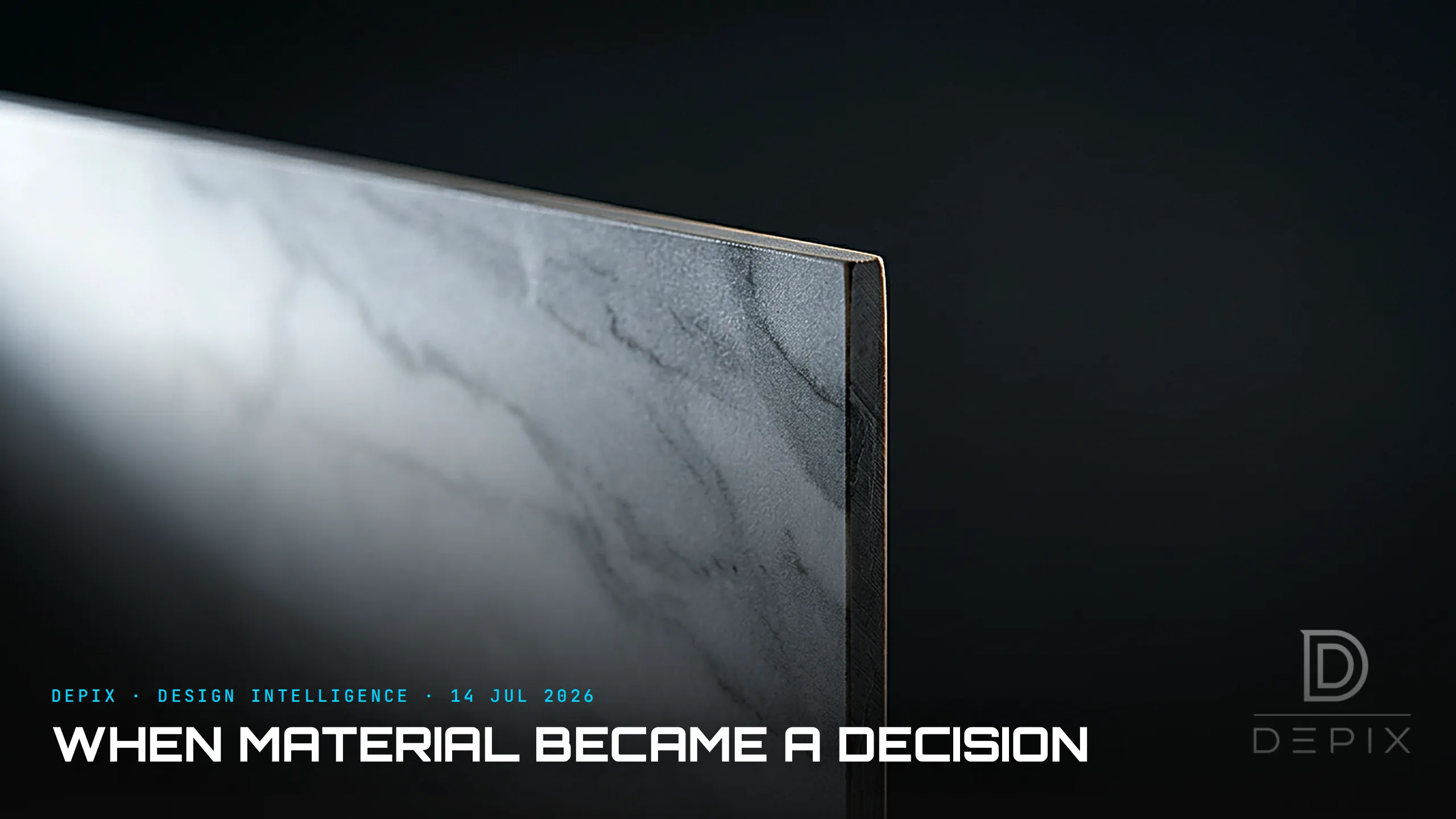
The engine of that shift is boring and total. Large-format porcelain slabs now reach 1620 by 3240 millimetres, thin enough to clad a wall and thick enough to carry a worktop. Onto them, single-pass digital inkjet sprays ceramic pigment at photographic resolution, a technology Durst first shipped commercially in 2004 and that EFI Cretaprint and others turned into an industry standard. Marazzi describes the result plainly: the same process reproduces the knots of wood, the grain of stone, the veins of marble and the flawed shades of concrete. The Xaar guide to ceramic decoration reads like a manual for convincing forgery.
Here is the contrarian point. The slab that reads as Carrara is not where the design lives. It is the output, the picture. The design happened upstream, at the concept phase, in decisions no visitor will ever see. Consider three of them.
First, the module and the joint. A slab is not a photograph; it is a component that must repeat. The choice of module dimension and the rectified edge, ground true after firing so tiles butt to a joint of a millimetre or two, is what lets many pieces read as one continuous plane. Get the module wrong and the eye reads a grid of pictures. Get it right and the surface disappears into architecture. That decision is made in CAD, months before the first slab is pressed.
Second, the loop. Natural marble never repeats; printed marble always wants to. So the concept-phase problem is randomisation: a designer must author enough distinct graphic faces, and enough rotation logic, that the pattern tiles seamlessly across hundreds of pieces without the eye ever catching the loop. This is a mathematical brief disguised as an aesthetic one. Cheap collections betray themselves the moment you notice the same 'unique' vein three tiles over. The good ones hide the seam in plain sight.
Third, and hardest, the choice of what to simulate and how honestly. This is where 'material honesty' needs rescuing. For a century the phrase meant a thing should be what it is made of. That test is now dead. When porcelain can convincingly be marble, the question is no longer what the surface is made of but whether it tells the truth about its role, its module and its making.
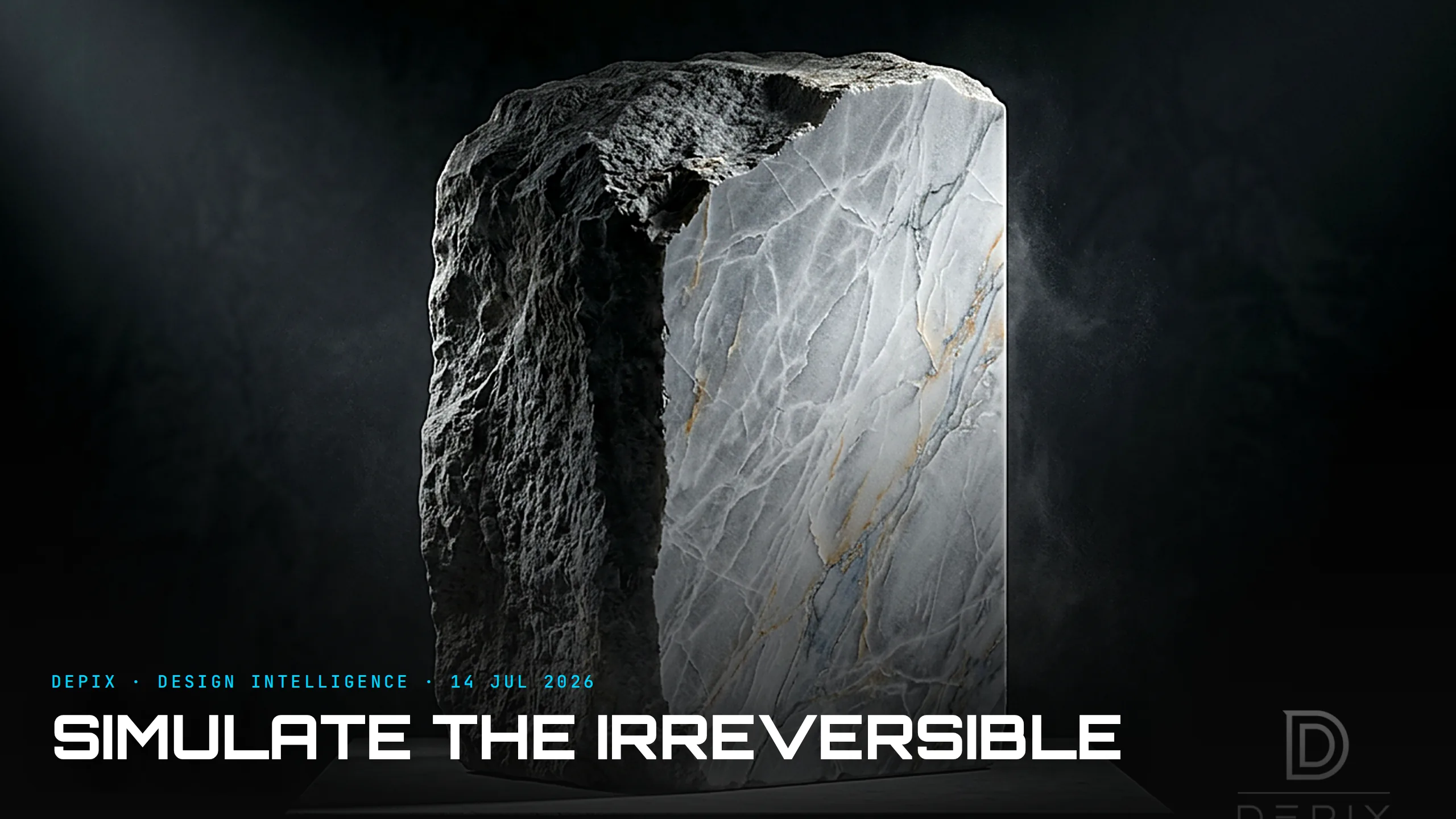
The industry's own most interesting move proves the point. Watch the growth of through-body veining, where the vein runs through the full thickness of the slab rather than sitting on top as ink. Atlas Plan's Natura-Vein Tech reproduces the pattern through the whole body, so a cut or mitred edge shows the same vein as the face. Florim Stone goes further, using a dry digital process free of glazes, inks and surface applications, where the design develops through the full thickness. SapienStone builds worktops the same way. None of this makes the porcelain into marble. What it does is make the porcelain honest about being a solid, machinable body rather than a printed skin. The vein no longer lies about what happens when you cut the edge.
That is a concept-phase decision, not a surface one. It is settled in the body composition and the press, long before decoration. And it is the tell that separates surfaces that age well from pictures that age badly. A tile designed as a picture is perfect on day one and disappointing at the first cut edge, the first repeated face, the first worn corner where the ink stops and grey biscuit begins. A tile designed as a surface survives contact with reality because its honesty was specified upstream.
So the real news at Cersaie is not that porcelain can now imitate anything. It is that imitation is free, and freedom relocates the design problem. When any surface can be any material, the decisive act is no longer choosing marble. It is choosing what your surface will be honest about, and locking that choice at the concept stage, before the printer makes it beautiful and the joint makes it permanent. The tile on the wall is the easy part. The design was finished before the ink was loaded.
Sources:
- ●Cersaie: International Exhibition of Ceramic Tile and Bathroom Furnishings (official)
- ●Cersaie Bologna 2026: dates, news, exhibitor list (Archiproducts)
- ●Laminam: Sizes and Thickness (1620x3240 large-format slabs)
- ●System Ceramics: Creadigit single-pass ceramic digital printer
- ●Durst: Ceramics segment (single-pass ceramic inkjet, first commercial 2004)
- ●EFI Cretaprint ceramic inkjet printers
- ●Marazzi: Inkjet digital printing on ceramic and stoneware tiles
- ●Xaar: A Guide to Ceramic Tile Digital Decoration (PDF)
- ●Refin: What is a Rectified Tile? (edge treatment, minimal joint)
- ●Atlas Plan: Natura-Vein Tech (through-body veining)
- ●RAK Ceramics: Through-Body Veining
- ●Florim Stone: dry digital, full-body porcelain surfaces
- ●SapienStone: full-body porcelain worktops
- ●Florim: Marble-effect porcelain tiles