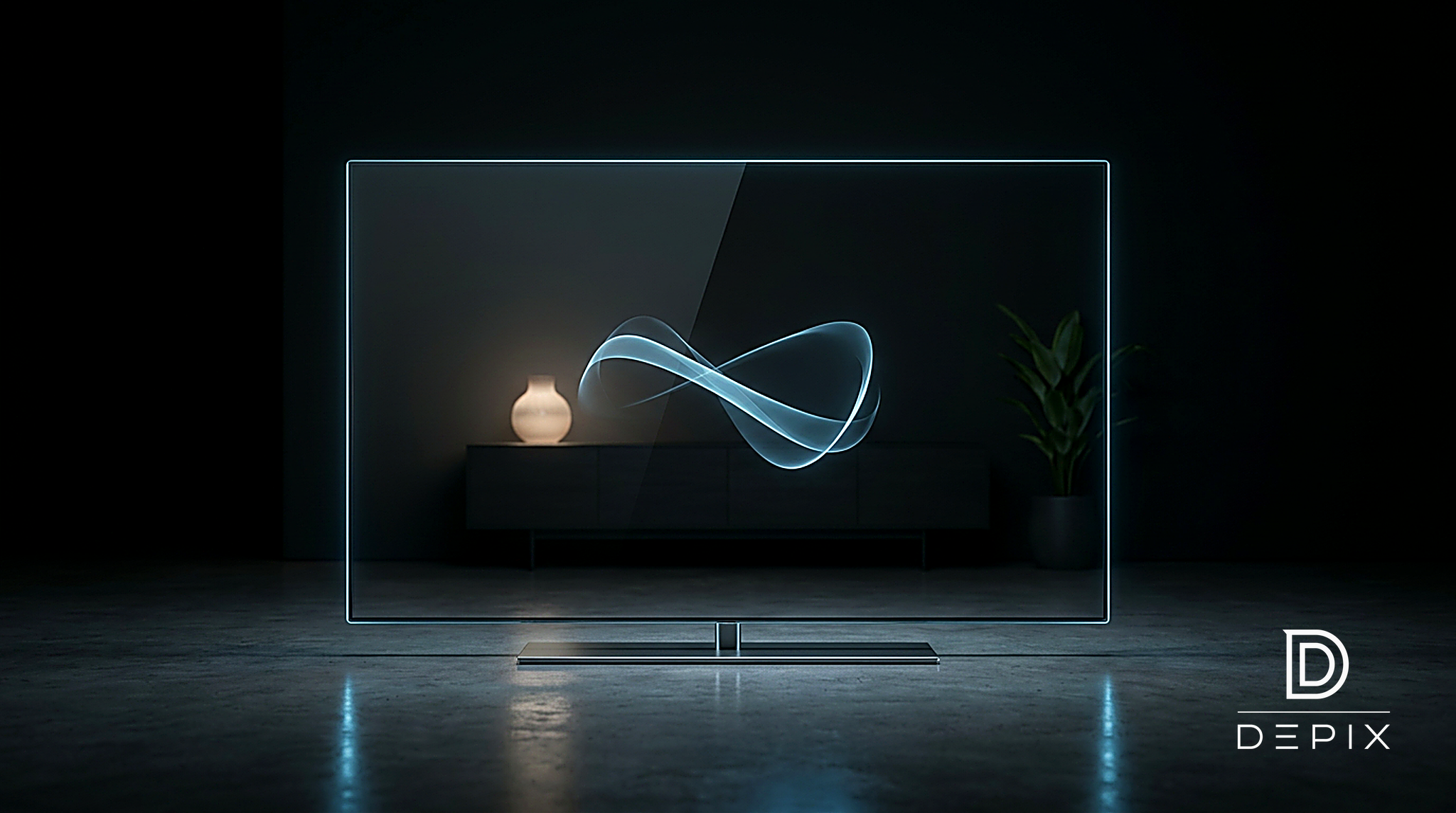
The transparent TV solves a problem nobody actually had.
For two years the most photographed object at every electronics show has been a television you can see through. Switch it off and it dissolves into the room — a pane of glass with the credenza and the houseplant glowing behind it. Switch it on and it performs the trick in reverse, an image hovering in mid-air with no visible box holding it up. People stop. People film it. That reaction is the entire product, and it is worth being honest about what it costs.
A display has exactly one job: control light so that an image has contrast. Black has to read as black. The whole reason a screen looks "deep" is that the dark parts stay dark while the bright parts punch through. Transparency is the direct enemy of that job. If you can see your living room through the panel, you can see your living room through the dark areas of the picture too. The shadows fill with whatever is behind the glass. So the engineering answer is almost comic: a transparent TV ships with a second, opaque screen that slides up behind the glass to give you a real black background — at which point you are watching an ordinary, very expensive television, and the magic you paid for is switched off.
Read that sequence slowly, because it is the tell. The feature that sells the product is the feature you have to disable to use the product. The transparency exists for the showroom and the off state. The watching happens behind a curtain. One of the launch models reached buyers in late 2024 at roughly sixty thousand dollars — for a 4K panel whose picture, with the contrast screen down, is competitive with sets costing a tenth as much.
This is not an attack on the engineering, which is genuinely hard and genuinely beautiful. It is a question about what the engineering was aimed at. Somewhere upstream, a decision was made to optimise for the reveal — the gasp when the screen vanishes — rather than for the ten thousand hours a television actually spends being looked at. Both are legitimate goals. They are just not the same goal, and a product can only be honestly tuned for one of them. The transparent TV is tuned for the three seconds in the shop and apologises for the rest of its life with a hidden panel.
Designers know this pattern because it keeps reappearing. The folding phone that needs a crease to fold. The "buttonless" cabin that adds back a row of buttons. The seamless laptop that runs hot because there is nowhere for the heat to go. Each began as a beautiful idea about how the object should appear and quietly externalised the cost onto how the object actually behaves. The reveal demos perfectly. The use does not.
The expensive part is not the glass. The expensive part is finding out, after tooling and launch and sixty-thousand-dollar price tags, that the headline feature is one you have to turn off. That discovery should arrive in week one of concept, not in the first review. It is cheap to ask, before anything is built, the brutal version of the question — what is this object for in the off state versus the on state, and which one are we really designing for? It is expensive to ask it after the line is running.
That gap is where concept-phase intelligence earns its keep. Being able to see a form, a finish, a lighting condition, a contrast scenario photo-real before committing tooling lets a team stage the gasp and the grind side by side and decide, with eyes open, which they are building. Spectacle is a perfectly good thing to design for. The mistake is designing for it by accident, and only learning the price once the customer is squinting at a milky shadow and reaching for the button that makes the trick go away.
The see-through television is a triumph of the demo and a referendum on the brief. It answers a question no living room ever asked, and it answers it brilliantly — which is exactly why it is the most instructive object on the show floor.
Sources
- ●LG Signature OLED T — the world's first wireless transparent OLED TV (LG Newsroom, January 2024)
- ●LG's transparent OLED T television goes on sale (The Verge, September 2024)
- ●Hands-on with LG's see-through OLED T at CES (CNET, January 2024)
- ●Samsung shows transparent MicroLED display at CES (Engadget, January 2024)
- ●Why transparent displays struggle with contrast (Wired, 2024)

Apple chose a clean silhouette over a usable mouse.

Everyone chased barefoot. Hoka bet on more sole and won.
