LDF26: A City-Wide Referendum on Concept-Phase Conviction
London opens its 24th London Design Festival on 12 September 2026 and, for nine days to 20 September, the city itself becomes the medium. LDF26 returns with the V&A as its central hub — a curated programme titled 'Awakenings', co-curated by Carrie Chan and Kristian Volsing, with new commissions from Aziza Kadyri and Eunjo Lee alongside V&A Emerging Designer 2026, Playfool. The Global Design Forum runs 12–14 September at South Kensington; eleven Design Districts stretch from Bankside to a brand-new Soho; and the flagship Landmark Projects arrive at full public scale. Founded in 2003 by Sir John Sorrell and Ben Evans and hubbed at the V&A since 2009, the Festival now stages over 400 events with more than 300 partner organisations across streets and squares.
It is read, almost by reflex, as a celebration of experimentation, process and iteration. About its most visible work, I'd argue the exact opposite — and it's the more useful lesson.
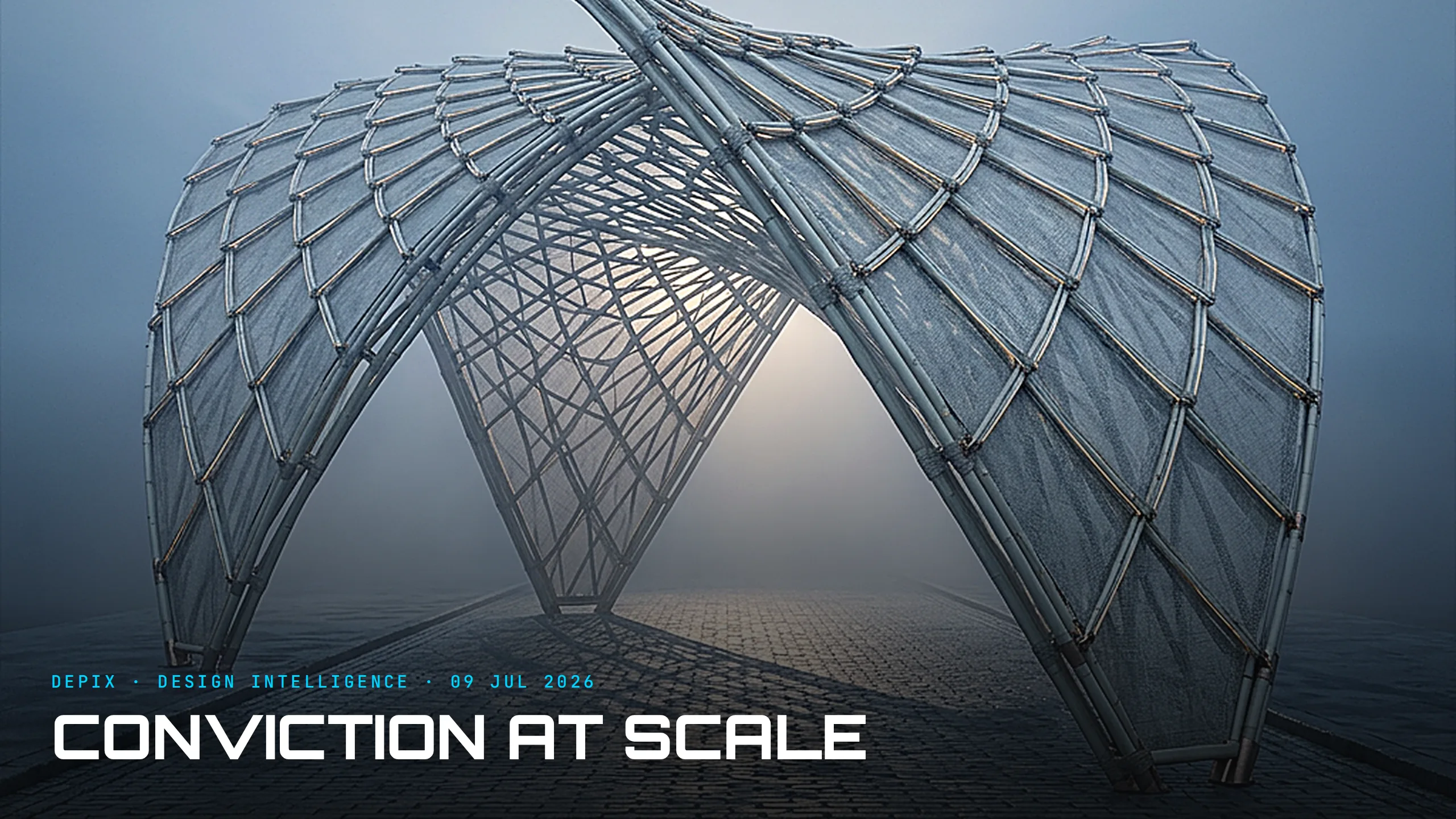
Look at the first Landmark announced. 'The Pangolin Shield' by Studio Saar with Atelier One is a lightweight bamboo gridshell on a pedestrianised stretch of the Strand, its overlapping scales fusing lathi police shields with woven 'knup' rain shields to speak to colonial legacy, power and the movement of people and species across borders. It will not be prototyped in public. It will not be A/B-tested against a rival Strand. Landmark Projects, first introduced in 2007, are commissioned months ahead and committed to at a single, irreversible scale. They land on the strength of their upfront intent — or they don't.
That is the quiet truth beneath the experimental reputation: the headline commissions are not a laboratory for iteration but a city-wide public referendum on concept-phase conviction. Amanda Levete's Timber Wave, Alison Brooks's 'The Smile', Waugh Thistleton's MultiPly, Kengo Kuma's Bamboo Ring, Paul Cocksedge's 2025 'What Nelson Sees' — each was a fixed bet, fabricated once. When Es Devlin added a fifth, roaring red lion in Trafalgar Square, at the foot of Nelson's Column, for Please Feed the Lions in 2018, the AI wrote fresh public poetry projected onto the Column nightly — but the lion's form, stance and scarlet were decided long before a crane arrived. The iteration lived inside the concept; the object did not move.
The same logic governs the most photographed public commission of the century. Chicago's Cloud Gate — 'The Bean' — was won at the concept stage in 1999, when a committee reviewed thirty artists, invited two, and chose Anish Kapoor's proposal over Jeff Koons's. The years that followed weren't redesign; they were engineering to realise a fixed idea. No test-and-iterate loop reopened the decision once fabrication began.
I raise this because the reigning orthodoxy insists on the opposite reflex. Test-and-iterate 'design thinking' became the default method across Adobe, Dropbox, Google and Meta; IDEO evangelised it through health care, government and Silicon Valley; Harvard Business Review placed prototyping at its core — ideas 'tested, evaluated, iterated, and refined.' Powerful, and often right. But Pentagram's Natasha Jen pushed back hard, arguing that reducing design to five repeatable steps strips out craft and accumulated expertise; Design Week reported her calling the packaged version 'extremely dangerous' precisely because it lets people skip the judgement serious work demands.
Landmark Projects are the standing proof of her point. At installation and production scale, you cannot iterate your way out. The Strand is closed, the bamboo is cut, the crowd arrives on 12 September whether the intent is right or not. This is why the Festival's own London Design Medal lineage — from Norman Foster and Michael Anastassiades back through Ilse Crawford and Vivienne Westwood — honours designers whose conviction reads as inevitability, not committee consensus.
None of this is anti-iteration; Landmarks are refined relentlessly — inside the concept, before anything locks. The decisive choices of form, stance, proportion, CMF and identity are made at the concept phase, where they are cheapest to change and most powerful to get right. Everything after fabrication is realisation, not rescue.
That is precisely the gap Depix works in. Before the Strand closes — before any production commitment locks — teams can visualise, restyle and pressure-test intent, staging the high-conviction bet while it is still cheap to move. LDF26 will be, as ever, a glorious argument for getting the idea right the first time. The festival happens at full scale in September; the design that carries it was already decided.
Sources:
- ●London Design Festival – About LDF
- ●London Design Festival – A First Look at LDF26
- ●Pangolin Shield – Architecture Today
- ●London Design Festival – Wikipedia
- ●London Design Festival — Programme (Landmark Projects / Please Feed the Lions)
- ●Cloud Gate — Wikipedia
- ●'Design thinking' is on its deathbed — Fast Company
- ●Design thinking was supposed to fix the world — MIT Technology Review
- ●Why Design Thinking Works — Harvard Business Review
- ●Why Design Thinking is bullshit — It's Nice That (Natasha Jen)
- ●Pentagram's Natasha Jen: 'Design thinking is extremely dangerous' — Design Week
- ●Anastassiades and Foster among 2025 London Design Medal winners — Dezeen