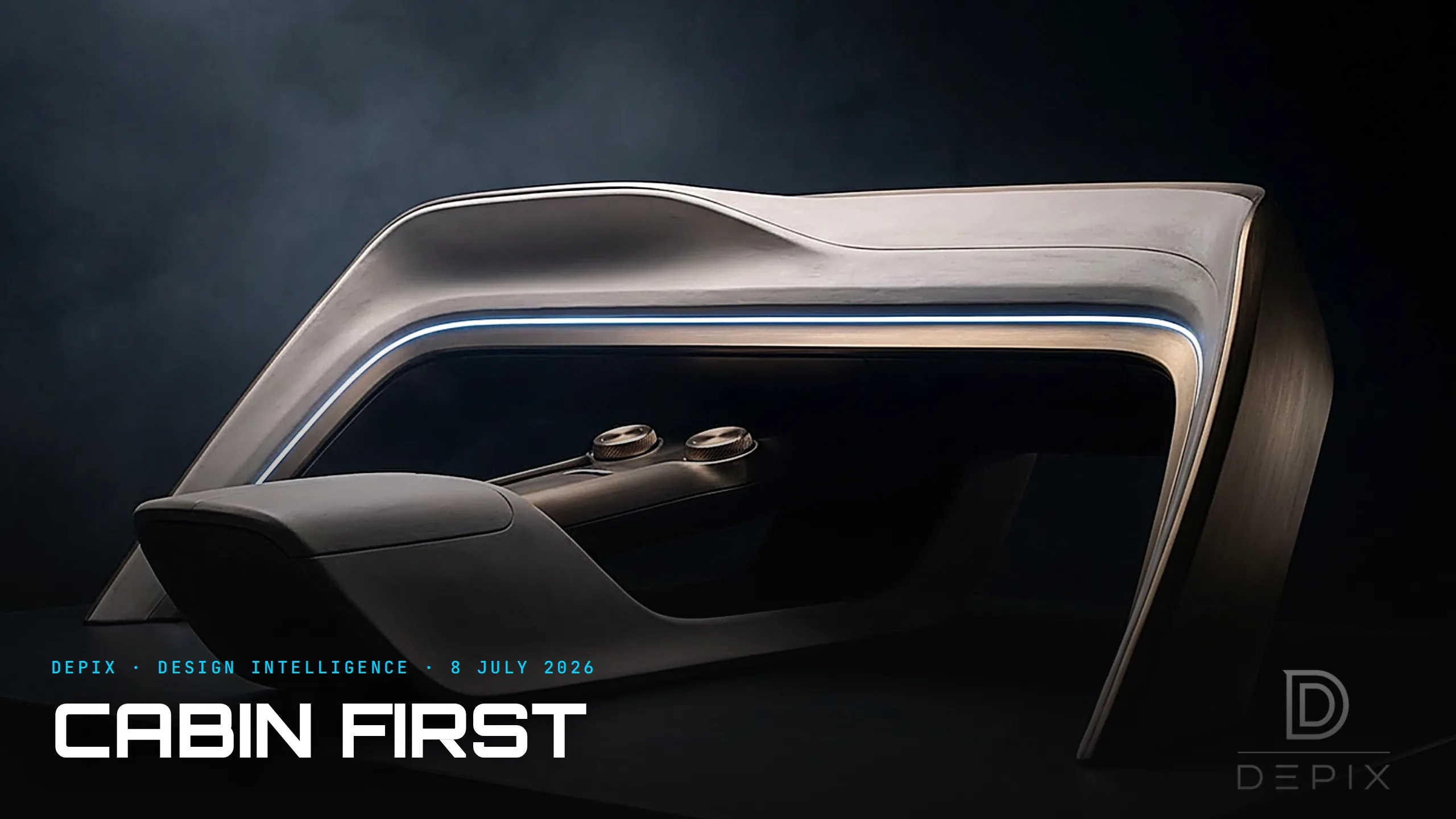
Interior-First Design Won the Brief — Then Euro NCAP Ruled the First Cabins Unsafe
For a century, the car sold itself from the outside in: a silhouette drew you across the showroom, and the interior was whatever the exterior's proportions left behind. That order has flipped. In 2025-2026, the cabin is writing the brief. London studio NewTerritory's founder Luke Miles — formerly head of design at Virgin Atlantic — argues bluntly that "while exterior design often represents the brand, the interior has been a missed opportunity," a gap his studio built a dedicated automotive division to close after being acquired in July 2025. The most telling proof isn't a concept sketch; it's a chassis. Kia's PV5, unveiled at Kia EV Day in Spain on 24 February 2025, is a "Purpose-Built Vehicle" whose flat E-GMP.S skateboard exists so the cabin can be configured 16 ways before anyone styles a body panel. Kia frames the PV5 as a connected workspace first and a van second, and the market rewarded it: cumulative European sales passed 10,000 units by June 2026, half a year after launch.
Here's the contrarian part. Inside-out design won the argument — and then the industry got the interior wrong. The first generation of cabin-led cars mistook screen acreage for interior design. BMW's Neue Klasse is the clearest tell: at CES 2025 in January, BMW made the interior the reveal, projecting a Panoramic Vision display across the full width of the windscreen from A-pillar to A-pillar. Design chief Adrian van Hooydonk called it "a very big change" that "cleans up the interior," and the production iX3 shipped it in early 2026 with a 17.9-inch central screen and minimal physical switchgear. Xiaomi, a phone-maker, went further still: the SU7's cabin is a HyperOS device on wheels, a 16.1-inch screen running the same OS as its handsets, with rear-seat tablets clipped in as accessories. The interior didn't follow the car; the ecosystem was the car.
Then the bill arrived. From January 2026, Euro NCAP requires physical controls for five core functions — indicators, hazard lights, horn, wipers and the eCall SOS — or a car forfeits points toward a five-star rating. NCAP's Matthew Avery didn't hedge: "The overuse of touchscreens is an industry-wide problem." That is a regulator telling the entire sector that the interior it just spent billions screen-ifying is, on the metric that sells cars to fleets and families, defective. Coverage through late 2025 framed it as buttons making a comeback, with critical controls "buried in digital menus, forcing drivers to take their eyes off the road."
The awards juries reached the same verdict from the opposite direction. WardsAuto's 2026 10 Best Interiors list — spanning a $35,000 Nissan Sentra to a $250,000 Corvette — explicitly praised cabins with "a healthy number of physical knobs and buttons," a pointed reversal after "more than a decade of ever-larger touchscreens and buried menus." When a value sedan and a hypercar win the same award for the same reason, that's not nostalgia; it's the market repricing a design decision.
Notice who saw it coming. Even Xiaomi, the most screen-native entrant, kept physical buttons for climate. Miles's own thesis was never "more screen" — it was to "quieten down the interior and bring information up as required," using light, sound and haptics instead of pixels. BMW's Panoramic iDrive, for all its glass, retained a haptic multifunction steering wheel with "shy-tech" illuminated buttons. The winners of the inside-out era aren't the ones who deleted the most switches — they're the ones who decided, at concept, exactly which interactions should stay physical.
That is the real design-intelligence lesson. Every expensive interior mistake of this cycle was locked in years before launch, in the concept phase, when someone decided how many screens, how deep the menus, and what packaging the platform would allow. Euro NCAP's rule was announced in 2024; cars failing it in 2026 were designed with the answer already visible. A skateboard platform like Kia's E-GMP.S is a concept-phase bet on interior volume that no amount of downstream styling can undo. This is precisely Depix's thesis: the highest-leverage design decisions are made in the concept phase, before commitment, and getting the cabin's information architecture, physical-control strategy and packaging right early is what compounds into a five-star rating and a Wards trophy — or a mid-cycle refresh spent bolting the buttons back on. Interior-first design isn't the risk. Deciding it late is.
Sources:
- ●The future of car interiors? Ask London studio NewTerritory
- ●Kia PV5 — Wikipedia
- ●Kia PV5 Redefines Mobility Through Flexible Design at Kia EV Day
- ●New BMW Panoramic iDrive revolutionizes vehicle operation (CES 2025)
- ●CES 2025: BMW debuts visionary Panoramic iDrive experience (interview)
- ●Launch report: BMW iX3 brings the Neue Klasse to the road
- ●Cars will need buttons not just touchscreens to get a 5-star Euro NCAP rating — ETSC
- ●Euro NCAP 2026 Rules Favour Physical Buttons — carwow
- ●2026 Wards 10 Best Interiors & UX Winners
- ●Xiaomi SU7: Interior of the Chinese electric saloon — Motor1
- ●Kia 'Transcend Journey' installation showcases PV5 at Milan Design Week 2025
- ●BMW Neue Klasse Design: What It Means and Why It Matters — BMWBlog

The Grille Was Supposed to Die With the Engine. Audi and Mercedes Just Revived It Instead.

The Silhouette Is Solved. In 2026 the Car Is Won on Its Surface.
