
The Most Consequential Vehicle Design Is a Truck
Every design headline goes to the same places: the hypercar reveal, the concept-car turntable, the fashion runway. Meanwhile the most consequential vehicle-design decision on the planet is being made on an object almost nobody photographs - the cab of a long-haul truck. When IAA Transportation opens in Hannover on September 15 under the motto "We Deliver", the halls will be full of it. This is the show that matters most, and it is the one the design press mostly ignores.
Here is the contrarian claim: a few centimetres of curvature on a truck cab does more measurable good than any supercar ever built - and, like every decision that matters, it has to be committed at the concept phase.
Start with the shape. For decades European trucks were bricks, their flat faces dictated by a hard legal limit on total vehicle length: every centimetre spent on a rounded nose was a centimetre stolen from cargo. Then the EU changed the rule, granting truckmakers an extra 80-90cm of cab length specifically so they could round the front for aerodynamics, vision and safety. The payoff is enormous: roughly 12% better airflow and 3-5% lower fuel use on long-haul, and - because a rounder, lower cab lets the driver actually see out - an estimated 300-500 vulnerable road users' lives saved every year. No wing, no spoiler, no badge. Just a nose drawn a little more carefully.
But you cannot bolt that on. A rounded aerodynamic cab is a whole-vehicle concept decision - it changes the crash structure, the driver's step-in, the door swing, the sightlines and the packaging behind the firewall. Mercedes-Benz's eActros 600, the first series-production long-haul electric truck in Europe and International Truck of the Year 2025, makes the point. Its "ProCabin" is a ground-up shape: a completely closed, rounded front, underbody panelling, sail-like end flaps and A-pillar deflectors that together improve airflow about 9% over the outgoing cab. Volvo's FH Aero range makes the same move - a longer, tapered nose bought purely for flow. None of it is decoration; all of it was decided before the first panel was tooled.
Electrification raises the stakes again. A diesel cab has to hide a tall engine; a battery-electric truck can lower and reshape the whole front because there is no engine block to package around - but only if that freedom is claimed at the concept stage rather than retrofitted onto a diesel platform. The cab stops being a box bolted to a drivetrain and becomes the drivetrain's first design consequence.
There is a human layer to this too. A long-haul cab is someone's office and bedroom for weeks at a time, and where the bunk, the storage, the flat floor and the sightlines end up is decided by that same rounded shell. Get the concept right and one set of curves improves fuel economy, pedestrian safety and a driver's daily life at once; get it wrong and no amount of trim, upholstery or infotainment can fix it afterwards. The interior and the exterior are not two projects - they are one concept, or they fight each other for the life of the platform.
Then there is autonomy, which quietly makes the case better than anyone. As Aurora prepares to run hundreds of driverless trucks across the US Sun Belt through 2026, it faces a pure design problem: where do the sensors go? The lazy answer is to bolt lidar pods onto the roof. Aurora instead ran airflow simulations and integrated the sensor pods into the body, because bolt-on pods add drag and cost range - a self-driving system undone by bad aerodynamics. Its long-range lidar and compute only pay off if the hardware is designed into the form, not stuck onto it. Same lesson, sharper: the sensing, the aero and the shape are one concept-phase decision, or they are a compromise.
At Depix we work in exactly this territory - the concept phase, where the load-bearing choices get locked. Trucks make the argument cleaner than supercars ever could, because nobody buys a truck for its looks. Every gram of drag is a line on a fleet's balance sheet; every centimetre of sightline is a life. There is no styling budget to hide a weak concept behind. The shape is the strategy, decided years upstream, and it either earns its keep at scale or it does not.
So when the covers come off in Hannover, resist the urge to hunt for the prettiest cab. Look for the one whose designers made the hardest decision earliest - and remember that the most beautiful thing a design can be is quietly, measurably right.
Sources:
- ●IAA Transportation 2026 (official)
- ●VDA - IAA Transportation 2026, 15-20 September, Hannover
- ●Transport & Environment - Breakthrough on safer, more aerodynamic truck cabs
- ●Transport & Environment - Safer, rounder trucks to hit the roads
- ●Volvo Trucks - What the EU's length legislation means
- ●Daimler Truck - eActros 600 world premiere
- ●WagenClub - eActros 600, International Truck of the Year 2025
- ●Move Electric - The striking new Mercedes-Benz eActros 600
- ●FleetOwner - Mercedes-Benz expands the eActros 600 portfolio
- ●Forbes - Aurora expands humanless operations in 2026
- ●Aurora - AV questions answered (driverless trucks 2026)
- ●Future Transport News - The transferable hardware behind Aurora
- ●Wikipedia - Aurora Innovation (FirstLight lidar, compute)
- ●IAA Transportation - Visitors / show info
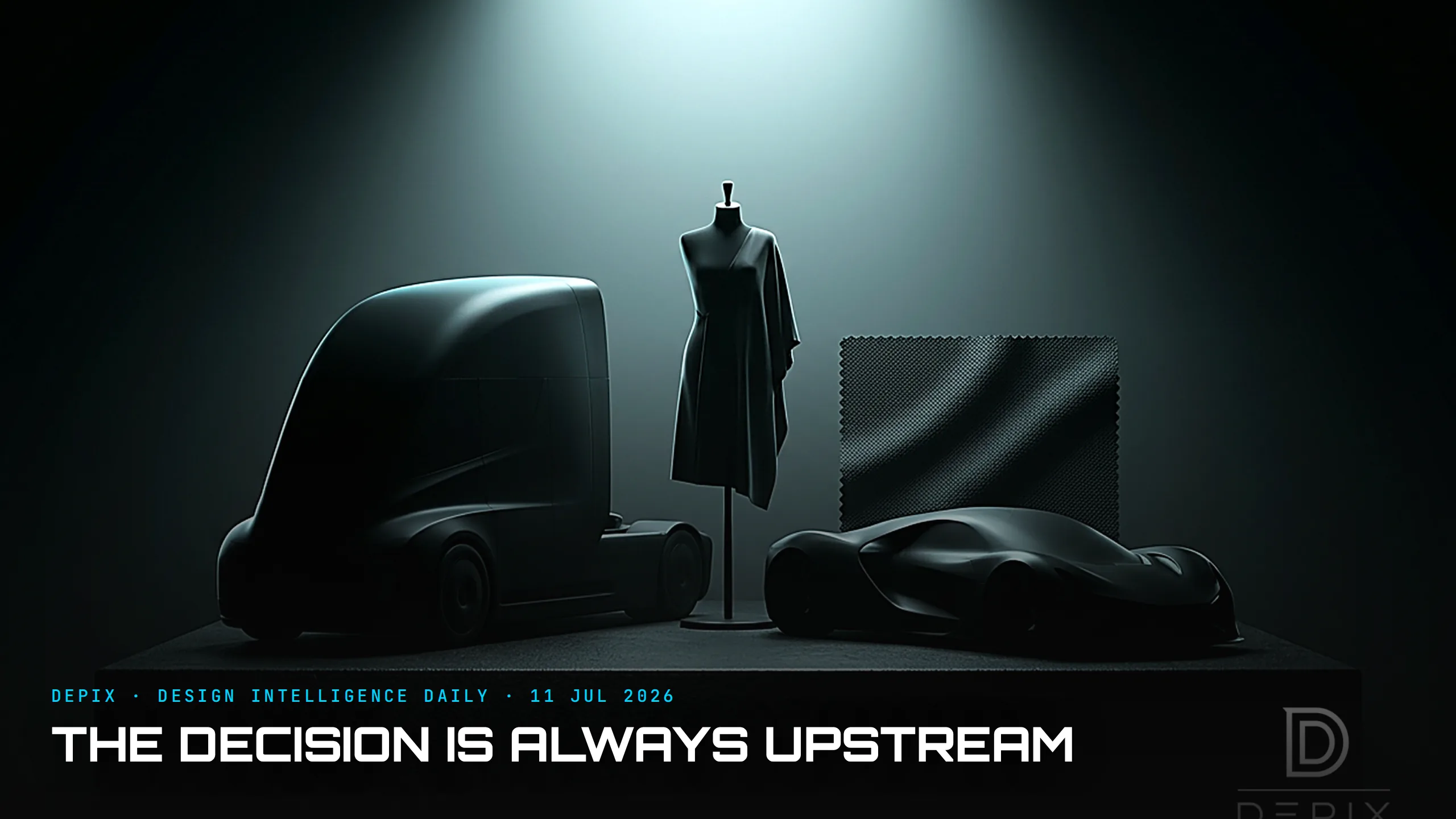
Design Intelligence Daily: The Decision Is Always Upstream

The Runway Is the Reveal, Not the Decision
