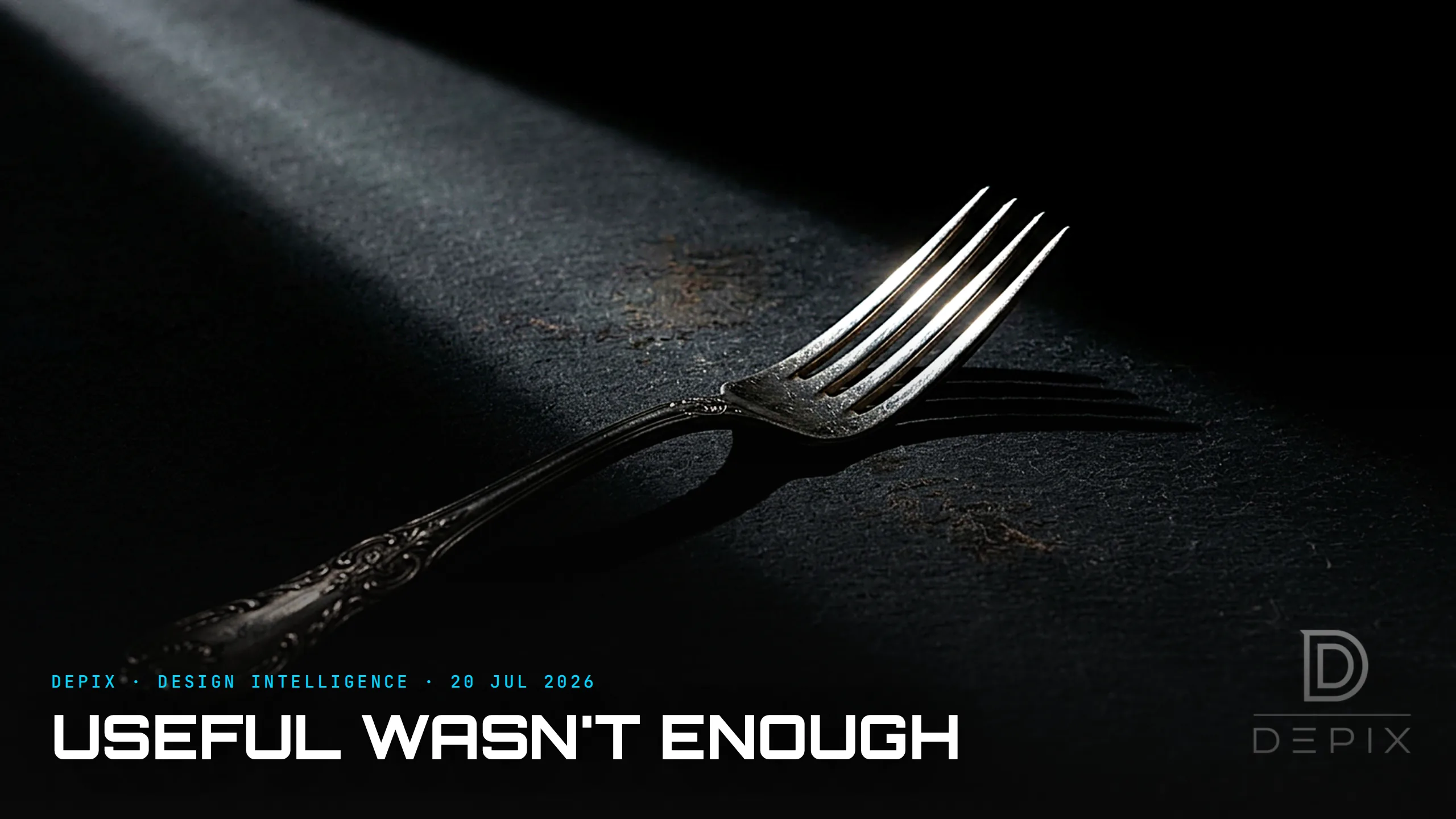
The Fork Took 500 Years to Catch On. Being Useful Was Never the Problem.
Pick up a fork and you are holding what looks like the most self-evidently useful tool imaginable: a handle, a few prongs, an obvious way to spear and lift food without burning or dirtying your fingers. It seems impossible that anyone could object to it. And yet for roughly five hundred years, Europe did exactly that — mocking, condemning and refusing the fork as decadent, effeminate and even sinful. Its story is one of the most important lessons in all of design, because it proves that being useful is never enough.
The scandal began, as good scandals do, with a princess. Around 1004 the Byzantine noblewoman Maria Argyropoulina married into the ruling family of Venice and brought with her a set of golden forks, eating with them instead of her hands. The reaction was fury. The theologian Peter Damian denounced her "excessive delicacy," writing that she scorned to touch her food with the fingers God had given her, preferring a little golden trident. When she died young, the clergy declared it divine punishment for her vanity. At its European debut, the fork was not a convenience. It was an affront to God.
That framing stuck for centuries. Across Europe the fork was dismissed as an unmanly, effeminate Italian affectation, a foreign vanity for people too precious to eat like everyone else. When the English traveller Thomas Coryat described using forks in Italy in his 1611 travelogue and began using one at home, he was mocked mercilessly and nicknamed "Furcifer" — Latin for fork-bearer, and also slang for rogue. Ben Jonson and other writers published satirical verses ridiculing his affected foreign manners. It was not until the eighteenth century that the fork finally became commonplace in Britain — the better part of a millennium after it first appeared on the continent.
Sit with the strangeness of that. The knife and the spoon are ancient and were never controversial. The fork — for many foods genuinely more useful than either — was the one that triggered moral panic, religious condemnation and centuries of ridicule. And crucially, none of the resistance was about whether it worked. It clearly worked as a tool. The resistance was about what the fork meant: foreignness, effeminacy, class pretension and etiquette, a rejection of the natural, God-given way of eating with the hands. People weren't rejecting a tool. They were rejecting what using it said about them.
This is the design-intelligence lesson, and it is one the most brilliant products keep re-learning the hard way. Adoption is a cultural act, not a functional one. A design can be measurably, obviously better and still fail — or crawl for centuries — because it collides with meaning: identity, religion, gender, class, habit, status. Function gets you a working object. It does not get you a used one. The gap between "this is better" and "people will actually pick it up" is not made of engineering; it is made of belief, and belief moves on its own schedule.
For anyone working at the concept phase, that changes the job. When you design something genuinely new, you are never only solving a problem — you are also asking people to change what they consider proper, natural or normal, and someone will always feel threatened by that. This is not a nuisance to be surprised by later; it is a real design constraint to be anticipated from the very start. The best designers ask two questions, not one: does it work, and what will it mean to be seen using it — because the second question has quietly killed more good designs than the first ever did. The graveyard of design is full of superior ideas that lost to familiar ones — not because they worked worse, but because switching asked people to become someone slightly different, and they declined.
The fork, of course, won completely. It won so totally that its five-century controversy now sounds absurd; you cannot imagine anyone finding a fork sinful. That is the final turn of the lesson: today's invisible, obvious, beneath-notice object was once somebody's scandal, resisted with total conviction by intelligent people. Being right is not the same as being adopted. The distance between the two is culture — and closing that distance, patiently and deliberately, is as much a part of design as the object itself.
Sources:
- ●Wikipedia — Fork
- ●Wikipedia — Maria Argyropoulina (golden forks to Venice, c.1004)
- ●Wikipedia — Peter Damian (condemned the fork's 'excessive delicacy')
- ●La Brujula Verde — How two Byzantine princesses scandalized Europe with a fork
- ●The Conversation — The thousand-year story of how the fork crossed Europe
- ●Wikipedia — Thomas Coryate ('Furcifer', 1611 travelogue)
- ●Greek City Times — How Byzantine princesses introduced Europe to the fork
- ●Leite's Culinaria — Origins of the common fork (knife & spoon are ancient)
- ●Trivia Oasis — The history of the fork and why people thought it sinful
- ●HandWiki — Engineering: Fork (the utensil as a tool)
- ●Etiquipedia — Etiquette and the history of forks

At Frieze, a Chair Can Outsell a Painting — and That Reveals What Design Really Is

The Armrest in the Middle of That Bench Was Never for Your Arm


