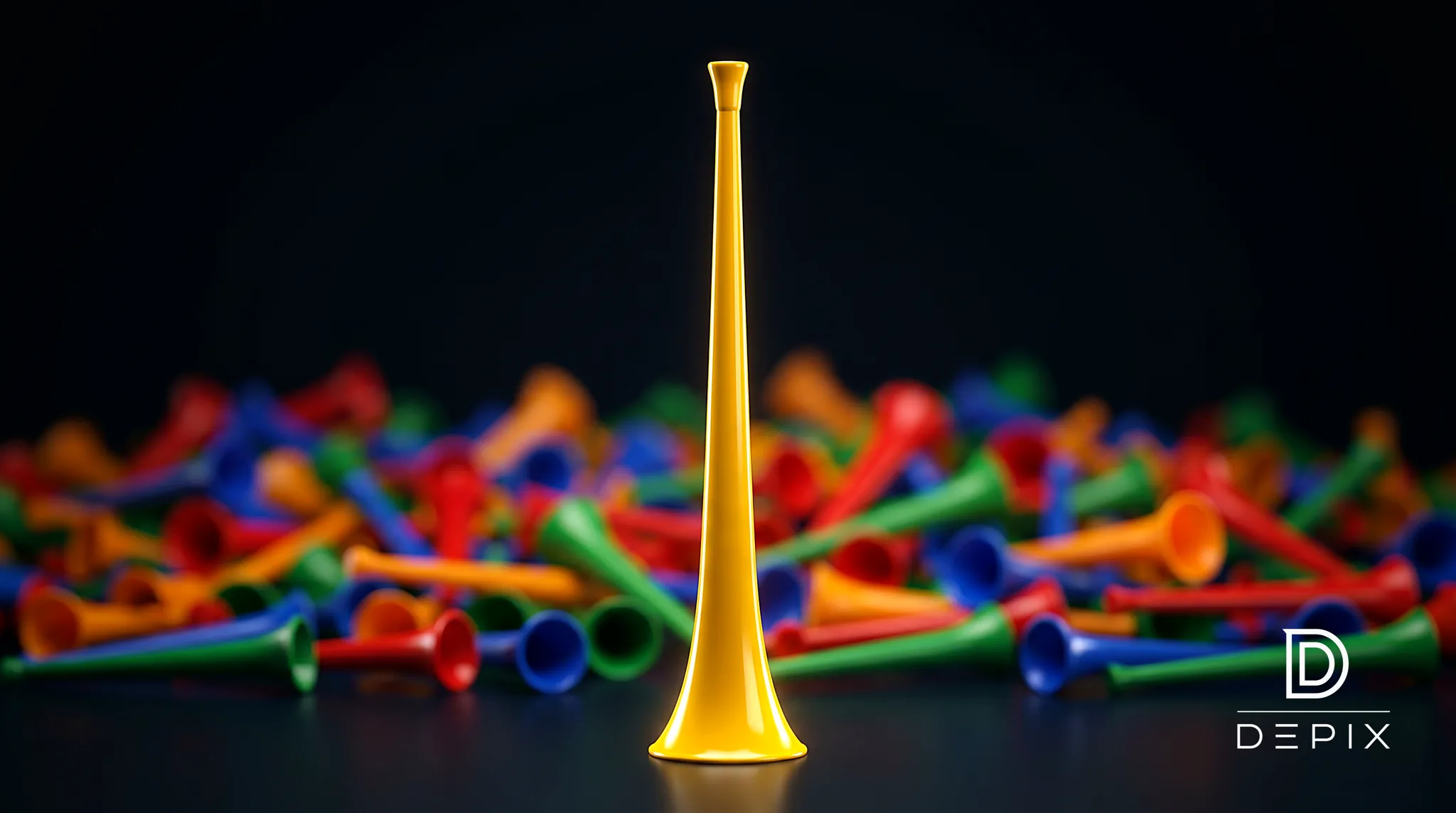
A cheap plastic horn out-designed FIFA's entire World Cup.
In 2010, the sound of the World Cup was not a whistle, an anthem or a commentator. It was a single, monotone drone — the vuvuzela, a 65-centimetre injection-moulded plastic horn that cost a few coins to make and drowned out an entire sport. FIFA has now banned it from the 2026 tournament across the United States, Canada and Mexico, listing it in a 35-page Stadium Code of Conduct alongside air horns and loudspeakers. The design that defined one World Cup has been formally designed out of the next.
That arc — from stadium mascot to prohibited object — is one of the purest design-intelligence case studies in modern sport, and it turns on a single decision made long before a ball was kicked.
The vuvuzela began as a homemade tin trumpet in South African townships. Its leap to global phenomenon came when Neil van Schalkwyk, working in a plastics factory, figured out how to injection-mould it. Through his company Masincedane Sport he made 500 in 2001; a corporate order for 20,000 followed a year later; by 2010 more than a million were sold. The genius wasn't the marketing. It was the tooling. Every parameter that mattered — the length, the bore, the flare of the bell — was frozen the moment the mould was cut. And those parameters fixed the sound.
Here the numbers demand care, because the vuvuzela's noise story is routinely mangled. A single vuvuzela measures roughly 127 decibels at the bell — louder than a referee's whistle (about 121.8 dB) or a drum (about 122 dB), but a source-level reading taken at close range from one instrument. That is a product spec. It is not the stadium: researchers at the University of Pretoria found the average in-match sound exposure was about 100.5 decibels, peaking near 144.2 — the sound of tens of thousands of horns together, not one. Conflating the two is how a plastic party horn gets mythologised into a jet engine. Both figures are real; they describe different things.
The backlash was immediate, and it was a broadcast problem, not a musical one. Commentators were drowned out. The BBC alone logged 545 complaints. Broadcasters said the stadium announcer had become pointless. FIFA had permitted the horn as a nod to South African identity, then, almost the moment the trophy was lifted, moved to ban it. Sixteen years later the ban is total.
The design lesson is unforgiving. The vuvuzela's entire character — the thing that made it beloved at home and unbearable on air — was not decided in marketing, distribution or use. It was decided in the concept phase, in the geometry of the mould. Once that tool existed, the sound existed, and the sound could not be edited. You could sell a million; you could not make them quieter. The object's greatest commercial asset and its fatal liability were the same feature, locked in at the same instant, invisible until a billion televisions carried it live.
That is the trap every product team walks into. The decisions that determine whether an object delights or repels are made at the very start, when they feel cheapest to change and are hardest to see. By the time the consequence is undeniable — the drone on the broadcast, the complaints, the ban — the tooling is cut and the market has already spoken.
This is precisely the gap DEPIX closes. Design intelligence means deciding design intent early and actually seeing the downstream consequences — how a form will read, sound, sell and age — while it still costs nothing to change your mind. The vuvuzela's makers got the mould right for one audience and catastrophically wrong for another, and had no way to know until it was irreversible. The next breakout object doesn't have to be a gamble. The concept phase is where World Cups are won and banned — and it is the one phase most teams still fly blind through.
Sources
- ●Vuvuzela — Wikipedia
- ●How loud is the vuvuzela and how likely is it to damage your hearing? — HearingAidKnow
- ●Vuvuzela inventor cashes in on success at World Cup — Summit Daily
- ●History of the vuvuzela: The fight for the right to the horn — CNN
- ●Iconic vuvuzelas banned from 2026 World Cup stadiums under FIFA code of conduct — Yahoo Sports
- ●FIFA bans vuvuzelas and loud noise-making devices from 2026 World Cup stadiums — Tribuna

Messi's jersey is now a hype drop, not fan gear.

Panini's biggest album ever is designed so you never finish.


