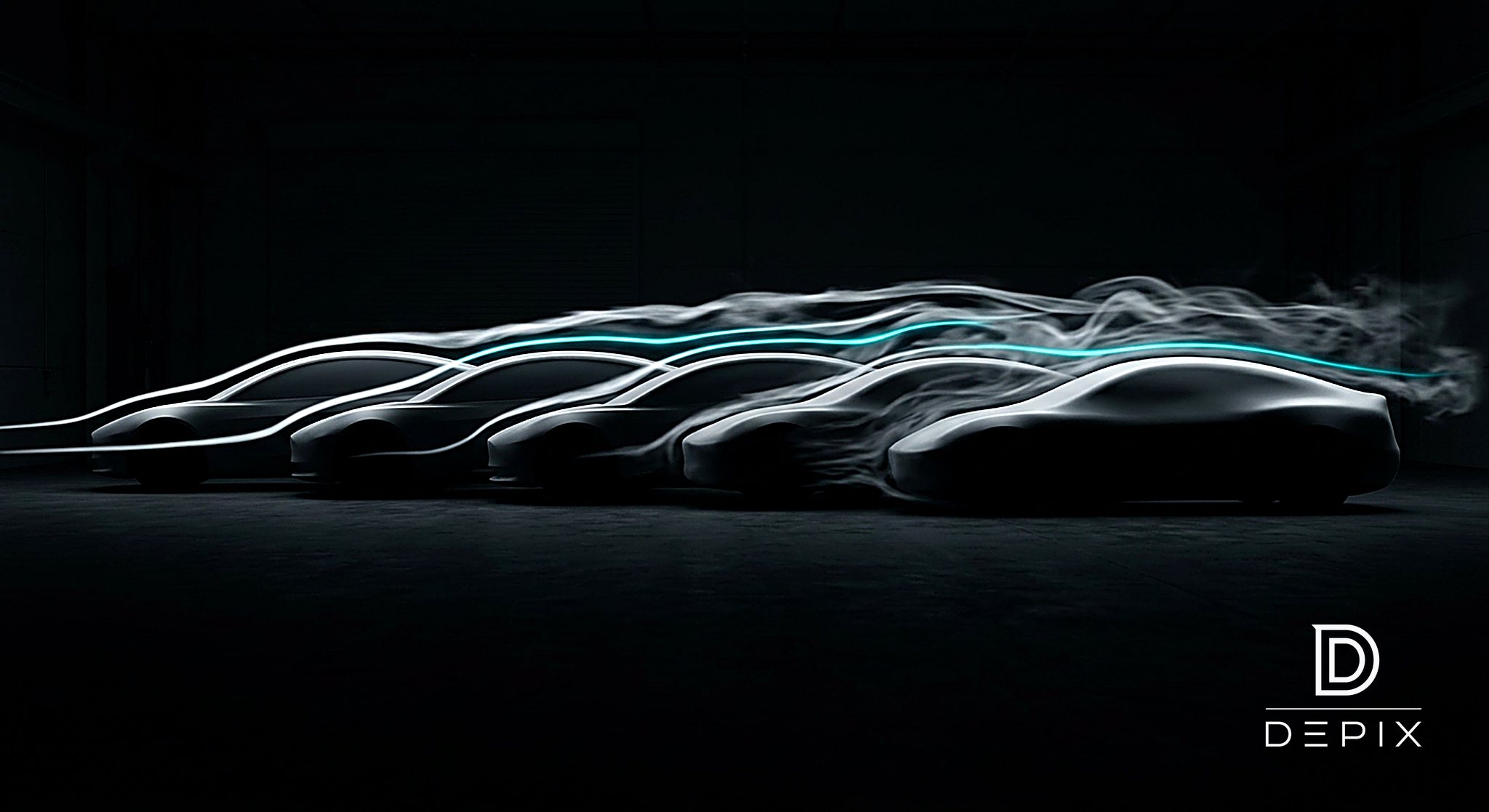
Chasing low drag made every EV look the same.
Line up a Mercedes EQS, a Tesla Model S and a Lucid Air in silhouette and try to tell them apart with the badges covered. You will struggle. Low nose, fast windscreen, a roof that arcs in one unbroken curve, rounded shoulders, flush everything, a tail that tucks and tapers away. Three different brands, three different design departments, three different design languages on paper — and one shape. That shape is not a coincidence, and it is not laziness. It is the output of a method: the relentless, range-driven hunt for a low drag coefficient. The physics of slipping through air has a single right answer, and the whole industry is converging on it.
The number that eats the design
For an electric car, aerodynamic drag is the enemy that never sleeps. At motorway speed the majority of the energy a car spends is spent pushing air out of the way, and on an EV that translates directly into range lost — the one figure on the window sticker every buyer reads first. So makers chase the drag coefficient, the Cd, with an obsession that borders on the religious. The leaders are now astonishingly close to one another: the Lucid Air sits at a Cd of around 0.197, the Mercedes EQS at 0.20, the Tesla Model S at 0.208, and the limited-run Lightyear 0 reached 0.175 — among the slipperiest road shapes ever built. To put that in historical perspective, cars of the 1970s ran drag coefficients around 0.45; modern cars sit at 0.25–0.30; the aero champions have gone lower still. Every tenth of a point is fought for in the wind tunnel and, increasingly, in CFD — computational fluid dynamics, the virtual wind tunnel that lets engineers test thousands of micro-variations of a surface before a single clay model is cut.
Here is the catch that flattens the showroom. The optimisation has one global minimum. When you ask the air for the lowest possible resistance, it gives the same instructions to everyone: drop the nose, stretch and lay back the windscreen, round every leading edge, seal the underbody flat, pull the roofline into a continuous teardrop, and boat-tail the rear so the air closes behind the car instead of dragging a low-pressure wake. Follow those instructions to their conclusion and you arrive at the same smooth, tapered, one-box blob — regardless of which logo you intend to bolt on the front. As one design critic put it this year, the most aerodynamically efficient shape for a car "tends to resemble a rounded blob," and "Air simply says: 'Smooth that out.'" Physics, the writer noted, is indifferent to brand identity.
The designers said it out loud
This is not a complaint invented by enthusiasts on a forum. The people running the studios have named it. Alfonso Albaisa, Nissan's senior vice president of global design, said the first wave of EVs has "a tendency to be jelly bean-ish: very clean and the body is high, the nose is low." His diagnosis was an engineering one: even with a so-called blank canvas — the flat skateboard battery platform that was supposed to free designers from the engine bay — the requirement to hit 300- and 400-mile range targets forces the nose into a particular posture to manage the airflow beneath it. The aero constraint overrides the design freedom. The skateboard promised liberation and delivered, paradoxically, conformity.
The critics have been blunter still. The EQS, the car Mercedes engineered to a class-leading 0.20 Cd, earned the nickname "jellybean" almost on arrival, and the marque has spent press cycles defending its styling against exactly that charge. The trade press now describes a generation of EVs as "giant jelly beans with LED eyebrows," carrying, as one writer cuttingly put it, "the emotional charisma of an office printer." Panels of ordinary buyers, not just journalists, nod along to the same observation: the cars look same-y. The promise of the electric era was a wave of radical new forms unlocked by the new packaging. The delivery, so far, is a row of slippery soap bars distinguished mainly by their lighting signatures.
A constraint is not a verdict
Strip away the hand-wringing and the real story is a methods story, and a familiar one to any engineer: a single dominant constraint, optimised hard enough, collapses a rich solution space down to a narrow band of near-identical answers. That is what a low-Cd target does to a car's exterior. It is genuinely powerful — the range it buys is real, and no serious maker is going to walk away from it. But treating the aero envelope as a verdict rather than a constraint is a choice, not a law. The teardrop is a region, not a point. Inside the window that keeps the drag coefficient low there are still hundreds of distinct surface treatments, shoulder lines, graphic breaks, stances and proportions that the air will tolerate — and the gap between "aerodynamically acceptable" and "unmistakably yours" is precisely the gap the industry is currently failing to explore, because exploring it the old way means weeks of clay and wind-tunnel time per variant.
This is the part worth dwelling on, because it is where the constraint stops being a sentence. The low-Cd window is wide enough to hold real brand identity; the bottleneck is the cost of searching it. Design intelligence exists to search that window at a scale the clay studio never could — generating and pressure-testing hundreds of forms inside the aerodynamic envelope, surfacing the handful that are both slippery and distinctly the brand's own, as photoreal evidence a design chief can actually decide on. The aero target is not what makes every EV look the same. The inability to explore the space the target still leaves open is. Resolve that, and efficiency stops costing you your face.
Sources
- ●Quest for Range Has Turned EVs to 'Jelly Beans,' Nissan Design Boss Says — The Drive
- ●Electric Car Range Drives Race For Aerodynamic Efficiency — InsideEVs
- ●Mercedes-Benz EQS Achieves 4 Mi/kWh With 0.20 Drag Coefficient — InsideEVs
- ●Lucid Air — Wikipedia (drag coefficient 0.197)
- ●Why Do All New Cars Look the Same? — Brown Car Guy
- ●Why do these cars look so boring? EV design sameness — CarsGuide
- ●Mercedes Defends EQS Styling, Calls It 'Very Progressive' — Motor1
- ●Why Are EVs Shaped the Way They Are? — Capital One Auto Navigator

Carmakers buried the buttons in touchscreens; regulators want them back.

Your premium car shares its bones with a cheap one.
