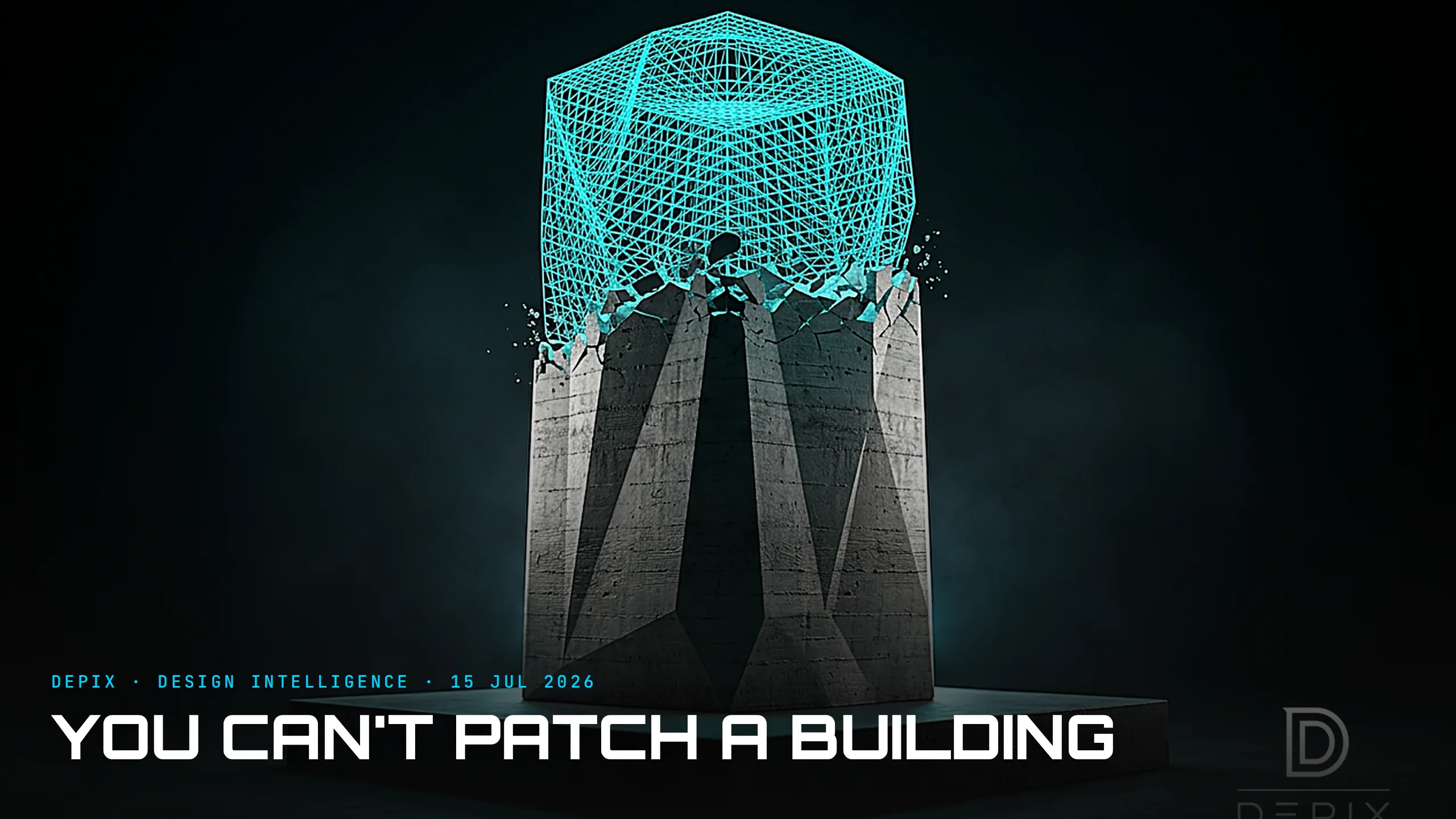
You Can't Patch a Building: What Archtober Knows That Software Forgot
A city as a classroom
Every October, New York turns itself into a design school. Archtober — the city's Architecture and Design Month, run out of the Center for Architecture and AIA New York — fills the calendar with tours, exhibitions, and its signature Building of the Day series, walking the public through one finished structure at a time. Notice what a festival like this actually venerates. We do not throw a month-long party for the beta, the prototype, or the pivot. We celebrate buildings precisely because they are permanent, public, and unrepeatable — decisions a city has agreed to live inside for the next fifty to a hundred years. A rendering can be revised overnight; the thing itself cannot.
That is the uncomfortable truth under the champagne: you can't patch a building.
The most unforgiving deadline in design
Software culture runs on a comforting premise — that change is cheap. Ship a minimum viable product, run an A/B test, watch the metric, patch on Friday. Architecture is the discipline where that premise collapses. You cannot A/B test a skyscraper. You cannot roll back a foundation. There is no staging environment for a city block. Once a weak plan is poured in concrete, correcting it means expensive adaptive reuse or outright demolition — a rewrite that costs tens of millions and years, not a git revert.
This is the cost-of-change curve in its most extreme form. Engineers have long observed that the price of fixing a flaw rises the later it is caught, which is the whole logic behind shift-left testing — move scrutiny earlier because every stage of delay multiplies the bill. In building, the curve doesn't just rise; it goes near-vertical the moment a shovel touches dirt.
Architects respond the only rational way: they front-load the thinking. Before construction, enormous effort goes into the parti) — the central organizing idea, the diagram that reduces a whole design to its essence — hammered out in intense charrettes and schematic design. This is why the profession spends real money on thinking before it spends any on building. The parti is the concept phase made non-negotiable: get it wrong and no amount of downstream craft can save the result, because there is no downstream in which to fix it.
Move fast and break what, exactly?
Move fast and break things, the Facebook-era mantra, is a perfectly good strategy — for decisions that are genuinely cheap to change. Its quiet failure is being applied indiscriminately, including to decisions that behave like architecture: your platform bet, your data model, your core infrastructure, the training run behind a foundation model. Those are poured concrete. They embed, accrete dependencies, and resist revision at almost any price.
The industry already has a name for the invoice: technical debt — literally the interest you pay for skipping the concept phase, compounding until a schema migration or re-platforming becomes its own demolition project. Unlike a facade, a data model has no adaptive-reuse market: you migrate or you live with it. The best engineering teams have quietly stopped pretending their core is patchable. They treat the schema, the API contract, and the model architecture with an architect's up-front rigor, and reserve 'move fast' for the surface where iteration is actually free.
Software is becoming more architecture-like
Here is the forward-looking turn. Stewart Brand, in How Buildings Learn, described buildings as a stack of shearing layers — site, structure, skin, services, space plan, stuff — each changing at its own pace. The insight generalizes: fast layers can be sketchy because you'll redo them anyway; slow layers must be right, because you can't. Brand's warning was that trouble comes when a slow layer traps a fast one. Every durable system, digital or physical, is a negotiation between what you can patch and what you can't.
As software sinks into infrastructure — foundation models retrained at eight-figure cost, city-scale platforms, smart cities that pour code into concrete — more of it migrates into the slow, unpatchable layers, which makes the architect's mindset the template for all high-stakes design. Jane Jacobs argued in The Death and Life of Great American Cities that cities are living systems you cannot master-plan into health from a single blueprint; her whole critique targeted exactly the failure DEPIX studies — an identity fixed badly at the concept phase, then imposed on millions who never get a patch.
Archtober's real lesson is not nostalgia for old facades. It is a month-long argument that the decisions worth celebrating are the ones you had to get right the first time. That is the discipline every designer is now inheriting.
Sources:
- ●Archtober — New York City's Architecture and Design Month
- ●Center for Architecture (New York)
- ●AIA New York — American Institute of Architects, New York Chapter
- ●Minimum viable product — Wikipedia
- ●A/B testing — Wikipedia
- ●Adaptive reuse — Wikipedia
- ●Shift-left testing (earlier defects cost less) — Wikipedia
- ●Parti (architecture) — Wikipedia)
- ●Charrette (intensive design/planning) — Wikipedia
- ●Move fast and break things — Wikipedia
- ●Foundation model — Wikipedia
- ●Technical debt — Wikipedia
- ●How Buildings Learn (Stewart Brand) — Wikipedia
- ●Shearing layers / pace layering — Wikipedia
- ●Smart city — Wikipedia
- ●The Death and Life of Great American Cities — Wikipedia
- ●Jane Jacobs — Wikipedia
Related posts

It's Only Original Once: What Monterey's Resurrected Race Cars Reveal About Design

The Mark Outlives the Machine: What the Automobilia Market Knows About Durable Design

Audited at the Parts Counter: Automechanika Frankfurt 2026 and the Design Decisions No Reveal Can Hide